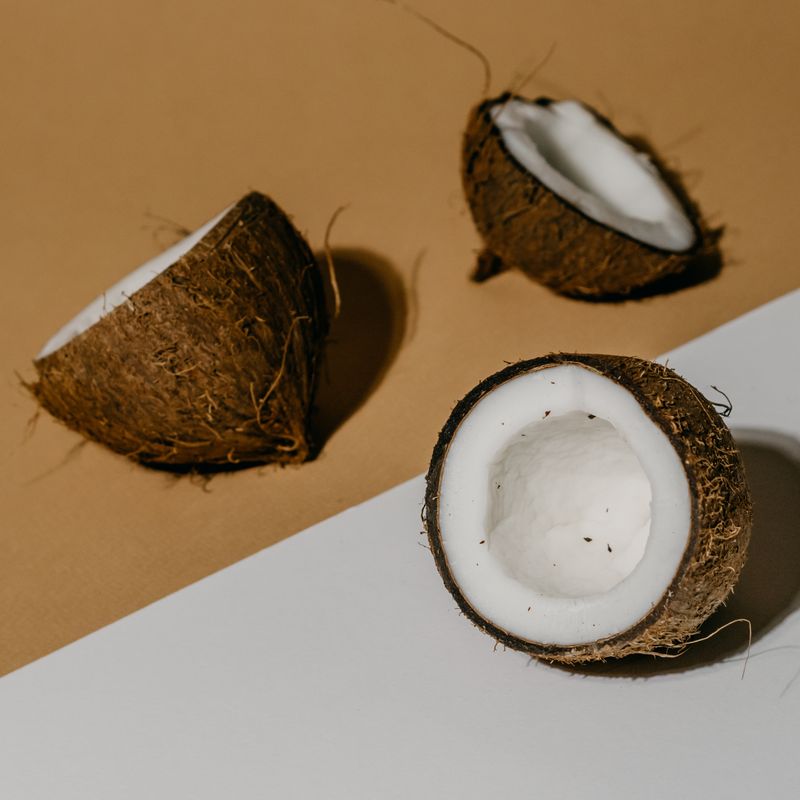
Passion Fruit and Coconut Scone Wedges
Tender, wedge-shaped scones infused with tangy passion fruit puree and creamy coconut milk, finished with a light glaze and toasted coconut. These Caribbean-inspired scones are best eaten warm with clotted cream and jam, and are equally delicious plain. The dough comes together quickly with cold butter and minimal mixing, yielding a crumbly texture that bakes into soft, fluffy wedges with a delicate crust.
- Prep
- 15 min
- Cook
- 18 min
- Wait
- 10 min
- Total
- 43 min
- Makes
- 6 scone wedges (from 1 large round)
Steps
Before you start
- Preheat oven to 400°F (200°C) and line a baking sheet with parchment paper
- Cut butter into ½-inch (1.25 cm) cubes and keep very cold—chill for at least 30 minutes before using
- Strain passion fruit puree to remove seeds if using fresh; you need 3 oz (85 ml) total liquid
- Have all ingredients measured and ready—scone dough comes together quickly
Mix dry ingredients
- In a large bowl, whisk together flour, granulated sugar, baking powder, and salt until evenly combined, about 30 seconds.
- Make a well in the center.
+ Show details− Hide details
Ready when: Mixture is uniform, no lumps of baking powder visible
Tip: Whisking aerates the flour and ensures even distribution of leavening—don't skip this.
Cut in cold butter
- Add the cold butter cubes to the flour mixture.
- Using your fingertips or a pastry cutter, rub the butter into the flour until the mixture resembles coarse breadcrumbs with pea-sized pieces of butter still visible, about 2 minutes.
- Work quickly to keep the butter cold.
+ Show details− Hide details
Ready when: Visible butter pieces remain throughout; mixture looks sandy and crumbly
Tip: Warm butter melts into the flour and creates dense scones. Keep your hands cool and work fast. If the mixture becomes slippery, chill it for 5 minutes.
Combine wet ingredients
- In a small bowl, whisk together the egg white (reserve the yolk), passion fruit puree, coconut milk, and vanilla extract (if using) until well combined, about 30 seconds.
+ Show details− Hide details
Ready when: Mixture is uniform and no streaks remain
Tip: Keeping the wet ingredients separate and cool prevents the butter from melting prematurely.
Form dough
- Pour the wet ingredients into the well in the dry ingredients.
- Using a wooden spoon or your hands, gently fold and mix until a shaggy, barely cohesive dough just forms, about 1 minute.
- Do not overmix—the dough should look rough and have visible crumbs.
+ Show details− Hide details
Ready when: Dough is shaggy and barely holds together; visible streaks of flour remain
Tip: Overmixing develops gluten and produces tough, rubbery scones. Stop as soon as no dry flour remains at the bottom of the bowl.
Shape into round
- Transfer the dough to the prepared baking sheet.
- Gently gather it together with your hands and press it into a rough 8-inch (20 cm) round about 1 inch (2.5 cm) thick.
- If using a cake pan or ring mold, press the dough into that mold, then carefully lift it away.
- The edges should be rustic, not perfectly smooth.
+ Show details− Hide details
Ready when: Dough forms a cohesive 8-inch round 1 inch thick
Tip: Handling the dough minimally keeps it cold. If the dough feels sticky, lightly flour your hands, but don't knead.
Egg wash and coconut topping
- Beat the reserved egg yolk lightly with a fork.
- Brush the egg wash over the top of the scone round, then sprinkle with the 1 tablespoon (9 g) of shredded coconut and coarse sugar (if using), pressing gently so they adhere.
+ Show details− Hide details
Ready when: Top is evenly coated with egg wash and coconut is pressed lightly into surface
Tip: A thin egg wash creates a light golden crust and helps toppings stick; don't oversaturate.
Cut into wedges
- Using a sharp, lightly floured knife, score the top of the dough round in 6 equal wedges (like a pie), cutting about ¼ inch (6 mm) deep.
- Do not cut all the way through—just mark the divisions so they bake as separate wedges.
+ Show details− Hide details
Ready when: Six evenly spaced shallow score lines are visible
Tip: Scoring guides clean separation during baking and creates an appealing appearance. A sharp knife prevents dragging the dough.
Bake sconesOven 400°F / 205°C
- Place the baking sheet in the preheated 400°F (200°C) oven.
- Bake for 16–18 minutes, until the top is golden brown and the scones smell fragrant and sweet.
- The top should spring back slightly when gently touched.
+ Show details− Hide details
Ready when: Top is golden brown; gentle touch leaves a slight indent that slowly springs back; interior is set but still tender
Tip: Do not overbake—scones dry out quickly. If the top is browning too fast, loosely tent with foil but bake to the full time. Rotation is not necessary for even baking in a home oven.
Cool briefly
- Remove the baking sheet from the oven and let the scones rest on the sheet for 5 minutes.
- This allows the structure to set slightly.
- Then, using the score lines as a guide, gently separate the wedges and transfer them to a wire rack or serving plate.
- Let cool for another 5 minutes before serving.
+ Show details− Hide details
Ready when: Scones are cool enough to handle; wedges separate cleanly along score lines
Tip: Cooling on the sheet for a few minutes prevents the bottoms from becoming tough, and the residual heat helps firm the crumb structure. Serve warm for the best texture and coconut-passion fruit flavor.
Good to know
Tips
- Cold ingredients are essential for tender, flaky scones. Chill your butter, eggs, and even your mixing bowl before starting.
- Do not squeeze or knead the dough; handle it as little as possible to avoid activating gluten, which toughens the crumb.
- If passion fruit puree is difficult to find, freeze fresh passion fruit flesh with a little sugar, then thaw and strain. Passion fruit is highest in acidity when tart, not overly ripe and sweet.
- Serve scones warm with clotted cream, jam, or a simple glaze made from icing sugar and a splash of passion fruit puree or coconut milk. A dollop of curd or marmalade also pairs beautifully.
Make ahead
Dough can be shaped, wrapped, and refrigerated for up to 4 hours before baking. Bake from cold, adding 2–3 minutes to the bake time. Baked scones are best eaten on the day they are made but keep, loosely covered at room temperature, for up to 1 day. Reheat gently in a 300°F (150°C) oven for 5–7 minutes.
Storage & reheating
Room temperature (loosely covered): up to 1 day. Freezer (wrapped individually in plastic, then foil): up to 3 months. Thaw at room temperature for 1 hour, then warm in a 300°F (150°C) oven for 8–10 minutes.
Substitutions
- passion fruit puree (fresh or frozen) → mango puree or pineapple puree. Use the same quantity. The flavor will shift to tropical mango or pineapple, but the scone structure and texture remain unchanged.
- unsweetened coconut milk (canned, full-fat) → whole milk or heavy cream. The scones will be slightly less creamy and coconut-forward, but the bake time and texture are identical.
- unsweetened shredded coconut → chopped macadamia nuts or toasted almonds. Toast nuts lightly before adding for extra flavor. The crunch will increase, offsetting some of the tropical character.
- baking powder → ½ teaspoon baking powder + ¼ teaspoon baking soda + ¼ teaspoon cream of tartar. This mix mimics the leavening action of baking powder. Bake immediately after mixing to capture the rise.
More scones & biscuits
See all →



Find more like this
- Meal
- Breakfast
- Cuisine
- Caribbean
- Diet
- VegetarianHalal
- Method
- Oven