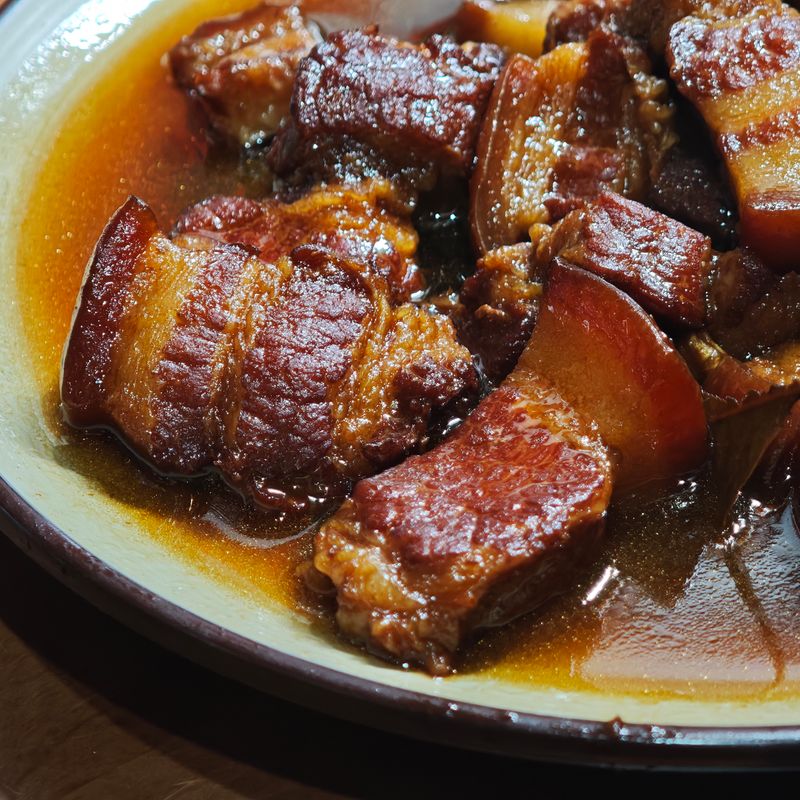
One-Pot Apple Cider Pork Shoulder Braised with Thyme & Mustard
A rustic American braise where pork shoulder becomes fall-apart tender, infused with apple cider's sweet notes, sharp mustard, and herbaceous thyme. The marinade becomes a silky pan sauce as the pork cooks low and slow. Perfect for autumn dinners, served with crusty bread or root vegetables.
- Prep
- 15 min
- Cook
- 3 hr
- Wait
- 30 min
- Total
- 3 hr 45 min
- Makes
- One 4-lb braised pork shoulder (6 servings)
Steps
Before you start
- Remove pork from refrigerator 30 minutes before braising so it comes to room temperature
- Preheat oven to 325°F (163°C)
- Gather all ingredients and equipment before you start—this is a hands-off braise once it goes in the oven
Season the pork
- Pat the pork shoulder completely dry with paper towels.
- Generously season all sides with the kosher salt and black pepper, letting the seasoning adhere evenly.
- Set aside at room temperature.
+ Show details− Hide details
Ready when: Pork is evenly coated with salt and pepper
Tip: Drying the pork ensures a better surface for browning
Sear the pork
- Heat the olive oil in a large Dutch oven over medium-high heat (about 2 minutes, until shimmer appears).
- Carefully lay the pork shoulder in the pot.
- Sear without moving for 4–5 minutes until the surface is deeply browned.
- Flip and sear the other side for 4 minutes until browned.
- Do not move the pork around—browning develops flavor.
- Transfer to a plate.
+ Show details− Hide details
Ready when: Both sides are golden brown with a caramelized crust
Tip: High heat and patience create a flavorful brown crust; moving the meat too soon releases moisture and prevents browning
Build the braising liquid
- In the same pot (do not wash it—the browned bits add flavor), whisk together the apple cider, whole grain mustard, apple cider vinegar, and honey.
- Add the crushed garlic, onion halves, bay leaves, and thyme sprigs.
- Stir well to combine.
- Pour in the chicken broth.
+ Show details− Hide details
Ready when: All ingredients are combined into a smooth, fragrant liquid
Tip: Whisking the mustard into the liquid prevents lumps; it will incorporate smoothly
Return pork and cover
- Place the seared pork back into the pot, nestling it into the braising liquid.
- The liquid should come about two-thirds of the way up the sides of the pork.
- Cover the Dutch oven with its lid.
+ Show details− Hide details
Ready when: Pork is submerged and pot is sealed
Tip: If liquid doesn't come up two-thirds of the way, add a splash more broth—the pork needs moisture to cook evenly
Braise in the ovenOven 325°F / 165°C
- Transfer the covered pot to a preheated 325°F (163°C) oven.
- Braise for 3 hours without opening the lid.
- The pork is done when it is fall-apart tender and an instant-read thermometer inserted into the thickest part registers 205°F (96°C).
+ Show details− Hide details
Ready when: Meat is fork-tender and internal temperature is 205°F (96°C); pork shreds easily when tested
Tip: Resist the urge to peek or stir—a sealed pot maintains even temperature and moisture. If you must check, keep the oven door open for only a few seconds
Rest before shredding
- Remove the pot from the oven and let it rest, covered, for 15 minutes.
- This allows the pork to relax and reabsorb juices, making it easier to shred without drying out.
+ Show details− Hide details
Ready when: Pork is still hot but has stopped actively steaming
Tip: Resting time is crucial—it ensures tender, juicy shreds rather than dry, stringy meat
Remove pork and strain sauce
- Carefully lift the pork from the pot and place on a cutting board.
- Using two forks, shred the meat into bite-sized pieces, discarding any remaining bone or gristle.
- Strain the braising liquid through a fine-mesh sieve into a bowl, pressing on the solids (garlic, thyme, onion, bay leaves) to extract all liquid.
- Discard the solids.
+ Show details− Hide details
Ready when: Pork is completely shredded, and liquid is clear of solids
Tip: Work quickly while the meat is still hot so it shreds cleanly; cold pork shreds unevenly
Finish the sauce
- Return the strained braising liquid to the same Dutch oven over medium heat.
- Bring to a simmer and cook, uncovered, for 5–8 minutes, stirring occasionally.
- The sauce will reduce slightly and concentrate in flavor.
- Taste and adjust seasoning with additional salt and pepper if needed.
- Stir the shredded pork back into the sauce.
+ Show details− Hide details
Ready when: Sauce is silky and coats the back of a spoon; pork is evenly distributed throughout
Tip: Reducing the sauce concentrates the apple cider and mustard flavors; don't skip this step even if you're in a hurry
Serve and garnish
- Transfer the braised pork and sauce to a serving dish or individual bowls.
- Garnish with fresh chopped parsley if desired.
- Serve immediately with crusty bread, over rice, or alongside roasted root vegetables.
+ Show details− Hide details
Ready when: Dish is plated and ready to serve
Tip: Fresh parsley brightens the rich, savory pork and adds a pop of color
Good to know
Tips
- The internal temperature of 205°F (96°C) is crucial—at this temperature, the collagen in the pork shoulder has fully converted to gelatin, resulting in fall-apart tenderness. Don't remove it at 190°F thinking it's done; it won't shred cleanly.
- This recipe is excellent for meal prep. Braise the pork up to 3 days ahead, store in the refrigerator, and gently reheat before serving. The flavors actually deepen as the pork rests in the sauce.
- If your pork shoulder is significantly larger than 4 lbs, allow an extra 30–45 minutes of braising time. A meat thermometer is your best friend here—don't rely on time alone.
- For a thicker, more sauce-forward serving, use an immersion blender or food processor to purée a portion of the cooled braising liquid and stir it back in to create a silkier consistency. This also helps any separated fat reincorporate into the sauce.
Make ahead
The braised pork can be made up to 3 days ahead. Cool completely, store in an airtight container in the refrigerator with the sauce, and gently reheat in a 325°F (163°C) oven for 20–30 minutes until warmed through, or on the stovetop over medium-low heat, stirring occasionally.
Storage & reheating
Room temperature (up to 2 hours): Cover loosely with foil. Refrigerator (up to 3 days): Store in an airtight container with sauce. Reheat gently on the stovetop over medium-low heat or in a 325°F (163°C) oven. Freezer (up to 2 months): Transfer to freezer containers or zip-top bags, removing as much air as possible. Thaw overnight in the refrigerator and reheat as above. The sauce will thicken slightly when cold; thin with a splash of broth or cider before reheating if needed.
Substitutions
- whole grain Dijon mustard → Dijon mustard (use 3 tablespoons / 45 ml). Dijon is finer-grained and less textured but delivers the same tangy mustard bite. The sauce will be smoother.
- unsweetened apple cider → Apple juice plus 1 tablespoon apple cider vinegar (use 3 cups / 720 ml of apple juice). Apple juice is sweeter and less acidic than fresh cider; adding vinegar balances the flavor profile.
- fresh thyme sprigs → Dried thyme (use 1.5 teaspoons / 4.5 g). Dried thyme is more concentrated; use one-quarter of the fresh amount. Add it in step 3 and avoid biting into whole leaves by wrapping dried thyme in cheesecloth if desired.
- honey → Brown sugar (use 2 tablespoons / 25 g). Brown sugar adds molasses depth and sweetness similar to honey. Dissolve it into the braising liquid in step 3.
More roasts
See all →



Find more like this
- Meal
- Dinner
- Cuisine
- American
- Main ingredient
- Pork Shoulder
- Method
- Oven
- Quick & Easy
- EasyMake Ahead
- Season
- Fall