
Moroccan Pastilla with Chicken and Almonds
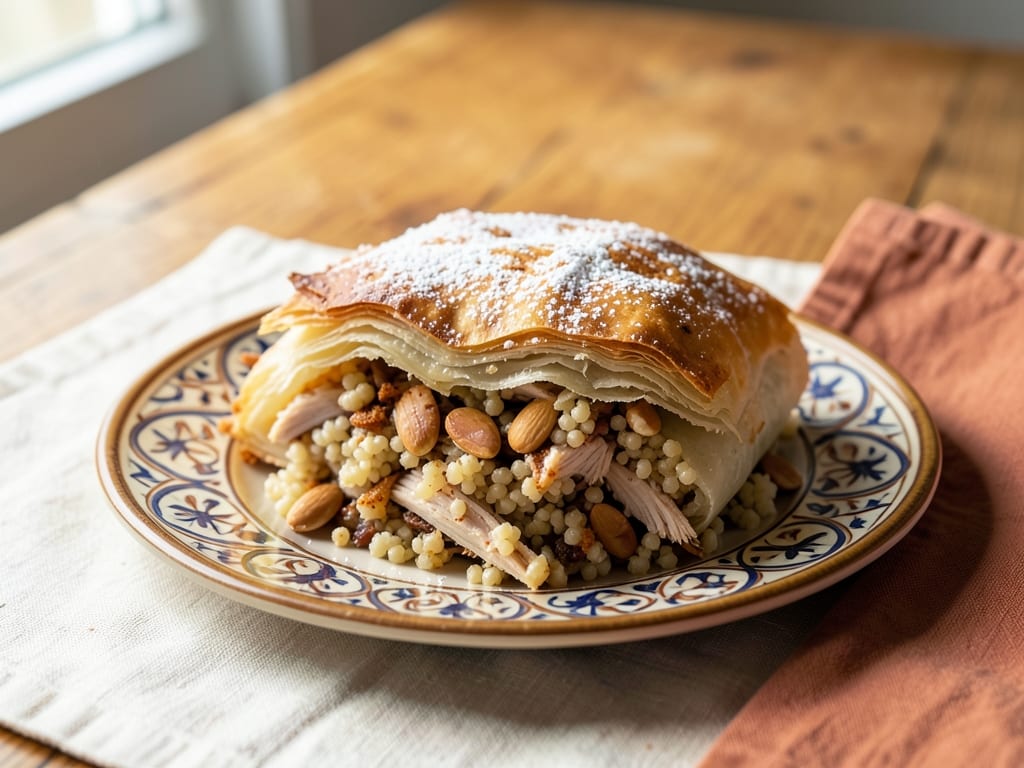
A legendary Moroccan pastry featuring crispy warka sheets wrapped around a spiced filling of shredded chicken, toasted almonds, and eggs. This showstopping dish balances savory, sweet, and warming spices—cinnamon dusted on top creates an elegant finishing touch. Traditionally served as a feast-day centerpiece, pastilla is crispy on the outside and tender within.
- Prep
- 40 min
- Cook
- 1 hr
- Wait
- 30 min
- Total
- 2 hr 10 min
- Makes
- 1 pastilla (4 servings)
Steps
Before you start
- Read through all steps before beginning—pastilla requires coordination of multiple components
- Have all filling ingredients prepped and at hand before you start assembling
- If using store-bought warka or phyllo, keep it covered with a damp towel to prevent drying
- Preheat oven to 400°F (200°C) 15 minutes before baking
Toast the almonds
- Heat a dry 10-inch (25 cm) skillet over medium heat.
- Add the almonds and toast, stirring frequently, for 5–6 minutes until fragrant and lightly golden.
- Transfer to a plate and let cool for 2 minutes, then coarsely chop them—some pieces should be about the size of a pea, others slightly larger, so the filling has varied texture.
- Set aside.
+ Show details− Hide details
Ready when: Almonds are fragrant and light golden brown
Tip: Toast the almonds first so they stay crunchy in the filling rather than softening from the cooking liquid
Sear and simmer chicken
- In a large heavy-bottomed pot (5–6 quart), melt 2 tablespoons of butter over medium-high heat.
- Pat the chicken thighs dry and season both sides with a pinch of salt and pepper.
- Sear them for 3 minutes per side, browning the exterior.
- Add the diced onion, minced ginger, and minced garlic; sauté for 2 minutes until fragrant.
- Stir in the ground cinnamon, turmeric, cumin, and the remaining salt and pepper.
- Pour in ¾ cup water, reduce heat to medium-low, and simmer uncovered for 20–25 minutes until the chicken is cooked through and the liquid has reduced by half.
- You should have about ¼ cup liquid remaining.
+ Show details− Hide details
Ready when: Chicken is tender and cooked through (no pink at bone); liquid is reduced to about ¼ cup
Tip: Don't cover the pot—you need the liquid to reduce and concentrate. If it's reducing too quickly, lower the heat slightly
Shred chicken and cool
- Transfer the chicken to a plate and let cool for 5 minutes until you can handle it comfortably.
- Using two forks or your fingers, shred the meat into bite-sized pieces, discarding any bones.
- Return the shredded chicken to the pot with the cooking liquid and stir in the chopped cilantro and parsley.
- Taste and adjust seasoning if needed.
- Let the mixture cool to room temperature, about 10 minutes.
+ Show details− Hide details
Ready when: Chicken is easily shredded into tender pieces; mixture is cooled to room temperature
Tip: Cool the filling completely before adding the eggs or they will scramble from the residual heat
Scramble eggs into filling
- In a small bowl, whisk together the 3 eggs with a pinch of salt until well combined.
- Melt the remaining butter (2 tablespoons) in a small skillet over medium heat.
- Add the whisked eggs and stir constantly, cooking until they form soft, small curds, about 2 minutes.
- The eggs should be just set but still creamy—they will continue to cook slightly when folded into the filling.
- Transfer to the bowl with the chicken mixture and fold together gently until evenly distributed.
- Fold in the toasted chopped almonds.
- The filling should be moist but not wet.
+ Show details− Hide details
Ready when: Eggs form soft curds and are creamy, not firm or scrambled dry
Tip: Scramble the eggs until they're slightly underdone—they finish cooking in the oven and should remain tender inside the pastilla
Brush pan and layer pastryOven 400°F / 205°C
- Preheat the oven to 400°F (200°C).
- Brush a 9-inch round cake pan or tart pan with removable bottom generously with melted butter.
- Take one sheet of warka or phyllo and lay it flat in the center of the pan.
- Brush lightly with melted butter, then rotate and lay another sheet on top at a slight angle, covering the bottom and sides.
- Continue layering 4–5 sheets total, rotating each one and brushing with butter between layers, so that they overlap and hang over the edges of the pan.
- This creates a cradle to hold the filling.
+ Show details− Hide details
Ready when: Bottom and sides of pan are covered; several sheets overhang the edge
Tip: Work quickly with phyllo or warka—it dries out fast. Keep unused sheets covered with a damp towel
Fill and fold pastilla
- Spoon the cooled chicken and almond filling into the center of the pastry-lined pan, mounding it slightly.
- Don't overfill—you need room to fold the pastry closed.
- Fold the overhanging sheets up and over the filling, overlapping them in the center and brushing each fold with melted butter so they adhere.
- You want the pastilla to look somewhat rustic—a few wrinkles and pleats are traditional and beautiful.
+ Show details− Hide details
Ready when: Filling is enclosed; pastry is folded and brushed with butter
Tip: If you have pastry sheets left over, layer 2–3 of them on top of the pastilla and brush with butter for extra crispness and color
Top with remaining pastry (optional but traditional)
- If desired, layer 2–3 additional warka or phyllo sheets on top of the pastilla, brushing each with melted butter before adding the next.
- This creates a more elegant finished appearance and extra crispy layers.
- Tuck the edges under and brush the entire top generously with melted butter.
+ Show details− Hide details
Ready when: Top is evenly brushed with butter and forms a golden dome
Tip: This step is traditional but optional—it's what makes the pastilla look show-stopping on the table
Bake until goldenOven 400°F / 205°C
- Place the pastilla on a baking sheet to catch any drips.
- Bake in the preheated 400°F (200°C) oven for 25–30 minutes until the top is deep golden brown and crispy.
- The pastry should sound crispy when you tap it gently.
- Transfer the pastilla to a cooling rack or serving platter, still in the pan.
- Let it rest for 5 minutes.
+ Show details− Hide details
Ready when: Top is deep golden brown; pastry is crispy and sounds hollow when tapped
Tip: If the top is browning too fast partway through, loosely tent it with foil. The interior is already cooked, so the oven time is only for crisping the pastry
Unmold and finish
- Once the pastilla has rested for 5 minutes, carefully remove the pan sides or run a thin knife around the edge and slide it onto a serving platter (the bottom may stay attached, which is fine).
- Combine the 1 tablespoon cinnamon and 1.5 tablespoons powdered sugar in a small fine-mesh sieve.
- Dust the top of the pastilla generously with the cinnamon-sugar mixture in a decorative pattern.
- This finishing touch is essential—it's both beautiful and adds the sweet-spice signature of traditional pastilla.
+ Show details− Hide details
Ready when: Pastilla is unmolded and dusted evenly with cinnamon-sugar
Tip: Dust the pastilla just before serving so the sugar doesn't dissolve into the pastry. If you're holding it for a short time, dust it right before bringing to the table
Good to know
Tips
- Warka (the paper-thin Moroccan pastry) is ideal but hard to find outside North Africa. Phyllo dough from the freezer section of most supermarkets is an excellent substitute—same technique, same result.
- The key to a crispy pastilla is melted butter between every layer and a hot oven. Phyllo and warka are naturally crispy when properly buttered and baked at 400°F (200°C).
- This is a showstopper dish that looks far more difficult than it is. Practicing the folding motion with a dry run on a few phyllo sheets before cooking can build confidence.
- Pastilla is traditionally served whole at the center of the table and cut into wedges with a sharp knife at the table, revealing the golden pastry and the moist, fragrant filling inside.
Make ahead
The filling can be made up to 1 day ahead, covered, and refrigerated. Bring it to room temperature before assembling. Assemble and bake the pastilla no more than 2 hours before serving for the best crispness.
Storage & reheating
Store leftover pastilla covered at room temperature for up to 4 hours. It is best eaten fresh and warm. For longer storage, wrap well and refrigerate for up to 2 days; reheat gently in a 300°F (150°C) oven for 10–12 minutes covered with foil to restore crispness (uncover for the last 2 minutes). Do not freeze whole pastilla as the pastry texture will not recover well after thawing.
Substitutions
- warka pastry sheets or phyllo dough → filo (phyllo) dough. Phyllo is the most widely available substitute and will work well, though traditional warka is thinner and crisps differently. Use the same number of sheets.
- raw unsalted almonds → mixture of unsalted pistachios and toasted blanched peanuts. Use 2/3 cup pistachios and 1/3 cup peanuts for a slightly different but delicious flavor profile. Toast and chop the same way.
- fresh cilantro → additional parsley. If you dislike cilantro's taste, use 2/3 cup parsley total instead of splitting it between the two herbs.
- boneless, skinless chicken thighs → bone-in, skin-on chicken thighs or breast meat. Thighs stay moister, but boneless skinless breasts work; reduce cooking time to 15–18 minutes. Check that internal temperature reaches 165°F (74°C).
More pastries
See all →


Find more like this
- Meal
- Dinner
- Cuisine
- Moroccan
- Main ingredient
- Chicken Thighs
- Diet
- Halal
- Method
- Oven
- Occasion
- Family Gatherings