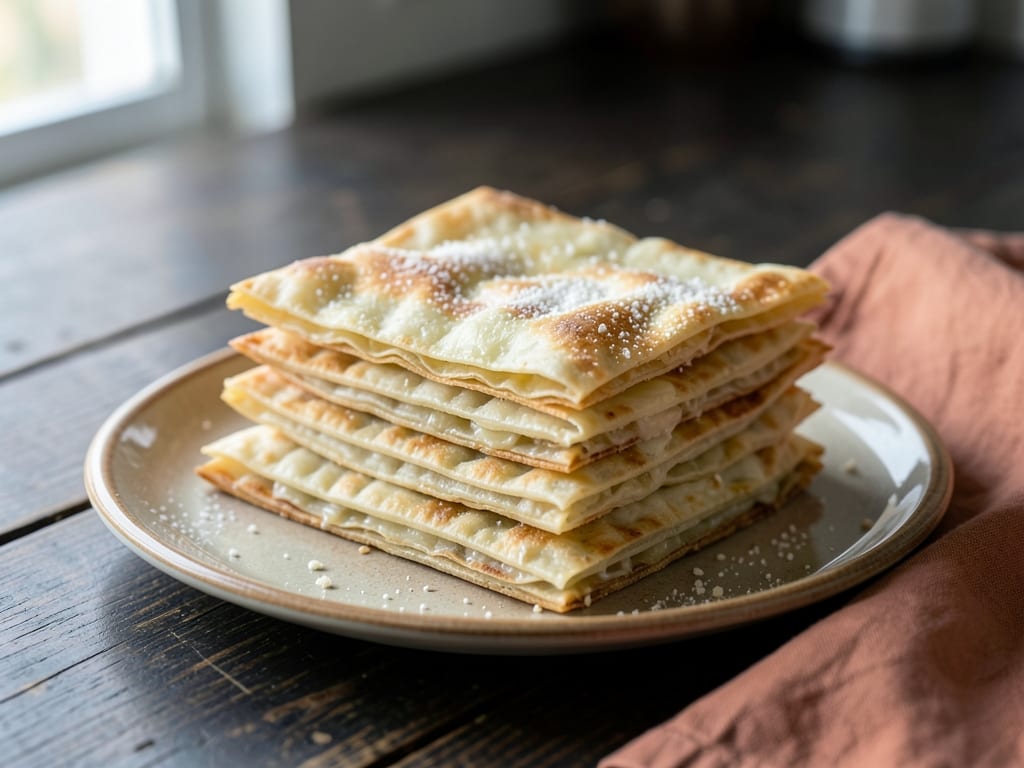
Moroccan Msemen (Layered Square Flatbread Pancakes)
Flaky, buttery Moroccan flatbreads made from a soft semolina-and-flour dough that is stretched paper-thin, brushed with butter, and folded into layers before pan-frying. Crisp at the edges, tender and layered inside, they're perfect with honey, jam, or tea.
- Prep
- 47 min
- Cook
- 24 min
- Wait
- 50 min
- Total
- 2 hr 1 min
- Makes
- 8 square msemen (2 per serving)
Steps
Before you start
- Read the timing: the dough needs a 20-minute rest and the folded squares need a 30-minute rest, so plan about 2 hours in all.
- Melt the butter and mix it with the oil before you start shaping, so it is warm and brushable but not hot.
- Clear a large, smooth work surface (at least 18 × 18 inches / 45 × 45 cm) and oil it and your hands; this dough is sticky and the oil is what makes the layers.
- Use fine semolina (sold as fine durum semolina), not coarse semolina or semolina flour for pasta, for the best texture.
Mix and knead dough
- In a large bowl, whisk the flour, 200 g fine semolina, salt, sugar, and yeast.
- Pour in the warm water and stir until a shaggy, sticky dough forms.
- Knead on the counter for 10 minutes (or 6–7 minutes in a stand mixer on medium-low) until the dough is smooth, soft, and elastic, and springs back slowly when poked.
- It will be tacky; resist adding much flour.
+ Show details− Hide details
Ready when: Dough is smooth, stretchy, and tacky but not sticking to your clean hands.
Tip: A well-kneaded dough stretches thin without tearing later, so don't cut the kneading short.
Shape and rest balls
- Oil your hands and work surface with some of the 30 ml work oil.
- Divide the dough into 8 equal pieces (about 100 g each).
- Roll each into a smooth ball by cupping your hand and rotating on the counter.
- Place the balls on the oiled tray, brush or rub the tops with a little more of the work oil, cover with a towel, and let rest for 20 minutes.
+ Show details− Hide details
Ready when: Balls look slightly puffy and feel very soft and relaxed.
Tip: Keep the balls covered; a dry skin will crack when stretched.
Prepare layering fat
- Stir the melted butter and 60 ml neutral oil together in a small bowl.
- Keep your 30 g dusting semolina in a small bowl within reach, along with the pastry brush.
+ Show details− Hide details
Ready when: Butter and oil form a single warm, liquid mixture.
Tip: If the mixture cools and firms up, warm it briefly so it stays brushable.
Stretch first ball
- Lightly oil the counter.
- Flatten one ball with your palm, then use oiled fingertips and the heel of your hand to push and stretch it outward into a very thin, roughly 10-inch (25 cm) square or round, so thin you can nearly see the counter through it.
- Small holes are fine.
- Pat the edges to even it out.
+ Show details− Hide details
Ready when: Dough is paper-thin and translucent in places, with thicker edges no wider than a finger.
Tip: Stretch from the center outward with flat fingers; pulling with pinched fingertips makes tears.
Brush, sprinkle, fold
- Brush the stretched dough generously with the butter-oil mixture and sprinkle with about ½ tablespoon of the dusting semolina.
- Fold the top third down over the middle, then the bottom third up over it, forming a long rectangle.
- Brush the top again with fat, sprinkle a pinch of semolina, then fold the left third over the middle and the right third over that to make a small, layered square about 3 inches (7–8 cm) across.
+ Show details− Hide details
Ready when: You have a neat, plump square with visible layers at the edges.
Tip: Tuck in any loose edges so the fat stays trapped between layers instead of leaking out.
Repeat with remaining balls
- Transfer the folded square to the oiled tray, cover, and repeat steps 4 and 5 with the remaining 7 balls, re-oiling the counter as needed.
- Keep the finished squares side by side, covered with a towel.
+ Show details− Hide details
Ready when: All 8 squares are folded and covered.
Tip: Work at a steady pace; the first squares begin resting while you finish the rest.
Rest folded squares
- Let the covered squares rest on the tray for 30 minutes.
- Meanwhile, nothing else is needed; this lets the gluten relax again so the layered squares can be flattened without tearing.
+ Show details− Hide details
Ready when: Squares feel soft and slightly spread out when pressed.
Flatten squares
- Place a square on a lightly oiled counter and gently press and stretch it with your fingertips into a flat square about 6 inches (15 cm) wide and ¼ inch (5–6 mm) thick.
- Flatten just before cooking, one or two at a time, keeping the others covered.
+ Show details− Hide details
Ready when: Square is even in thickness and about 6 inches wide, with layers still visible at the edges.
Tip: Press, don't roll with a pin; pressing keeps the layers from fusing.
Pan-fry msemen
- Heat the skillet over medium heat for 2 minutes.
- Lightly grease with a little cooking butter, if using.
- Cook one flattened msemen for about 1½ minutes, until the underside is pale golden with brown spots, then flip and cook another 1½ minutes.
- Flip once more if needed for 30 seconds to even the color.
- Repeat with the remaining squares, flattening the next one while each cooks.
+ Show details− Hide details
Ready when: Both sides are golden brown with darker spots, edges are crisp, and the center puffs slightly and feels flaky.
Tip: If the pan smokes or the msemen browns in under a minute, lower the heat; the layers need time to cook through.
Fluff and serve
- As each msemen comes off the pan, place it on a board and gently clap or push the edges toward the center with your hands to crinkle and open the layers.
- Stack under a towel to keep warm and serve right away with honey, jam, or butter.
+ Show details− Hide details
Ready when: Layers separate into flaky, ruffled ridges.
Tip: Be careful, the msemen is hot; fluff with a towel in hand if needed.
Good to know
Tips
- Oil is your friend: an oiled counter and oiled hands keep the sticky dough manageable and prevent adding extra flour, which toughens the msemen.
- Stretch the dough as thin as you can; thinner sheets create more layers and a flakier result.
- Cook over steady medium heat; too hot browns the outside before the inner layers cook, too low dries them out.
- For a savory version, sprinkle a little finely chopped onion, cumin, and chili between layers before the final fold.
Make ahead
"Shape, fold, and rest the squares, then wrap them individually in plastic and refrigerate for up to 24 hours. Bring to room temperature for 30 minutes, then flatten and cook. Alternatively, freeze the folded uncooked squares (see storage)."
Storage & reheating
"Room temperature: cooked msemen keep, covered, for up to 1 day. Fridge: up to 4 days in an airtight container. Freezer: up to 3 months, with parchment between each; freeze cooked or uncooked folded squares. Reheat cooked msemen in a dry skillet over medium heat for 1–2 minutes per side, from frozen if needed. Cook frozen uncooked squares after thawing in the fridge overnight."
Substitutions
- fine semolina → Additional all-purpose flour (200 g). The msemen will be softer and less nutty, with less of the characteristic slight crunch.
- unsalted butter → Ghee or additional neutral oil. Ghee gives a similar rich flavor; all oil makes a lighter, vegan-friendly version.
- instant yeast → Active dry yeast (1 tsp, 3 g). Dissolve in the warm water and let stand 5 minutes until foamy before mixing in.
- neutral oil (such as sunflower or canola) → Melted ghee or olive oil. Olive oil adds a mild fruity taste; use a light one.
More flatbreads
See all →


Find more like this
- Meal
- Breakfast
- Cuisine
- Moroccan
- Diet
- VegetarianHalal
- Method
- Stovetop