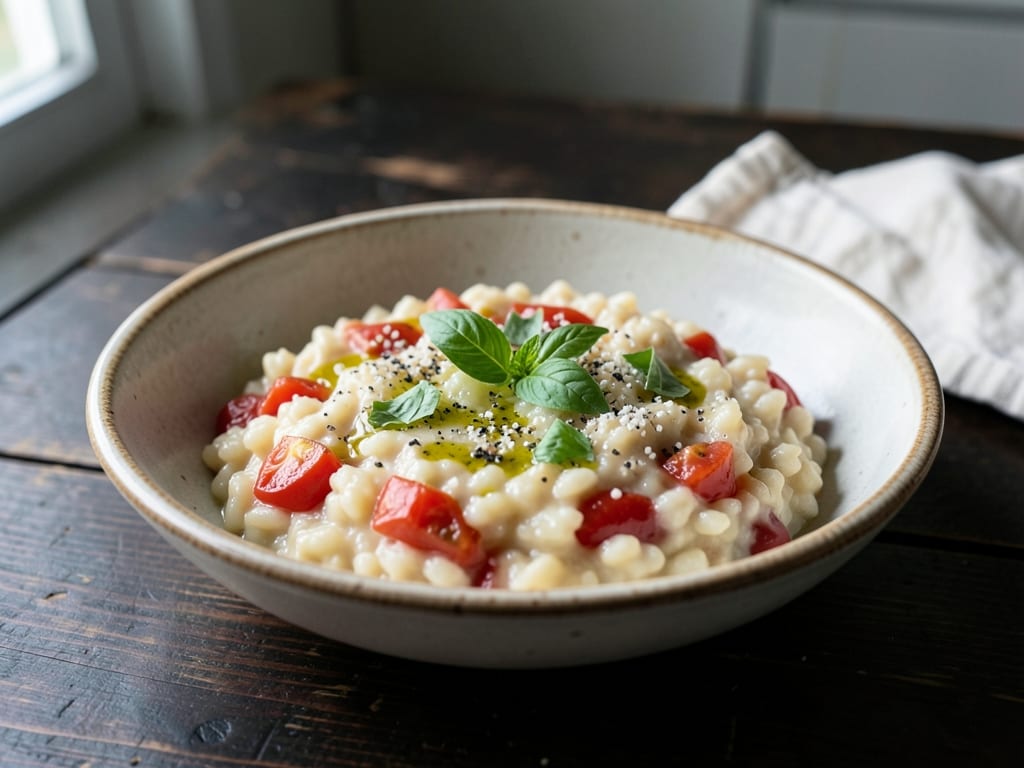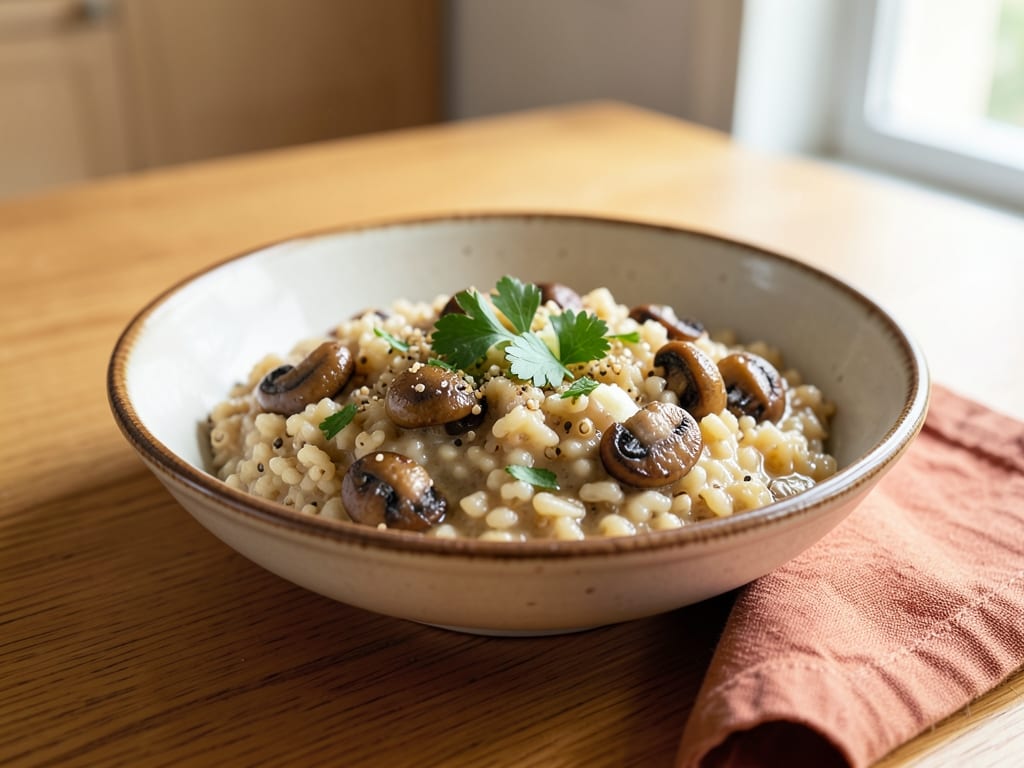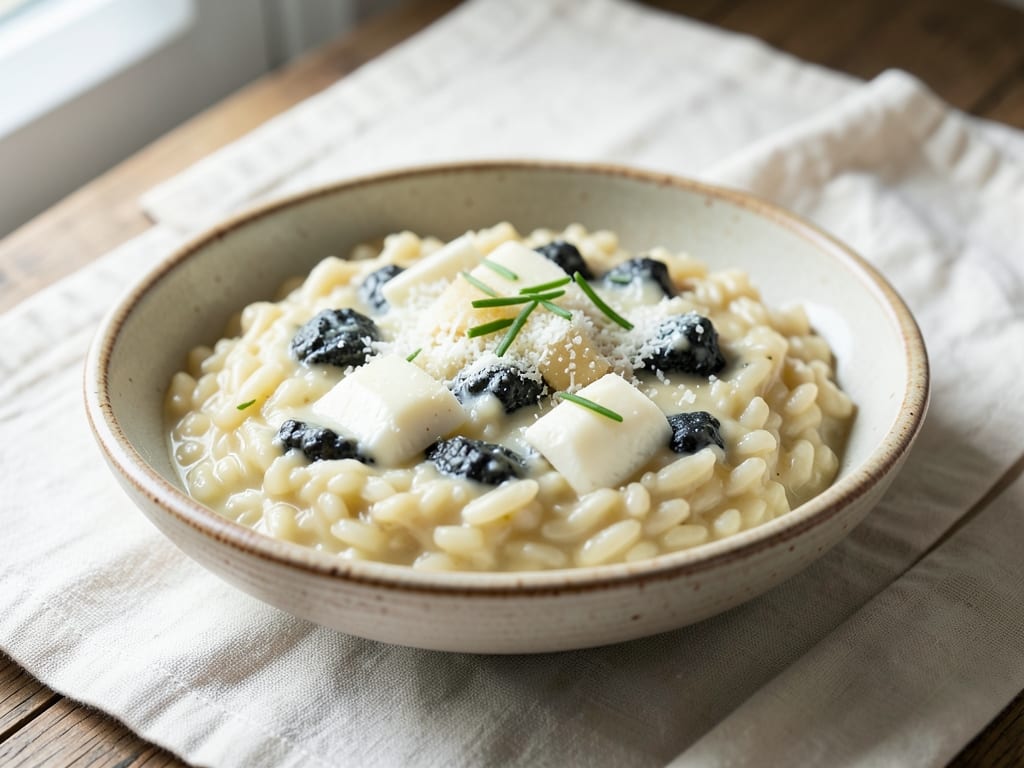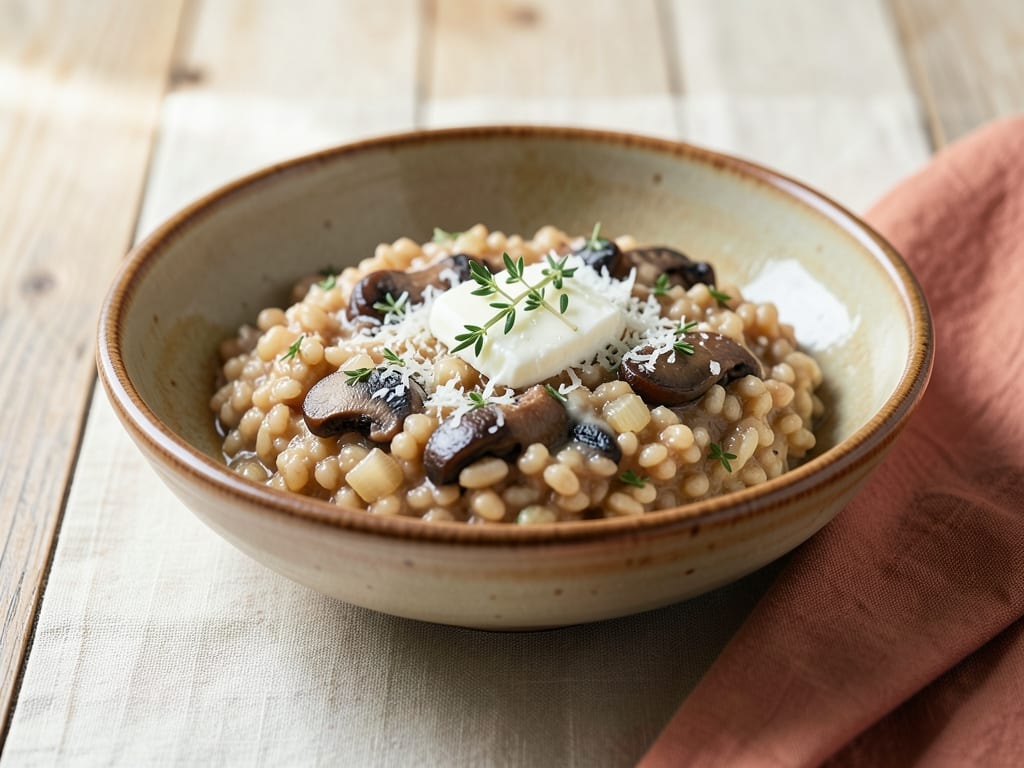
Leek and Gruyère Risotto
Creamy arborio risotto built on slowly softened leeks, dry white wine and nutty Gruyère, finished with a squeeze of lemon and fresh chives. Classic French bistro comfort, entirely vegetarian.
- Prep
- 20 min
- Cook
- 40 min
- Wait
- 3 min
- Total
- 1 hr 3 min
- Makes
- 4 main-course servings (about 6 cups / 1.4 L), or 6 starter servings
Steps
Before you start
- Risotto needs near-constant attention for about 20 minutes once the rice goes in. Have everything chopped, measured and within reach before you light the stove.
- Leeks hide grit between their layers. Plan on a thorough rinse after slicing (Step 1).
- Grate the Gruyère on the small holes of a box grater so it melts smoothly. Let it sit at room temperature while you cook.
- Choose a dry white wine you would happily drink, such as Sauvignon Blanc or Pinot Grigio. Avoid anything oaky or sweet.
- Do not rinse the arborio rice. The surface starch is what makes the risotto creamy.
Clean and slice leeks
- Trim off the roots and dark green tops.
- Halve each leek lengthwise, then slice crosswise into ½-inch (1.25 cm) half-moons.
- Drop the slices into a large bowl of cold water and swish with your hands to loosen grit.
- Let them sit 2 minutes so the dirt sinks, then lift the leeks out with your hands (don't pour them out, or the grit goes back on) and drain well in a colander.
- Pat fairly dry.
+ Show details− Hide details
Ready when: Water at the bottom of the bowl has no visible sand and the leeks feel clean between the layers
Tip: Check the bottom of the bowl. If you see sand, rinse the leeks a second time.
Heat the broth
- Pour the broth into a medium saucepan and bring to a bare simmer over medium heat, then reduce to low and keep it hot with the lid ajar.
- Cold broth stops the rice from cooking evenly and makes the risotto gluey.
+ Show details− Hide details
Ready when: Small bubbles break at the edges and steam rises; it should not boil hard
Tip: Taste the broth. If it is very salty, hold back some of the salt in Step 3.
Soften the leeks
- Set the wide sauté pan over medium-low heat and add the 3 tbsp butter and the olive oil.
- When the butter foams, add the leeks and ¾ tsp salt.
- Cook, stirring every minute or so, for 10–12 minutes until the leeks are completely tender and glossy with no raw crunch.
- Do not let them brown.
+ Show details− Hide details
Ready when: Leeks are limp, silky and collapsed to about half their volume, pale green with no browning
Tip: If the leeks begin to brown or stick, lower the heat and add 1 tbsp water.
Add aromatics
- Stir in the shallot and thyme and cook 3 minutes, stirring, until the shallot is translucent and soft.
- Add the garlic and cook 30 seconds more until fragrant.
- Do not let the garlic color or it will turn bitter.
+ Show details− Hide details
Ready when: Shallot is translucent and the garlic smells sweet and fragrant but is not browned
Toast the rice
- Raise the heat to medium.
- Add the arborio rice and stir constantly for 2 minutes so every grain is coated in the buttery leeks.
- The edges of the grains should turn translucent while the centers stay chalky white.
+ Show details− Hide details
Ready when: Grain edges look translucent with a small opaque white dot in the center, and the rice smells lightly nutty
Cook off the wine
- Pour in the white wine; it will sizzle.
- Stir steadily for about 2–3 minutes until the pan looks almost dry and the sharp alcohol smell has faded.
+ Show details− Hide details
Ready when: When you drag the spoon across the bottom of the pan, the trail stays open for a second and almost no liquid pools
Add broth gradually
- Add 1 ladleful (about ½ cup / 120 ml) of hot broth and stir until it is mostly absorbed, then add the next.
- Keep the heat at medium-low so the risotto bubbles gently, not violently, and stir often, scraping the bottom and corners.
- Continue for 18–22 minutes, using most or all of the 5 cups.
- After about 16 minutes, begin tasting a grain every couple of minutes.
+ Show details− Hide details
Ready when: Rice is tender with a slight firmness at the very center (al dente), and the mixture is loose and creamy, flowing slowly when the pan is tilted
Tip: If you run out of broth before the rice is tender, finish with hot water, ¼ cup at a time.
Finish with cheese
- Remove the pan from the heat.
- Vigorously stir in the cold butter cubes, then the Gruyère in two additions, until melted and the risotto turns glossy and creamy.
- Stir in the lemon juice, a few grinds of pepper and the nutmeg, if using.
- Taste and add more salt if needed.
- If it is stiff, loosen with a splash of hot broth.
+ Show details− Hide details
Ready when: Cheese is fully melted with no strings or clumps, and the risotto looks glossy and flows in a soft wave
Tip: Adding the cheese off the heat keeps it from turning stringy or greasy.
Rest and serve
- Cover the pan and let the risotto rest 3 minutes so the rice relaxes into a creamy, spoonable texture.
- Divide among warm shallow bowls and scatter with the chives.
- Serve immediately, as risotto thickens quickly as it cools.
+ Show details− Hide details
Ready when: Risotto is creamy and slightly loose, spreading gently across the bowl
Tip: Warm the bowls under hot tap water first so the risotto stays creamy longer.
Good to know
Tips
- Use a wide pan rather than a deep pot. More surface area means the broth reduces evenly and the rice cooks at the same rate.
- Don't rush with high heat. A gentle bubble gives you creamy rice with a tender-but-firm center instead of mushy outsides and a raw core.
- Salt in layers: the leeks get salt early, but taste only at the end, since the broth and the cheese both add saltiness.
- For extra crunch and color, fry a few thin rings of leek in oil until golden and scatter them on top.
Make ahead
Risotto is best served right away, but you can save time by slicing and rinsing the leeks, grating the Gruyère and snipping the chives up to 1 day ahead. Keep each covered in the refrigerator, with the leeks wrapped in a dry paper towel.
Storage & reheating
Room temperature: no more than 1 hour. Refrigerator: cool quickly and store in an airtight container up to 3 days. Freezer: not recommended for the creamy texture, but leftovers can be frozen up to 1 month and used for arancini or rice cakes. To reheat, warm in a saucepan over low heat with a splash of broth or water, stirring until hot and creamy again, about 5 minutes.
Substitutions
- Gruyère cheese → Comté, Emmental or Fontina. Use the same weight. Comté is closest in flavor; Emmental is milder.
- dry white wine → Additional vegetable broth plus 1 tbsp white wine vinegar or lemon juice. Use ¾ cup (180 ml) broth with 1 tbsp acid to replace the wine's brightness.
- shallot → Yellow onion. Use ¼ cup (40 g) finely chopped onion and cook an extra minute.
- fresh chives → Fresh flat-leaf parsley or tarragon. Use the same amount; tarragon is stronger, so use half as much.