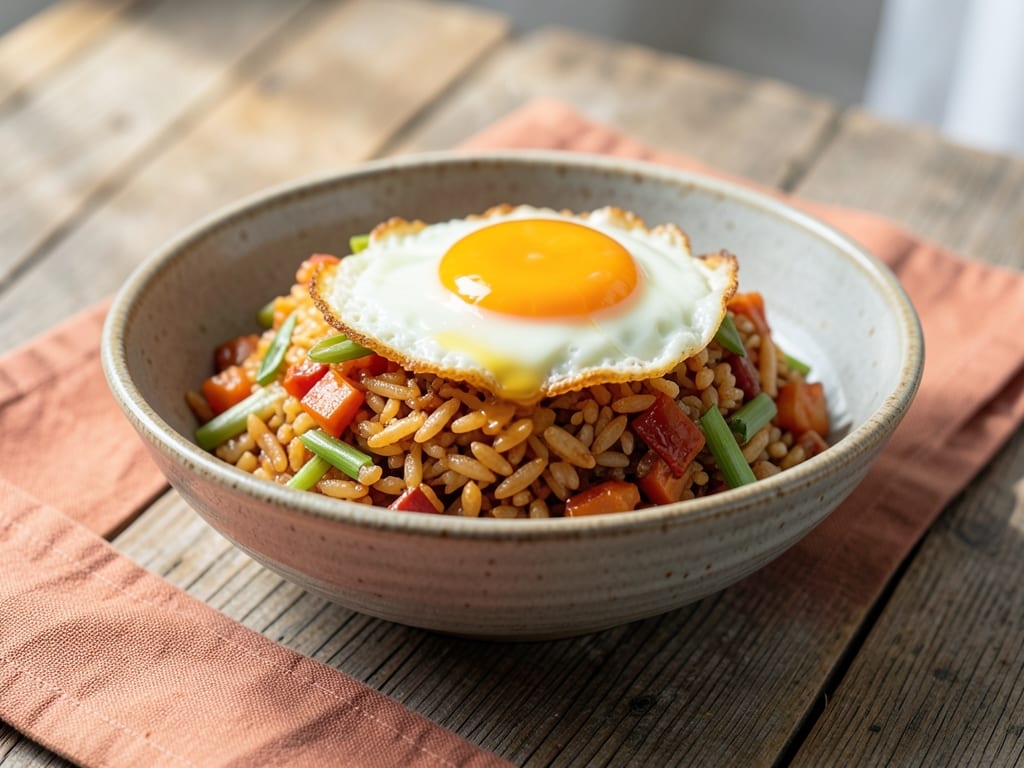
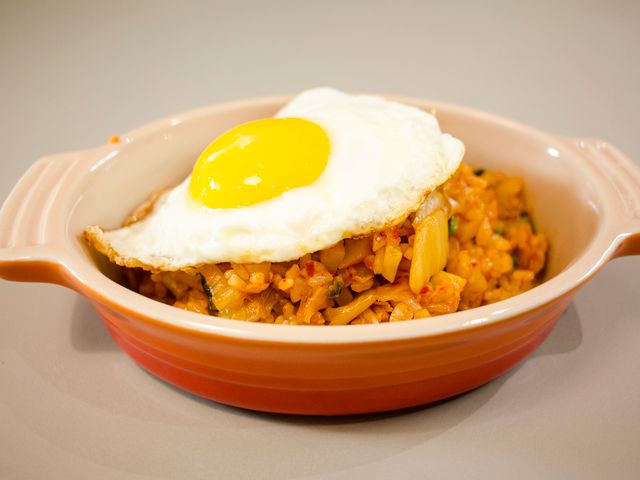
Korean Kimchi Fried Couscous with Spam and Gochugaru
A vibrant one-pan fried couscous with tangy kimchi, crispy Spam, and a fiery gochugaru kick. Topped with a fried egg and fresh scallions, this quick weeknight meal marries Mediterranean grain cooking with Korean flavors.
- Prep
- 15 min
- Cook
- 20 min
- Wait
- 5 min
- Total
- 40 min
- Makes
- 4 bowls (about 1.5 cups each)
Steps
Before you start
- Have all ingredients prepped and within arm's reach—couscous fries quickly once the pan is hot
- If using leftover cooked couscous, break up any clumps with your fingers before cooking
- Taste your kimchi beforehand so you know how spicy it is, and adjust the gochugaru amount accordingly
Cook the couscous
- Bring 2.25 cups (530 ml) water to a boil in a small saucepan with 0.75 teaspoon (4 g) salt.
- Stir in 1.5 cups (270 g) couscous, then remove from heat, cover, and let sit for 5 minutes until the water is absorbed and the couscous is fluffy.
- Fluff with a fork and spread on a plate to cool for 2–3 minutes so it doesn't clump during frying.
+ Show details− Hide details
Ready when: Couscous is light, fluffy, and grains are separate
Tip: Spreading warm couscous on a plate helps it cool and prevents sticking in the pan.
Prepare and cube the Spam
- Remove the Spam from the can and slice into four thin lengthwise planks (about ¼ inch or 6 mm thick).
- Cut each plank into ½-inch (1.25 cm) cubes.
- This gives you more surface area for crisping.
+ Show details− Hide details
Tip: Cold Spam cubes are easier to handle and cut. Dicing rather than slicing gives you more crispy edges.
Crisp the Spam
- Heat 1 tablespoon (15 ml) of the vegetable oil in a 12-inch (30 cm) nonstick skillet or wok over medium-high heat.
- Once the oil shimmers, add the Spam cubes in a single layer and cook undisturbed for 2 minutes.
- Stir and cook for another 1–2 minutes until golden and crispy on most edges.
- Transfer to a paper-towel-lined plate.
+ Show details− Hide details
Ready when: Spam edges are golden and the meat releases fat
Tip: Don't stir too early—let the cubes sit undisturbed to develop color and crispiness.
Sauté garlic and kimchi
- In the same skillet, add the remaining 2 tablespoons (30 ml) vegetable oil.
- Once hot, add 2 minced garlic cloves and cook for 20 seconds until fragrant.
- Add 1 cup (200 g) drained, chopped kimchi and cook, stirring occasionally, for 2 minutes.
- The kimchi should caramelize slightly at the edges.
+ Show details− Hide details
Ready when: Kimchi is fragrant and edges are slightly browned
Tip: The acidity of the kimchi will help season the couscous, so don't be shy with the amount.
Add couscous and seasonings
- Add the cooled couscous to the pan and break up any clumps with your spoon or spatula.
- Stir constantly for 2–3 minutes, coating the grains evenly with the oil and kimchi mixture.
- Pour in 2 tablespoons (30 ml) soy sauce, 2 tablespoons (30 ml) sesame oil, and 1.5 teaspoons (3 g) gochugaru.
- Stir well for 1 minute until the couscous is uniformly red-tinted and aromatic.
+ Show details− Hide details
Ready when: Couscous is heated through and evenly coated with seasoning and oil
Tip: Stir constantly to prevent sticking and ensure the spices coat every grain evenly.
Mix in Spam and scallions
- Add the crispy Spam cubes back to the pan along with the white and light-green parts of 3 sliced scallions.
- Toss everything together for 30 seconds until combined and heated through.
- Taste and adjust seasoning if needed (more soy sauce for saltiness, more gochugaru for heat).
- Transfer to a clean skillet or move couscous to the side of the current skillet to make room for frying the eggs.
+ Show details− Hide details
Ready when: Spam and scallions are evenly distributed and warm
Tip: If your pan is crowded, transfer the finished couscous to a bowl and keep it warm while you fry the eggs.
Fry the eggs
- If using the same skillet, push the couscous to the sides to create space in the center.
- Add a splash more oil (about ½ tablespoon / 7 ml) to the empty space.
- Once it's hot, crack all 4 eggs into the pan and cook over medium heat for 3–4 minutes until the whites are set and opaque but the yolks are still runny.
- Season lightly with salt.
+ Show details− Hide details
Ready when: Egg whites are completely opaque; yolks jiggle slightly when nudged
Tip: Keep the heat at medium so the bottoms don't burn. If you prefer fully cooked yolks, cook for 1–2 minutes longer.
Plate and garnish
- Divide the kimchi fried couscous among 4 bowls.
- Top each bowl with one fried egg.
- Garnish with the reserved dark-green scallion tops, 2 teaspoons (10 g) toasted sesame seeds if desired, and a pinch more gochugaru.
- Serve immediately while the egg yolk is still warm and runny.
+ Show details− Hide details
Tip: Serve right away so the runny egg yolk can coat the couscous as you mix it.
Good to know
Tips
- This dish comes together quickly once the couscous is cooked, so prep all ingredients before you start cooking. A mise en place (everything in place) setup will make the process smooth and prevent overcooking.
- Kimchi varies in spice level by brand and fermentation time. Taste yours first and adjust the gochugaru accordingly—you can always add more heat, but you can't take it out.
- The runny egg yolk is essential to the dish; it acts as a sauce that coats and enriches the couscous. If you prefer firmer yolks, cook the eggs a bit longer or cover the pan with a lid for the last minute.
- Leftover kimchi brine (the spicy liquid at the bottom of the jar) can be drizzled into the couscous in place of some of the soy sauce for extra depth and tang.
Make ahead
Couscous can be cooked up to 1 day ahead, cooled completely, and stored in an airtight container in the refrigerator. Reheat gently in a skillet with a splash of water or oil before frying. Kimchi can be chopped and Spam diced up to 4 hours in advance and kept in separate containers.
Storage & reheating
Store leftover fried couscous (without eggs) in an airtight container in the refrigerator for up to 3 days. Reheat in a skillet over medium heat with a splash of water or oil until warmed through, 2–3 minutes. Do not freeze, as the couscous texture may become mushy upon thawing. Fry fresh eggs when ready to serve.
Substitutions
- Spam or luncheon meat, canned → Diced ham, bacon, or Chinese lap cheong (Chinese sausage), diced and crisped. Use about 12 oz (340 g). Bacon will give a smokier flavor; lap cheong adds sweetness.
- gochugaru (Korean red chili flakes) → Sambal oelek, sriracha, or cayenne pepper. Sambal oelek has similar texture and heat. Use 1–2 tablespoons sambal or 1 tablespoon sriracha. Cayenne is hotter; start with ½ teaspoon.
- couscous → Quinoa or millet (cooked weight should be about 3 cups / 600 g). Cook these grains according to package directions first, then fry as directed.
- sesame oil → Extra-virgin olive oil or roasted peanut oil. Use the same amount. Sesame oil provides the most authentic Korean flavor, but these alternatives work well.