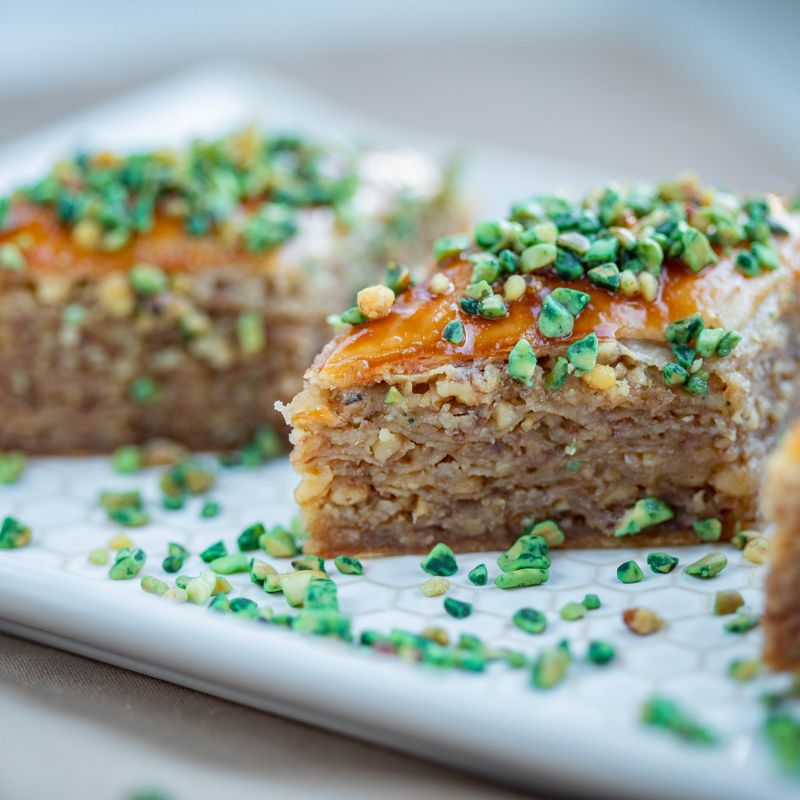
Korean Honey Butter Namoura Cake
A fusion twist on the classic Middle Eastern namoura cake that marries the delicate, coconut-studded semolina sponge with Korean honey butter flavors. The cake is baked until golden, then soaked in a warm honey-butter syrup infused with cardamom and a touch of sesame, creating a moist, aromatic crumb with a glossy glaze. Topped with roasted almonds for crunch and elegance, this is a showstopper dessert that bridges two culinary traditions.
- Prep
- 20 min
- Cook
- 35 min
- Wait
- 45 min
- Total
- 1 hr 40 min
- Makes
- One 9×13-inch cake (12 pieces)
Steps
Before you start
- Preheat oven to 350°F (175°C)
- Use softened butter at room temperature for the batter
- Have all dry ingredients measured and combined before mixing
- Toast almonds lightly if they are not already roasted
Combine dry ingredients
- In a medium bowl, whisk together the semolina flour, shredded coconut, baking powder, and salt.
- Set aside.
- This mixture forms the base of your cake and ensures the leavening is evenly distributed.
+ Show details− Hide details
Ready when: Dry ingredients are well combined with no lumps
Tip: Whisk thoroughly so the baking powder is evenly dispersed, preventing dense pockets in the finished cake.
Cream butter and sugar
- In a large mixing bowl, beat the softened butter and sugar together for 3–4 minutes using a whisk or electric mixer on medium speed until the mixture is pale, fluffy, and increased in volume.
- Scrape down the sides of the bowl.
+ Show details− Hide details
Ready when: Mixture is pale yellow, fluffy, and has noticeably increased in volume
Tip: Do not skip the creaming step—this incorporates air and creates the cake's tender crumb.
Add eggs and aromatics
- Add the eggs one at a time, beating well after each addition until fully incorporated.
- Pour in the vanilla extract and toasted sesame oil, whisking until the mixture is smooth and homogeneous.
+ Show details− Hide details
Ready when: Mixture is smooth, glossy, and well emulsified
Tip: Add eggs slowly to prevent curdling. The sesame oil adds a subtle Korean honey-butter note.
Fold in dry mixture and yogurt
- Alternate adding the dry mixture and Greek yogurt to the butter mixture: add one-third of the dry mixture and fold gently with a wooden spoon or spatula, then add half the yogurt and fold, then the remaining dry mixture, then the remaining yogurt.
- Fold until just combined; do not overmix.
+ Show details− Hide details
Ready when: No visible streaks of dry mixture remain; batter is thick and creamy
Tip: Overmixing develops gluten and results in a tough cake. Stop as soon as ingredients are incorporated.
Prepare and fill pan
- Pour the batter into your greased 9×13-inch (23×33 cm) baking pan and smooth the top with a spatula.
- Let the batter rest for 5 minutes so it settles evenly.
- Cut the cake into diamond shapes: make three diagonal cuts one way, then three diagonal cuts the other way to create 12 diamonds.
- Place one whole roasted almond in the center of each diamond.
+ Show details− Hide details
Ready when: Diamonds are clearly marked and each topped with an almond
Tip: Cut the diamonds before baking so the almond sits securely and the cake breaks cleanly along score lines after soaking.
Bake the cakeOven 350°F / 175°C
- Bake in a preheated 350°F (175°C) oven for 30–35 minutes.
- The top should be golden brown and a skewer inserted into the center should come out with just a few moist crumbs attached.
- The cake should spring back lightly when touched.
+ Show details− Hide details
Ready when: Top is deep golden, skewer shows few moist crumbs, cake springs back when lightly pressed
Tip: Do not overbake—the cake will continue to firm up as it cools and absorbs syrup. A slightly underdone center is preferable.
Make honey butter syrup
- While the cake bakes, combine the honey, butter, water, ground cardamom, and lemon juice in a small saucepan.
- Bring to a gentle simmer over medium heat, stirring occasionally, and let it bubble softly for 3–4 minutes.
- Do not boil rapidly.
- The syrup should be warm and pourable when the cake comes out of the oven.
+ Show details− Hide details
Ready when: Syrup gently bubbles and reaches 160°F (70°C); honey is fully dissolved
Tip: Keep the syrup warm until the cake is ready. If it cools, reheat gently before pouring.
Soak the hot cake
- Remove the cake from the oven and immediately pour the warm honey butter syrup evenly over the entire surface, working carefully along the diamond score lines so the syrup soaks into each piece.
- Let the syrup soak in for 2–3 minutes, then pour any remaining syrup from around the edges back over the top.
- The cake should be glossy and saturated.
+ Show details− Hide details
Ready when: Cake is glossy and glistens; syrup has been absorbed into score lines
Tip: Hot cake + hot syrup = maximum absorption. Never pour cold syrup onto a hot cake.
Cool and finish
- Allow the cake to cool in the pan for 15 minutes.
- If desired, sprinkle the toasted sesame seeds over the top for extra nuttiness and visual appeal.
- Let cool completely before serving—this allows the cake to set and the flavors to fully develop.
- The cooled cake will stay moist for several days.
+ Show details− Hide details
Ready when: Cake is warm to the touch but no longer hot; sesame seeds adhere to the glossy surface
Tip: Cooling in the pan keeps the cake intact and moist. Serve at room temperature for best flavor.
Good to know
Tips
- Toast the almonds lightly in a dry skillet over medium-low heat for 2–3 minutes before using. This deepens their flavor and ensures they don't soften excessively during baking.
- The Korean honey-butter syrup is the soul of this cake. Use quality honey—raw or clover honey adds floral notes that enhance the fusion concept. Lower-quality honey will make the cake taste overly sweet.
- Do not skip the sesame oil. Though just 1 tablespoon, it adds a subtle nutty depth that signals the Korean-fusion element without overpowering the traditional namoura flavor.
- This cake is best served at room temperature. Refrigeration dulls the delicate flavors; if you must chill it, bring it back to room temperature 30 minutes before serving and warm gently in the oven.
Make ahead
The cake actually improves after 24 hours as the syrup continues to be absorbed. Bake and soak up to 2 days ahead, cover tightly with plastic wrap, and store at room temperature. Reheat gently in a 300°F (150°C) oven for 10 minutes if desired before serving.
Storage & reheating
Room temperature (covered): up to 4 days. Refrigerator (airtight container): up to 1 week. Freezer (wrapped well): up to 3 months. Thaw at room temperature for 2 hours, then gently warm in a 300°F (150°C) oven for 10 minutes to restore moisture.
Substitutions
- unsweetened shredded coconut → finely ground pistachios or walnuts. Use the same amount. The nut flavor will be more prominent and the texture slightly denser, but equally delicious.
- toasted sesame oil → one additional tablespoon of honey plus 1 tsp of melted butter. This adds sweetness instead of the nutty sesame note, making the cake sweeter and less distinctly Korean.
- Greek yogurt → sour cream or plain yogurt (use the same volume). Sour cream makes the cake slightly tangier; regular yogurt works well but may be thinner, so reduce water in the syrup by 2 tbsp.
- ground cardamom → ½ tsp of ground cinnamon mixed with a pinch of clove. This creates a warm spice profile instead of the floral cardamom; adjust to taste.
More cakes
See all →


Find more like this
- Meal
- Dessert
- Cuisine
- Middle Eastern
- Main ingredient
- Lemons
- Diet
- VegetarianHalal
- Method
- Oven