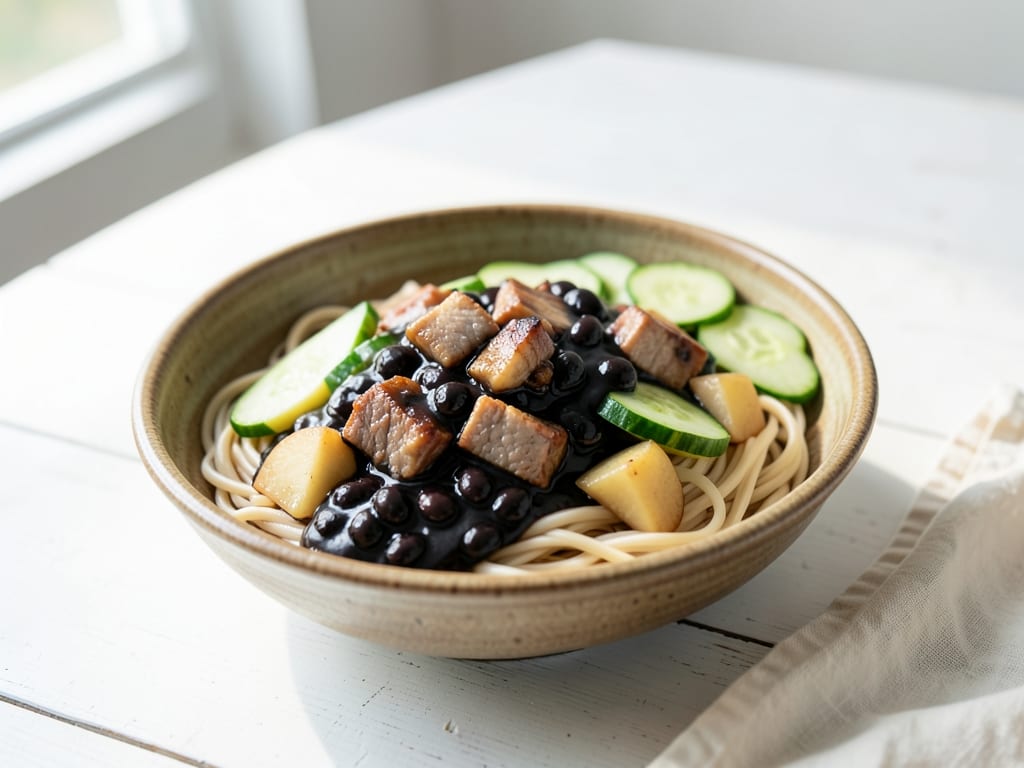
Jajangmyeon (Korean Black Bean Noodles)
Thick, glossy black bean sauce made by frying chunjang in oil to mellow its bitterness, then simmering with pork, onion, zucchini and potato. Spoon it over chewy wheat noodles and top with crisp cucumber.
- Prep
- 25 min
- Cook
- 35 min
- Total
- 1 hr
- Makes
- 4 large bowls of noodles (about 3 cups / 720 ml sauce)
Steps
Before you start
- Cut everything into ½-inch (1.2 cm) pieces before you turn on the stove; the sauce moves quickly once started.
- Chunjang is salty and bitter straight from the jar. Frying it in oil (step 3) is essential, so don't skip it.
- Mix the cornstarch slurry just before using, since the starch settles.
- Boil the noodles only when the sauce is nearly done so they are hot and not clumped.
Prep the ingredients
- Cut the pork, onions, zucchini and potato into ½-inch (1.2 cm) pieces.
- Grate the ginger, mince the garlic, and cut the cucumber into thin matchsticks.
- Stir the cornstarch with 3 tbsp cold water in a small bowl.
- Bring a large pot of water to a boil later in step 6.
+ Show details− Hide details
Ready when: Vegetables are uniformly diced and cucumber is ready for garnish.
Tip: Even ½-inch pieces cook at the same pace, so the potato softens as the zucchini holds its shape.
Brown the pork
- Heat 1 tbsp (15 ml) of the oil in a 12-inch (30 cm) skillet or wok over medium-high heat.
- Add the pork and cook, stirring occasionally, 5 to 6 minutes.
- Add the ginger and garlic and stir 30 seconds.
+ Show details− Hide details
Ready when: Pork is browned at the edges, fat has rendered, and the garlic smells fragrant.
Tip: If using fatty pork belly, spoon off all but 2 tbsp of fat before continuing.
Fry the black bean paste
- Push the pork to the side.
- Add the remaining 4 tbsp (55 ml) oil and the chunjang to the cleared space.
- Fry, stirring constantly, 3 to 4 minutes, then mix it into the pork.
+ Show details− Hide details
Ready when: Paste loosens, looks glossy and bubbles, and smells toasty rather than sharp.
Tip: Lower the heat if the paste spits or darkens too fast; scorched paste turns bitter.
Sauté the vegetables
- Add the onions, potato and sugar.
- Stir to coat in the paste and cook 5 minutes, until the onions begin to turn translucent and release liquid.
- Add the zucchini and soy sauce and stir 2 minutes.
+ Show details− Hide details
Ready when: Onions are translucent and the vegetables are well coated in dark sauce.
Tip: Scrape the bottom as you stir so the paste doesn't stick and burn.
Simmer the sauce
- Pour in 1½ cups (360 ml) water and bring to a boil.
- Reduce to medium-low, cover and simmer 12 to 15 minutes, stirring once or twice.
+ Show details− Hide details
Ready when: A piece of potato is easily pierced with a fork.
Thicken the sauce
- Stir the slurry again and pour it into the simmering sauce, stirring.
- Cook 1 to 2 minutes, then stir in the sesame oil and turn off the heat.
- Meanwhile, bring a large pot of water to a boil.
+ Show details− Hide details
Ready when: Sauce turns glossy and thick enough to coat the back of a spoon.
Tip: Add water by the tablespoon if it gets too thick while you cook noodles.
Boil the noodles
- Cook the noodles in the boiling water following package directions, usually 4 to 6 minutes for fresh and 8 to 10 for dried.
- Drain well and rinse briefly under hot water to remove surface starch.
+ Show details− Hide details
Ready when: Noodles are chewy but tender with no hard center.
Tip: Drain thoroughly; extra water thins the sauce.
Assemble and serve
- Divide the hot noodles among 4 bowls.
- Ladle about ¾ cup (180 ml) sauce over each and top with cucumber.
- Toss together at the table and eat right away.
+ Show details− Hide details
Ready when: Noodles are coated in glossy dark sauce.
Good to know
Tips
- Always fry the chunjang in oil first; this removes its raw bitterness and gives the sauce depth.
- The oil amount may seem generous, but it carries the flavor and gives the sauce its gloss.
- Serve with yellow pickled radish (danmuji) and raw onion dipped in extra chunjang if you like.
- For a spicy version, add 1 tsp gochugaru with the garlic.
Make ahead
The sauce can be made through step 6 up to 4 days ahead. Cool and refrigerate, then reheat with a splash of water. Cook noodles fresh.
Storage & reheating
Store sauce and noodles separately. Sauce keeps 4 days in the fridge in an airtight container or 2 months in the freezer. Reheat in a saucepan over medium-low heat with 2 to 3 tbsp water, stirring until steaming. Noodles are best fresh and do not store well.
Substitutions
- boneless pork belly or pork shoulder → diced shiitake mushrooms, firm tofu, or shrimp. For vegetarian, use 8 oz (225 g) mushrooms and brown well; shrimp needs only 2 minutes of cooking.
- chunjang (Korean black bean paste) → Chinese sweet bean sauce or roasted black bean paste. Flavor will be saltier and less sweet; omit the soy sauce and taste before adding sugar.
- fresh or dried thick wheat noodles (jajangmyeon or udon-style) → fresh udon or spaghetti. Spaghetti works in a pinch but is less chewy.
- Yukon Gold potato → daikon radish or extra zucchini. Cook daikon the same way; zucchini can go in with the onions.
More pasta sauces
See all →
Find more like this
- Meal
- Dinner
- Cuisine
- Korean
- Main ingredient
- Pork Shoulder
- Diet
- Dairy-Free
- Method
- Stovetop
- Quick & Easy
- Easy