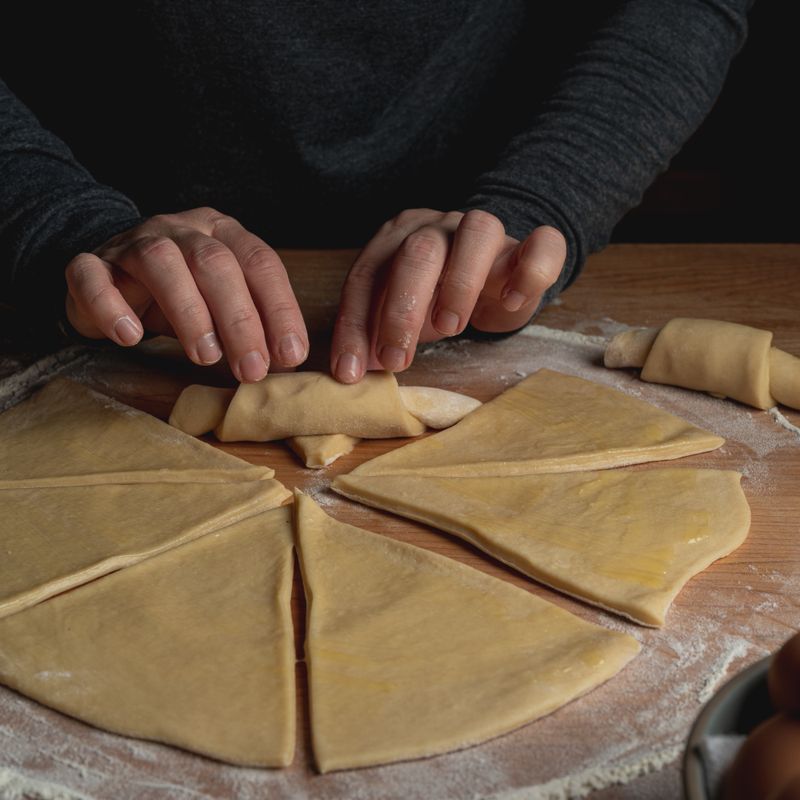
Italian Michetta Rolls
Michetta rolls are a classic Lombard specialty: hand-shaped, crusty artisan rolls with a light, open crumb and a distinctive pinched top. They're perfect for sandwiches or served alongside a meal, with a crispy exterior that yields to a tender, airy interior. This recipe uses a simple dough fermented long and slow for maximum flavor and structure.
Steps
Before you start
- Read the recipe fully—the long fermentation spans most of the time but is mostly hands-off.
- Use a kitchen scale for accuracy; baker's percentages matter here.
- Place an oven-safe bowl of water on the bottom rack before preheating to generate steam.
- Have a spray bottle of water ready for misting the rolls.
Mix the dough
- Combine 500g (3.5 cups) bread flour, 300ml (1.25 cups) room-temperature water, 1g (¼ teaspoon) instant yeast, and 9g (1.5 teaspoons) salt in a stand mixer bowl.
- Using the dough hook on medium-low speed, mix for 8–10 minutes until a shaggy, cohesive dough forms.
- The dough will be slightly sticky; do not add more flour.
- Once mixed, drizzle in 22ml (1.5 tablespoons) olive oil and mix for another 2–3 minutes until fully incorporated and smooth.
+ Show details− Hide details
Ready when: Dough is smooth, elastic, and slightly sticky to the touch
Tip: The low yeast amount and cold fermentation produce superior flavor; resist using more yeast to speed up the process.
First rise (cold fermentation)
- Transfer the dough to a lightly oiled large bowl, cover tightly with plastic wrap, and refrigerate for at least 18 hours (or up to 48 hours).
- Cold fermentation develops flavor and makes the dough easier to shape.
- The dough will rise slowly; it should increase in volume by about 25–50% but will not double.
- If you prefer a shorter timeline, you may leave the dough at room temperature (68–72°F / 20–22°C) for 6–8 hours, but refrigeration is strongly recommended.
+ Show details− Hide details
Ready when: Dough has increased in volume, feels airy, and passes the poke test (indent slowly springs back halfway)
Tip: Long cold fermentation is not just convenient—it's essential for the authentic open crumb and flavor of michetta rolls.
Turn out and divide
- Remove the dough from the refrigerator and let it sit at room temperature for 20–30 minutes.
- Dust a clean work surface lightly with flour.
- Gently tip the dough onto the surface; it will be loose and extensible.
- Divide the dough into 8 equal pieces (approximately 100g each).
- Cup your hand over each piece and drag it toward you gently 3–4 times to create surface tension, then flip seam-side down and let rest on the work surface.
+ Show details− Hide details
Ready when: Dough pieces are rounded, feel warm to the touch, and are relaxed but not flat
Tip: Handle the dough gently to preserve the gas structure that creates the open crumb; avoid degassing.
Pre-shape and rest
- Pat each dough piece into a flat oval about 4 inches (10 cm) long.
- You are not shaping the final roll yet—just relaxing and flattening the dough.
- Let the pieces rest seam-side down on the work surface for 15 minutes.
- This intermediate rest makes the final shaping easier and keeps the dough extensible.
+ Show details− Hide details
Ready when: Dough pieces are flat and feel soft and relaxed
Tip: Do not skip this rest; it prevents the dough from snapping back and tearing when you form the final shape.
Shape the michetta rolls
- Working with one piece at a time, flip it seam-side up.
- Fold the top third of the oval down toward the center, press lightly to seal, then fold the bottom third up and seal.
- You now have a roughly rectangular packet.
- Rotate it 90 degrees so the seam runs along the long axis.
- Using the heel of your hand, roll the dough away from you, sealing as you go, into a tight cylinder about 4–5 inches (10–13 cm) long.
- Place it seam-side down on a piece of parchment paper.
- Repeat with the remaining 7 pieces, spacing them about 2 inches (5 cm) apart on the parchment.
+ Show details− Hide details
Ready when: Rolls are evenly shaped, smooth on top, and held together firmly
Tip: Michetta rolls are characteristically elongated, not round; keep them oblong. Sealing the seams well prevents the crumb from being too open or collapsing during baking.
Pinch the top
- This is the signature michetta shape.
- Using the side of your hand or thumb, pinch a line down the center of each roll from one end to the other, making an indentation about ¼ inch (6 mm) deep.
- This creates the distinctive two-lobed appearance and controls how the roll opens and expands in the oven.
+ Show details− Hide details
Ready when: Each roll has a clear, centered pinch line running its length
Tip: The pinch line is not just decorative; it guides the steam escape and ensures the two lobes rise evenly.
Final proofOven 450°F / 230°C
- Transfer the rolls on their parchment to a large baking sheet or, if you have one, a proof box.
- Cover loosely with plastic wrap or a damp towel.
- Let the rolls proof at room temperature (68–72°F / 20–22°C) for 90–120 minutes.
- During this time, preheat your oven to 450°F (230°C) with a Dutch oven or covered baking vessel inside.
- Place a bowl of hot water on the bottom rack to generate steam.
+ Show details− Hide details
Ready when: Rolls are visibly puffy, feel light when lifted, and jiggle slightly when the pan is moved gently
Tip: Do not overproof; the rolls should rise noticeably but still have some tension. A too-long proof yields flat, dense rolls.
Score and bakeOven 450°F / 230°C
- Carefully transfer the rolls (still on parchment) into the preheated Dutch oven or covered baking vessel.
- Using a lame or sharp knife, score a single ¼-inch-deep slash along the pinch line of each roll, or make a small crosshatch over the top of each—this encourages the roll to open predictably.
- Spritz the rolls lightly with water using a spray bottle.
- Cover the Dutch oven and bake at 450°F (230°C) for 15 minutes.
- Remove the cover and bake for a further 10–12 minutes until the rolls are deep golden brown and sound hollow when tapped on the bottom.
+ Show details− Hide details
Ready when: Rolls are deep golden brown, crispy on top, and sound hollow when tapped; internal temperature is 205–210°F (96–99°C)
Tip: The Dutch oven traps steam in the first 15 minutes, creating the characteristic crispy crust. Do not skip this step.
Cool
- Transfer the rolls to a wire rack using tongs or a bench scraper, being careful not to deflate them.
- Let cool at room temperature for at least 20 minutes before serving.
- The rolls will continue to set and crisp as they cool.
+ Show details− Hide details
Ready when: Rolls are completely cool to the touch and are no longer steaming
Tip: Serve warm or at room temperature. Michetta rolls are best eaten the day they are baked but can be reheated.
Good to know
Tips
- Michetta rolls are all about long, cool fermentation. The 18–48 hour refrigeration is not optional; it develops the flavor and open crumb that make these rolls special. If you're in a hurry, a room-temperature rise of 6–8 hours will work, but the result will be less complex.
- The high hydration dough (60% water) is intentional and produces the open, airy crumb. If the dough feels too sticky, resist adding flour; instead, work with wet hands or use a bench scraper.
- Steam is crucial for a crispy crust. If you don't have a Dutch oven, you can create a steamy environment by pouring boiling water into a cast-iron skillet on the bottom rack just before the rolls go in, or use a bread cloche.
- The pinch line is both functional and decorative. It not only guides the rise but also makes it easy to split the rolls for sandwiches without tearing them.
- If your rolls spread too much during the final proof and lose definition, your dough was likely overproofed. Reduce the final proofing time by 15–20 minutes next time.
Make ahead
You can refrigerate the shaped, unpinched rolls on a parchment-lined tray for up to 16 hours before pinching and final proofing. Alternatively, you can freeze them: after shaping and pinching, wrap each roll individually in plastic wrap and freeze for up to 3 months. Bake directly from frozen, extending the final uncovered bake by 5–7 minutes.
Storage & reheating
Room temperature (uncovered or in a paper bag): up to 2 days. Reheat in a 375°F (190°C) oven for 8–10 minutes to restore crispness. Refrigerator: not recommended, as rolls dry out quickly. Freezer: wrap cooled rolls tightly in plastic wrap and freeze for up to 3 months; reheat from frozen in a 375°F (190°C) oven for 12–15 minutes.
Substitutions
- bread flour → all-purpose flour. The rolls will be slightly less chewy and have a less open crumb, but they will still be very good. Reduce the water slightly (to 280ml / 1.2 cups) if using all-purpose flour, as it absorbs less water than bread flour.
- instant (bread) yeast → active dry yeast or fresh yeast. Use 1.5g (½ teaspoon) active dry yeast or 3g (about 1 teaspoon) fresh compressed yeast. Instant yeast ferments slightly faster, so active dry may require an extra 30 minutes during cold fermentation.
- extra-virgin olive oil → neutral oil (vegetable, canola, or sunflower oil). The rolls will be less flavorful but still excellent. Use the same amount.
- water → milk or milk + water (1:1 blend). This will add richness and slightly soften the crust, making the rolls closer to dinner rolls. Use the same volume.
More rolls & buns
See all →

Find more like this
- Meal
- Lunch
- Cuisine
- Italian
- Method
- Oven
- Quick & Easy
- 5 Ingredients or Less