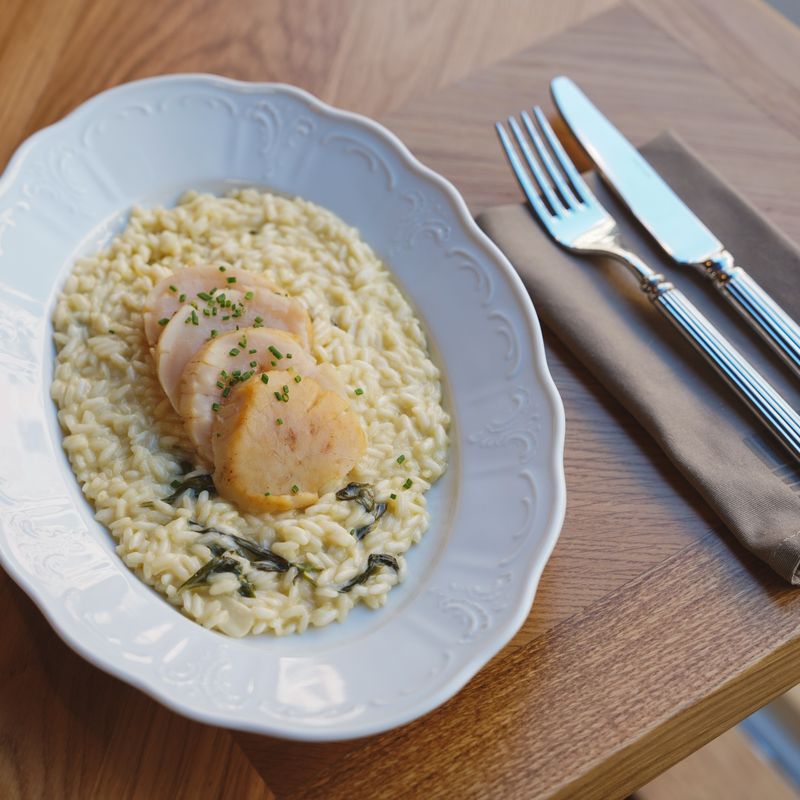
Italian Arborio Asparagus Saffron Risotto
A silky, saffron-infused risotto with tender asparagus spears and creamy Arborio rice, finished with Parmesan cheese. This elegant Northern Italian dish requires constant attention but rewards you with luxurious, restaurant-quality results in under 30 minutes.
- Prep
- 10 min
- Cook
- 20 min
- Wait
- 5 min
- Total
- 35 min
- Makes
- 4 servings (about 1½ cups each)
Steps
Before you start
- Bring the vegetable broth to a gentle simmer in a separate pot and keep it hot throughout cooking—cold broth will stop the rice from cooking evenly.
- Measure out the saffron threads and steep them in 2 tablespoons of the warm broth while you prepare other ingredients.
- Cut asparagus into 1½-inch pieces, keeping tips separate from the thicker stem pieces so they cook evenly.
- Have all ingredients measured and within arm's reach; risotto cooking cannot pause for preparation.
Steep the saffron
- Pour 2 tablespoons (30 ml) of warm vegetable broth into a small bowl.
- Add the crushed saffron threads and set aside for at least 5 minutes—this releases the color and flavor into the liquid.
- The broth will turn a deep golden-yellow.
+ Show details− Hide details
Ready when: Broth is golden-yellow and fragrant
Tip: Do not skip the steeping step; it unlocks the saffron's distinctive earthy flavor and vibrant color.
Sauté the aromatics
- Melt 1 tablespoon (15 g) of butter in a large heavy-bottomed saucepan over medium heat.
- Add the diced onion and cook, stirring frequently, for 3–4 minutes until softened and fragrant.
- The onion should be translucent but not browned.
+ Show details− Hide details
Ready when: Onion is soft, translucent, and fragrant
Tip: Keep heat at medium; too high and the onion will brown instead of soften, affecting the risotto's delicate flavor.
Toast the rice
- Add the Arborio rice to the saucepan with the cooked onion.
- Stir constantly for 2 minutes, coating all the grains with the butter.
- The rice should look slightly translucent at the edges while remaining opaque in the center (this is called the "nutty" stage).
- You'll hear a gentle clicking sound as you stir.
+ Show details− Hide details
Ready when: Rice grains are translucent at edges, opaque at center; audible clicking when stirred
Tip: Do not skip toasting the rice—it seals the starch inside and creates the creamy texture. Do not brown it.
Deglaze with wine
- Pour the dry white wine into the rice and stir constantly for 1 minute.
- The wine will bubble and steam.
- Continue stirring until the rice has absorbed nearly all the liquid, then the pan will smell dry and you'll see the rice moving freely at the bottom without pooling liquid.
+ Show details− Hide details
Ready when: Rice grains are exposed, pan smells dry, no pooling liquid
Tip: Keep the heat steady; the wine's alcohol burns off, leaving its acidic sweetness to flavor the rice.
Begin broth additions
- Add 1 cup (240 ml) of the simmering broth to the rice.
- Stir occasionally but not constantly—every 15–20 seconds or so—for 3–4 minutes.
- The rice will gradually absorb the broth; when it looks like a porridge, add another 1 cup (240 ml) of broth.
- Continue this process, adding broth in 1-cup portions every 3–4 minutes, stirring regularly throughout.
+ Show details− Hide details
Ready when: Each addition of broth is absorbed by the rice within a few minutes; rice is creamy but not mushy
Tip: Never let the rice sit dry between additions. The stirring creates friction that helps release the rice's starch, which makes the risotto creamy—this cannot be rushed or skipped.
Add saffron broth and asparagus
- When you have about 1 cup (240 ml) of broth left, pour in the steeped saffron broth and stir well to distribute the saffron throughout.
- At the same time, add the thicker asparagus stem pieces and stir to combine.
- Continue cooking and stirring for 2 minutes.
- Then add the reserved asparagus tips and the remaining 1 cup (240 ml) of plain broth.
- Stir frequently.
+ Show details− Hide details
Ready when: Saffron color is evenly distributed; asparagus is bright green and tender-crisp
Tip: Add asparagus tips last so they stay tender and don't overcook. Stir constantly in this final stage to monitor doneness.
Finish and serve
- When the risotto looks creamy and the rice grains are tender but still have a very slight firmness (al dente), remove from heat.
- This should take about 18–20 minutes total from when you started adding broth.
- Stir in the remaining 1 tablespoon (15 g) of cold butter and the grated Parmigiano-Reggiano cheese.
- Season generously with sea salt and freshly ground black pepper to taste.
- Taste and adjust seasoning.
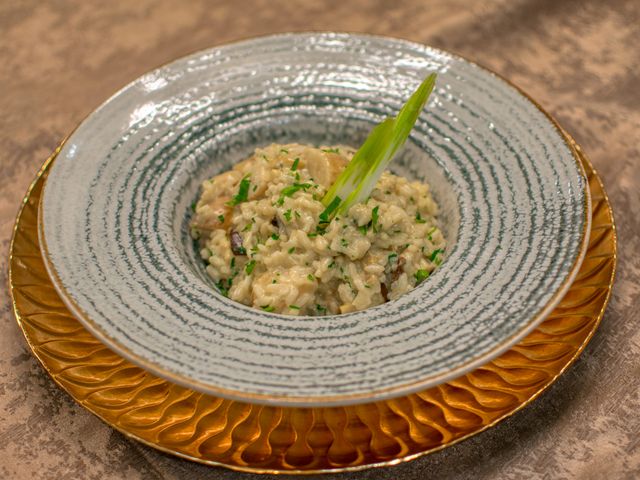
- The risotto should flow slightly on the plate (not stiff), with a luxurious, creamy consistency.
- Serve immediately in warm bowls, garnished with torn basil if desired.
+ Show details− Hide details
Ready when: Rice is al dente (tender with slight firmness); risotto flows on the plate; saffron is evenly distributed
Tip: Add the cold butter and cheese off the heat in a technique called mantecatura—this cools the risotto slightly so the cheese and butter create creaminess without clumping. Serve immediately; risotto does not hold well.
Rest brieflyOven 200°F / 95°C
- While the risotto finishes, warm four shallow bowls in a low oven (200°F / 93°C) or by running them under hot water and drying them.
- This keeps the risotto at serving temperature longer.
+ Show details− Hide details
Ready when: Bowls are hot to the touch
Good to know
Tips
- Risotto demands your attention and constant gentle stirring—this is not a set-it-and-forget-it dish. The frequent stirring is what creates the creamy texture by releasing the rice's natural starch. Avoid the temptation to rush or skip steps.
- Keep the broth at a gentle simmer the entire time, not boiling. Boiling broth cooks the rice too fast on the outside while the inside stays hard, preventing the creamy fusion you're after.
- The rice is done when each grain is tender to bite but still has a whisper of firmness at the core (al dente). Overcooked risotto becomes mushy and loses its texture. Taste frequently in the final minutes.
- Mantecatura—the final vigorous stirring with cold butter and cheese off the heat—is what transforms risotto from nice rice into silky luxury. Do not skip this step and do not add the cheese while still on heat, or it will clump.
Storage & reheating
Risotto is best served immediately. Leftover risotto may be refrigerated in an airtight container for up to 2 days. To reheat, place in a saucepan over medium heat with a splash of warm broth or water, stirring frequently until warmed through and creamy again (about 5–7 minutes). The texture will not be quite as silky as fresh risotto, but it remains delicious. Do not freeze risotto; the texture breaks down irreversibly.
Substitutions
- saffron threads → ½ teaspoon of turmeric or a pinch of annatto (achiote) powder. These provide color and a subtle warmth, but lack saffron's distinctive floral, earthy flavor. The result will be pleasant but noticeably different. Do not use food coloring alone.
- fresh asparagus spears → 1 pound (450 g) of fresh green peas, fava beans, or a mix of spring vegetables (peas, snap peas, green beans). These maintain the bright, spring-like character of the dish. Cook similarly, adding firmer vegetables earlier and tender ones toward the end.
- dry white wine → 4 ounces (120 ml) of dry vermouth or ¼ cup (60 ml) of white wine mixed with ¼ cup (60 ml) of vegetable broth. Vermouth adds herbal notes; the broth mixture works but provides less acidity. Omitting wine entirely is not recommended as it adds essential flavor.
- Parmigiano-Reggiano cheese, finely grated → Grana Padano cheese or a blend of Pecorino Romano (¼ cup) and Asiago (½ cup). Grana Padano is nearly identical in flavor and texture. Pecorino adds saltiness and sharpness, so reduce added salt and use less cheese (¾ cup total) when substituting.