
Instant Pot Sourdough Cassoulet with Crusty Bread Lid
A modern take on the French classic cassoulet, made faster in an Instant Pot and topped with a golden sourdough crust. Tender white beans, duck confit, and spiced sausage simmer together until the flavors meld, then the pot is finished under the broiler with a sourdough bread lid that bakes into a savory crown. The sourdough starter adds depth and tang that complements the rich, slow-cooked flavors traditionally achieved over hours.
- Prep
- 25 min
- Cook
- 55 min
- Wait
- 45 min
- Total
- 2 hr 5 min
- Makes
- 6 servings (about 8 cups cassoulet, 1 sourdough lid)
Steps
Before you start
- Have sourdough starter at room temperature and fed (bubbly and active) for at least 4–6 hours before starting
- If using canned white beans, drain and rinse them; if using dried, soak overnight and drain
- Have duck confit prepared ahead (store-bought is fine), or use leftover roasted duck
- Preheat your oven to 425°F (220°C) for the sourdough lid about 15 minutes before you finish the cassoulet
Sear the sausage
- Set the Instant Pot to the sauté function on high heat.
- Add 1 tbsp olive oil.
- Once hot, add the sausage chunks and cook for 4–5 minutes, breaking them up slightly with a wooden spoon, until the exterior is browned but the inside remains pink (they'll finish cooking in the pressure cooker).
- Transfer to a plate and set aside.
- Leave the rendered fat in the pot.
+ Show details− Hide details
Ready when: Sausage is browned on the outside but still pink inside; fat is rendered
Tip: Don't cook the sausage through—it will finish cooking under pressure. Browning it adds flavor and helps it hold its shape.
Build the sauce base
- To the same pot, add the remaining 1 tbsp olive oil.
- Add the diced onion and carrots, and sauté on high heat for 3 minutes, stirring occasionally, until the vegetables soften slightly and release their aromatics.
- Add the minced garlic and cook for 30 seconds until fragrant.
- Stir in the tomato paste and cook for 1 minute to caramelize it slightly.
+ Show details− Hide details
Ready when: Vegetables are softened and fragrant, tomato paste has darkened
Tip: Caramelizing the tomato paste develops deeper, savory flavors that mimic long, slow cooking.
Deglaze and add stock
- Pour in the white wine, scraping the bottom of the pot with a wooden spoon to release any browned bits (fond).
- Let it simmer for 1–2 minutes.
- Add the chicken stock, white beans, reserved browned sausage, and the shredded duck confit.
- Stir well to combine.
+ Show details− Hide details
Ready when: Fond is fully dissolved, all ingredients are submerged in liquid
Tip: Don't skip the deglazing—those stuck-on bits contain intense, concentrated flavors.
Add herbs and season
- Tuck the thyme sprigs and bay leaves into the mixture.
- Season with 1 tsp kosher salt and ½ tsp black pepper (you'll taste and adjust after pressure cooking).
- Turn off sauté mode and cancel any pending function.
+ Show details− Hide details
Ready when: Herbs are submerged, seasoning is evenly dispersed
Tip: Taste after pressure cooking because salt absorption varies; you may need more or less.
Pressure cook the cassoulet
- Secure the lid and set the pot to high pressure for 20 minutes.
- The pot will take about 8–10 minutes to come to pressure (don't open it).
- Once the timer beeps, let the pressure release naturally for 10 minutes, then carefully perform a quick release to vent any remaining steam.
- Remove the lid, tilting it away from you, and stir.
- Taste and adjust salt and pepper.
- Remove and discard the thyme sprigs and bay leaves.
- The sausage should register at least 160°F (71°C) when tested with an instant-read thermometer inserted into the thickest piece, and the duck should reach at least 165°F (74°C).
+ Show details− Hide details
Ready when: Beans are very tender and break easily under a spoon; sausage registers 160°F (71°C) and duck reaches 165°F (74°C); liquid has reduced slightly
Tip: Natural release is gentler on the beans and prevents them from bursting. If you're short on time, a 5-minute natural release followed by quick release is acceptable.
Make the sourdough lid dough
- While the cassoulet is cooking, combine the sourdough starter, bread flour, room-temperature water, and salt in a large mixing bowl.
- Mix with a wooden spoon until a shaggy dough forms (it will be slightly sticky).
- Knead gently by hand in the bowl for 2 minutes—don't overwork it; the gluten structure will develop during resting.
- Cover with a damp kitchen towel and let it rest for 15 minutes at room temperature.
+ Show details− Hide details
Ready when: Dough is cohesive, slightly tacky but not sticky, and has relaxed
Tip: A slack dough is easier to work with than a stiff one. Don't be afraid of a wetter dough—it will produce a more open crumb.
Shape and proof the lid
- Lightly flour a baking sheet.
- Turn the dough out onto a lightly floured surface and shape it into a round or oval roughly 8–9 inches (20–23 cm) across and about ½ inch (1.3 cm) thick—it should roughly fit the opening of your Instant Pot or be large enough to rest on the rim of an oven-safe dish.
- Place it on the floured baking sheet and cover loosely with a damp towel.
- Let it proof for 15 minutes at room temperature while the cassoulet finishes cooking.
- The dough should puff slightly and feel airy to the touch.
+ Show details− Hide details
Ready when: Dough has risen slightly, feels airy, and springs back slowly when poked
Tip: A short proof is fine here because the dough will puff more in the oven. If it over-proofs, it may deflate when you dock it.
Transfer cassoulet to baking dishOven 425°F / 220°C
- Once the cassoulet has finished cooking and the pressure is released, preheat your oven to 425°F (220°C).
- Carefully transfer the cassoulet (including all liquid and solids) from the Instant Pot to a 9×13-inch (23×33 cm) or similar oven-safe baking dish.
- The cassoulet should fill the dish about two-thirds full.
- If there's excess liquid, leave it—the bread will absorb some of it.
+ Show details− Hide details
Ready when: Cassoulet is fully transferred without spilling; oven is preheated
Tip: Use a slotted spoon if you prefer less liquid on top, or keep all the braising liquid for extra moisture and richness.
Dock and brush the dough
- Brush the top of the proofed dough round with duck fat (or olive oil).
- Using a sharp knife or fork, lightly score or dock the surface with shallow cuts or prick marks—this prevents large steam bubbles from forming and creates an even bake.
- Gently place the dough round directly onto the hot cassoulet, centering it as best you can.
- It's okay if it's slightly uneven; it will stretch as it bakes.
+ Show details− Hide details
Ready when: Dough is brushed, scored, and resting on top of the cassoulet
Tip: Dock the dough to control how it puffs. Without docking, a large dome can form and block heat from reaching the cassoulet below.
Bake until goldenOven 425°F / 220°C
- Place the baking dish in the preheated 425°F (220°C) oven for 20–25 minutes.
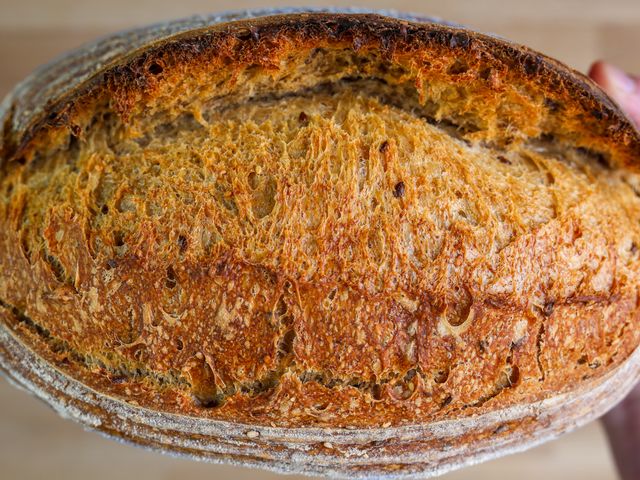
- The sourdough lid should puff, turn deep golden brown, and feel firm to the touch.
- The edges of the cassoulet around the bread will bubble gently, and you should see steam rising.
- If the bread is browning too quickly, tent it loosely with aluminum foil for the last 5 minutes.
- The internal temperature of the bread should reach 205–210°F (96–99°C) at the thickest point when measured with an instant-read thermometer.
+ Show details− Hide details
Ready when: Bread is deep golden brown, firm to the touch, and registers 205–210°F (96–99°C) internally
Tip: The sourdough lid won't have the dark crust of a traditional loaf because it's steaming in the cassoulet—that's intentional. It should be golden and sturdy enough to cut.
Rest and finish
- Remove the cassoulet from the oven and let it rest for 5 minutes before serving.
- This allows the bread to set and the cassoulet to settle slightly.
- If desired, sprinkle a pinch of fleur de sel over the bread.
- Serve directly from the baking dish, breaking off pieces of the sourdough lid and serving them with the cassoulet.
+ Show details− Hide details
Ready when: Bread is cool enough to touch and cut cleanly
Tip: Serve the cassoulet while it's still warm. The bread lid will soften as it cools, so don't delay.
Good to know
Tips
- Plan ahead: the sourdough starter should be fed and bubbly at least 4–6 hours before you begin. A thin, sluggish starter will produce a dense bread lid.
- The ratio of cassoulet to bread is important. Too much bread and it becomes a bread casserole; too little and the lid is fragile. The dough round should rest on top and nestle slightly into the beans.
- Don't skip the natural pressure release step. It prevents the beans from breaking apart and keeps them creamy rather than mushy.
- Sourdough doughs benefit from high hydration (a wet, sticky dough). This one is intentionally slack to mimic a rustic, open crumb—resist the urge to add extra flour.
Make ahead
Prepare the cassoulet (steps 1–5) up to 2 days ahead and refrigerate in an airtight container. Reheat in a 350°F (175°C) oven for 15–20 minutes, then proceed with the sourdough lid (steps 6–10). Alternatively, prepare the sourdough dough 4 hours ahead, refrigerate it, and let it come to room temperature before shaping and proofing.
Storage & reheating
Store the cooled cassoulet (without the bread lid) in an airtight container in the refrigerator for up to 4 days. Reheat gently in a 350°F (175°C) oven or on the stovetop over low heat until steaming. The sourdough lid is best eaten fresh but can be wrapped in foil and reheated at 350°F (175°C) for 10 minutes if needed. The cassoulet freezes well for up to 3 months; thaw overnight in the refrigerator and reheat as above. Do not freeze the sourdough lid; bake it fresh instead.
Substitutions
- duck confit, thighs and legs, shredded (or roasted duck) → Roasted chicken thighs, leftover roasted duck, or even pulled pork. Any tender, rich, slow-cooked meat works. Adjust salt if using pork, which may be less salty than duck. Ensure all poultry reaches 165°F (74°C) and pork reaches 145°F (63°C).
- fresh pork sausage, preferably with herbs (fennel or thyme) → Toulouse sausage, Polish kielbasa, or ground pork mixed with herbs and fennel seed. Choose a sausage with herbal notes (thyme, sage, or fennel) to complement the cassoulet. Remove casings if using link sausages. Ensure pork sausage reaches 160°F (71°C).
- canned white beans (cannellini or great northern), drained and rinsed → Dried beans (soak overnight, then drain; use 2 cups dried, which yields about 4 cups cooked) or other beans such as haricot vert or cannellini. If using dried beans, increase Instant Pot cooking time to 30 minutes on high pressure.
- active sourdough starter, unfed → ½ cup whole wheat starter, or use 1 cup store-bought dough (thawed if frozen) and skip the water, salt, and flour in the bread lid. A 100%-hydration starter (equal parts flour and water by weight) works best. If your starter is thicker, reduce water slightly.
More casseroles
See all →




Find more like this
- Meal
- Dinner
- Cuisine
- French
- Main ingredient
- White BeansSausage
- Method
- OvenInstant Pot
- Quick & Easy
- Make AheadFreezer Friendly