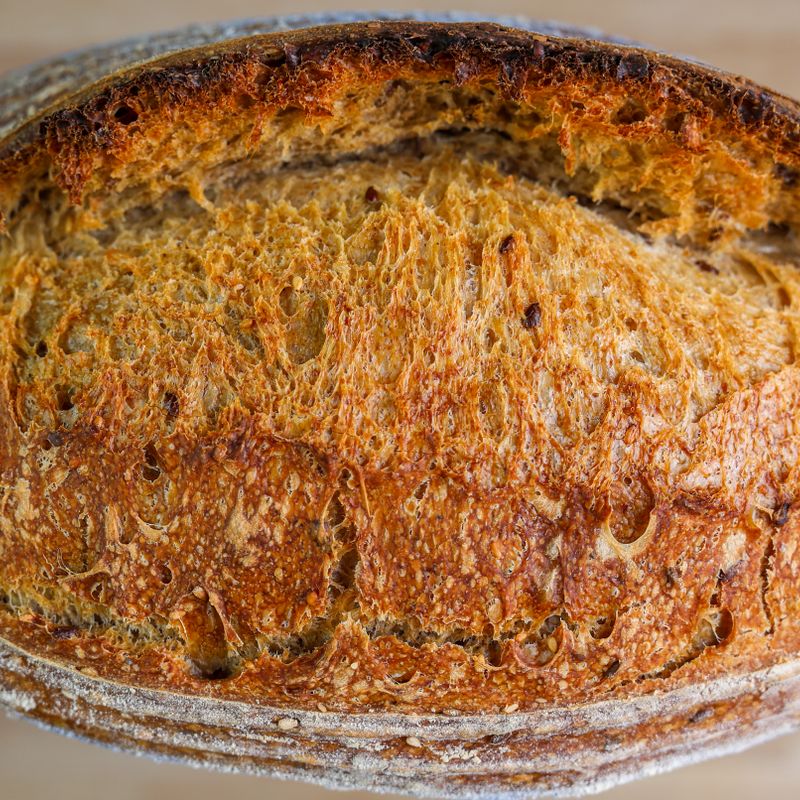
Slow Cooker Sourdough Discard Vegetable Ragù with Polenta Crust
A rustic Italian-inspired vegetable ragù built on sourdough discard for tangy depth and body, slow-cooked until the eggplant and zucchini collapse into a rich sauce, then crowned with a baked polenta crust. The sourdough adds subtle fermented complexity that makes this humble dish feel layered and sophisticated.
- Prep
- 20 min
- Cook
- 45 min
- Wait
- 8 hr
- Total
- 9 hr 5 min
- Makes
- 4 servings (about 2 cups ragù per person with polenta crust)
Steps
Before you start
- Ensure sourdough discard is at room temperature and fed 2–4 hours prior (active and bubbly)
- Preheat oven to 400°F (200°C) for the polenta crust bake
- Dice eggplant and zucchini into ¾-inch cubes and salt lightly 15 minutes ahead to draw out moisture
- Have a 9×13-inch (23×33 cm) or similar baking dish ready for assembly
Prepare vegetables for slow cooker
- Pat the salted, drained eggplant cubes dry with paper towels.
- In a large bowl, combine the dried eggplant, zucchini cubes, diced onion, and minced garlic.
- Drizzle with 3 tablespoons (45 ml) olive oil, tossing gently to coat.
- Season lightly with salt and black pepper.
+ Show details− Hide details
Ready when: Vegetables are evenly coated with oil and well combined
Tip: Drying the eggplant prevents it from releasing excess water into the ragù, keeping the sauce concentrated and flavorful.
Build ragù in slow cooker
- Transfer the vegetable mixture to a 5–6 quart slow cooker.
- Add the canned crushed tomatoes, tomato paste, vegetable broth, sourdough discard, dried oregano, dried thyme, bay leaf, and red pepper flakes (if using).
- Stir well to distribute the sourdough evenly—it will break down and thicken the ragù as it cooks.
- Season with a pinch of salt and black pepper.
+ Show details− Hide details
Ready when: Ragù is evenly mixed with no dry pockets of sourdough visible
Tip: Stir the sourdough in thoroughly so it distributes evenly and adds subtle fermented flavor throughout, rather than clumping in spots.
Slow cook the ragù
- Cover the slow cooker and cook on LOW for 8 hours, or on HIGH for 4–5 hours.
- The ragù is ready when the eggplant is completely tender and the sauce has thickened slightly, with the vegetables breaking down into a cohesive stew.
- The sourdough will have largely dissolved, adding body and a subtle tanginess.
- Taste and adjust salt and black pepper as needed.
- Remove and discard the bay leaf.
+ Show details− Hide details
Ready when: Eggplant is very tender and collapses easily; sauce coats the back of a spoon
Tip: Low and slow cooking allows the sourdough's fermented tang to integrate gently. Cooking on HIGH will make the finish time faster but may result in less developed flavor.
Prepare polenta
- About 45 minutes before serving, bring 4 cups (960 ml) water to a boil in a medium saucepan.
- Slowly whisk in 1 cup (240 ml) polenta in a thin stream while stirring constantly to prevent lumps.
- Reduce heat to medium-low and simmer, stirring frequently, for 25–30 minutes until the polenta is very thick, creamy, and pulls away from the sides of the pan.
- It should have the texture of thick mashed potatoes.
+ Show details− Hide details
Ready when: Polenta is thick, creamy, and pulls away slightly from the pan sides when stirred
Tip: Whisk slowly to avoid lumps. Stir often to prevent sticking and burning on the bottom, especially toward the end.
Finish polenta and prepare for baking
- Remove the polenta from heat.
- Stir in 4 tablespoons (57 g) cold butter, broken into small pieces, and 0.75 cup (75 g) finely grated Parmigiano-Reggiano cheese.
- Season to taste with salt and black pepper.
- The polenta should be smooth and creamy.
+ Show details− Hide details
Ready when: Cheese and butter are melted and fully incorporated into creamy polenta
Tip: Stir in the butter and cheese immediately while the polenta is hot so they melt smoothly and add richness.
Assemble in baking dishOven 400°F / 205°C
- Preheat the oven to 400°F (200°C) if not already done.
- Pour the hot ragù from the slow cooker into a 9×13-inch (23×33 cm) baking dish (or similar 3–4 quart capacity).
- Spread the polenta evenly over the ragù in a single layer, using the back of a spoon or an offset spatula to create a roughly ½-inch (1 cm) thick layer that covers as much of the ragù as possible.
- Leave a thin edge showing the ragù underneath for visual contrast.
+ Show details− Hide details
Ready when: Polenta is spread evenly and covers most of the ragù
Tip: Spread the polenta while both the ragù and polenta are hot—this helps them marry slightly and prevents separation.
Bake the polenta crustOven 400°F / 205°C
- Place the baking dish in the preheated 400°F (200°C) oven and bake for 12–15 minutes until the top of the polenta is lightly golden and set, with the edges beginning to crisp slightly.
- The ragù should just begin to bubble around the edges.
+ Show details− Hide details
Ready when: Polenta top is light golden brown and springs back when lightly touched; ragù bubbles at edges
Tip: Watch carefully—the polenta crust firms up quickly. If it browns too fast, tent with foil to prevent over-browning.
Rest and serve
- Remove from the oven and let rest for 5 minutes before serving.
- This allows the ragù to set slightly and makes it easier to portion neatly.
- Spoon into bowls or onto plates, taking care to get both the polenta crust and the ragù in each serving.
+ Show details− Hide details
Ready when: Ragù has set enough that it doesn't run excessively when spooned
Tip: A 5-minute rest makes the difference between a runny dish and one that holds its shape on the plate.
Good to know
Tips
- Sourdough discard is the star here: use discard that's active and bubbly, fed 2–4 hours ahead. As it cooks slowly, it dissolves and adds a subtle tangy depth that bridges the bright tomatoes and earthy vegetables. Store-bought starters or unfed starter won't provide the same rise and flavor.
- Salt the eggplant cubes 15 minutes before cooking. This draws out excess water so the ragù stays thick and concentrated rather than watery. Pat them dry before adding to the slow cooker.
- The polenta crust can be made while the ragù cooks—time the polenta so it finishes just as you're ready to assemble. You have a 5–10 minute window of leeway if timing is tight.
- For a vegetable-forward meal, serve with crusty bread, a simple green salad dressed with red wine vinegar and olive oil, or alongside wilted greens like spinach or lacinato kale.
Make ahead
Prepare the ragù mixture (Step 2) up to 12 hours ahead and refrigerate in the slow cooker bowl covered. In the morning, place the cold bowl in the slow cooker insert and cook on LOW for 8–9 hours (cooking time may be slightly longer from cold). The polenta must be made fresh within 1 hour of serving.
Storage & reheating
Refrigerate the finished dish (or just the ragù, without the polenta crust) in an airtight container for up to 4 days. Reheat gently on the stovetop over medium-low heat, stirring occasionally, until warmed through (about 10 minutes). The polenta crust may soften upon reheating; if desired, remove it and top with fresh polenta or crusty bread. The ragù alone freezes well for up to 3 months; thaw overnight in the refrigerator and reheat as above.
Substitutions
- sourdough starter discard, active and bubbly → active all-purpose flour starter (unfed sourdough starter). Use the same volume (1 cup) to maintain the fermented tang and thickening effect. If using a less active starter, increase to 1.25 cups and reduce vegetable broth slightly to compensate for extra liquid.
- polenta (cornmeal) → cornmeal (polenta cornmeal), store-bought instant polenta, or finely ground cornmeal. Instant polenta cooks in 5–10 minutes instead of 25–30 minutes, reducing active cooking time. Follow package instructions; the final texture should be thick and creamy.
- Parmigiano-Reggiano cheese → Grana Padano or aged Pecorino Romano (use half the amount for the latter, as it is sharper). Both provide similar richness and saltiness. Pecorino will add a brighter, more assertive cheese flavor.
- canned crushed tomatoes → fresh tomatoes, chopped and simmered, or a combination of canned diced and tomato sauce. Use about 3 cups (720 ml) fresh tomato pulp (from about 2 lbs/900 g fresh tomatoes) or 1.5 cups (360 ml) diced canned tomatoes plus 1 cup (240 ml) tomato sauce. Fresh tomato season is ideal; canned works year-round.
More casseroles
See all →
Find more like this
- Meal
- Dinner
- Cuisine
- Italian
- Method
- OvenSlow Cooker
- Quick & Easy
- Make Ahead