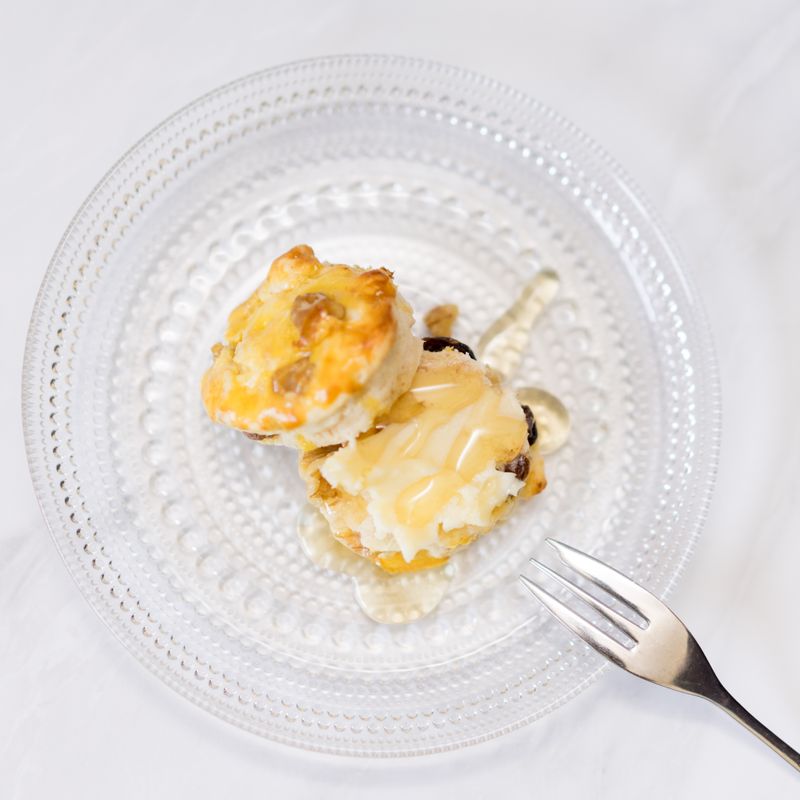
Honey Butter Biscuits with Salt
Tender, drop-style biscuits enriched with honey and butter, with a subtle kiss of sea salt that enhances the sweetness. These biscuits are quick to make—no rolling or cutting required—and deliver a delicate crumb with crispy edges and a warm, buttery interior. Finish with a honey-butter glaze and fleur de sel for an elegant touch.
Steps
Before you start
- Preheat oven to 400°F (200°C) for 10 minutes
- Cut cold butter into ½-inch cubes and keep chilled
- Line a baking sheet with parchment paper
- Have all ingredients measured and ready
Mix dry ingredients
- In a large mixing bowl, whisk together 2 cups (250 g) flour, 1 tablespoon (15 g) baking powder, and ¾ teaspoon (5 g) kosher salt.
- Stir for about 30 seconds to combine evenly and aerate the flour.
+ Show details− Hide details
Ready when: mixture is uniform and pale
Tip: Sifting the flour before measuring ensures lighter biscuits; if you don't have a sifter, fluff the flour in its container and scoop gently into the measuring cup.
Cut in butter
- Add the 6 tablespoons (85 g) cold butter cubes to the dry mixture.
- Using a fork or pastry cutter, quickly break down the butter into pea-sized pieces, working gently for about 2 minutes.
- Do not overmix; some small butter pieces should remain visible.
- The mixture should feel crumbly and cool to the touch.
+ Show details− Hide details
Ready when: mixture resembles coarse breadcrumbs with pea-sized butter visible
Tip: If the butter starts to soften or the mixture feels warm, refrigerate for 5 minutes before continuing. Visible butter pieces steam during baking, creating flaky layers.
Add liquid ingredients
- Pour 3 tablespoons (45 ml) honey and ¾ cup (180 ml) cold buttermilk into the flour-butter mixture.
- Stir gently with a fork or wooden spoon, folding the wet ingredients into the dry until a soft, shaggy dough just forms.
- Do not overmix; a few floury streaks are fine.
- This should take about 1 minute of gentle stirring.
+ Show details− Hide details
Ready when: dough is wet and clumpy, with slight floury streaks remaining
Tip: Overmixing toughens the biscuits. Stop stirring the moment there are no large patches of dry flour; the dough will look messy and that is correct.
Drop biscuits onto sheet
- Using a spoon or small offset spatula, drop roughly 2-tablespoon (30 ml) portions of batter onto the prepared parchment-lined baking sheet, spacing them about 2 inches apart.
- You should have 12 biscuits.
- The dough pieces will be wet and irregular; do not smooth them out.
- If your fingers get sticky, dip them in water between drops.
+ Show details− Hide details
Ready when: 12 biscuit portions are on the sheet, roughly 2 tablespoons each
Tip: Drop biscuits are intentionally lumpy and irregular—this creates rustic texture and crispy edges. Avoid using a cookie scoop, which would compress the dough.
Bake until goldenOven 400°F / 205°C
- Place the baking sheet in the preheated 400°F (200°C) oven.
- Bake for 12–14 minutes, until the biscuits are deep golden brown on top and firm to the touch at the edges.
- The centers may still feel slightly soft.
- The biscuits will have risen and spread slightly.
+ Show details− Hide details
Ready when: tops are deep golden brown, edges are firm, and biscuits have spread and risen
Tip: If your oven runs hot, check at 11 minutes. Overbaking dries them out, so watch for golden color rather than a longer time.
Cool briefly and glaze
- Remove the baking sheet from the oven and let the biscuits rest for 2 minutes on the pan.
- While they cool slightly, whisk together 2 tablespoons (28 g) melted butter and 1 tablespoon (15 ml) honey in a small bowl until combined.
- Brush the warm biscuits generously with the honey-butter glaze using a pastry brush or the back of a spoon.
+ Show details− Hide details
Ready when: glaze is absorbed into the warm biscuits and glistens
Tip: Glaze the biscuits while they are still warm so the honey-butter soaks in and caramelizes slightly. Letting them cool completely makes the glaze sit on top rather than penetrate.
Finish with sea salt
- If using fleur de sel or finishing sea salt, sprinkle ¼ teaspoon (2 g) over the warm glazed biscuits.
- The salt crystals will adhere to the honey-butter and provide a subtle contrast to the sweetness.
- Let the biscuits cool for at least 1 minute more on the pan before transferring to a wire rack or serving warm.
+ Show details− Hide details
Ready when: sea salt is sprinkled evenly and adhered to the glaze
Tip: Fleur de sel provides a delicate, mineral finish; regular table salt will taste harsh by comparison. If you don't have fleur de sel, finish sea salt is the next best choice.
Good to know
Tips
- Keep all ingredients—especially butter and buttermilk—cold for the flakiest biscuits.
- The batter will look wet and unpromising; this is correct and results in tender, moist biscuits.
- These biscuits are best eaten warm, within a few hours of baking, when the honey butter glaze is still soft.
- For extra richness, brush the biscuits with additional honey-butter before serving.
Storage & reheating
Store in an airtight container at room temperature for up to 2 days. For longer storage, freeze in a freezer bag for up to 1 month. To reheat, wrap in foil and warm in a 300°F (150°C) oven for 8–10 minutes until heated through. Do not microwave, as the biscuits will become rubbery.
Substitutions
- buttermilk, cold → plain Greek yogurt mixed with milk (½ cup / 120 ml yogurt plus ¼ cup / 60 ml milk). Provides similar tang and structure; yogurt adds richness
- honey → maple syrup or agave nectar. Use the same amount; maple will add a distinct flavor, agave is more neutral
- all-purpose flour → pastry flour (2 cups / 240 g). Lower protein content yields even more tender crumb; reduce baking powder to 2 teaspoons if using
- fleur de sel or sea salt → Maldon salt or any coarse finishing sea salt. Any finishing salt works; avoid fine table salt, which will taste too salty
More scones & biscuits
See all →


Find more like this
- Meal
- Breakfast
- Diet
- VegetarianHalal
- Method
- Oven
- Quick & Easy
- Easy