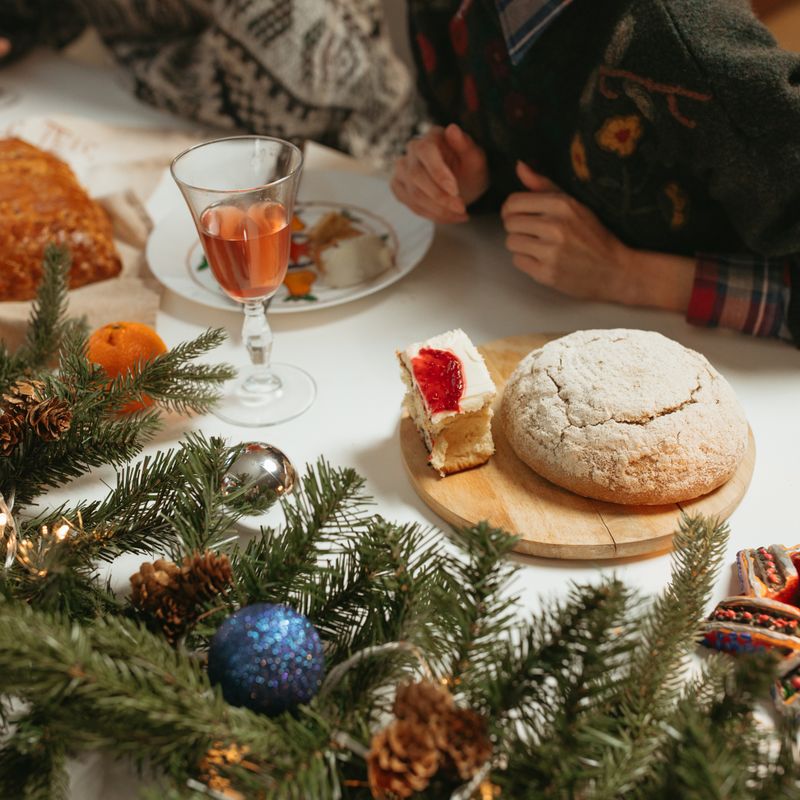
Holiday Sourdough Roasted Chestnut and Sage Dinner Roll Ring
A stunning ring of pull-apart sourdough dinner rolls infused with roasted chestnuts, crispy sage leaves, and brown butter. The rolls rise on their own overnight, making this an elegant holiday centerpiece that's surprisingly hands-off. Serve warm with more sage brown butter for dipping.
- Prep
- 30 min
- Cook
- 25 min
- Wait
- 10 hr
- Total
- 10 hr 55 min
- Makes
- 1 ring (8 large pull-apart rolls)
Steps
Before you start
- Have active sourdough starter at room temperature (fed 4–8 hours prior, bubbly and doubled)
- Roast and cool the chestnuts at least 2 hours ahead (or buy roasted ones)
- Line a 10-inch (25 cm) round cake pan or springform with parchment; lightly oil it
- Have all ingredients measured and at room temperature
Mix and knead the dough
- In a large bowl, combine sourdough starter, bread flour, water, and salt.
- Stir with a wet hand or wooden spoon for 2–3 minutes until all flour is hydrated and a shaggy dough forms.
- If using a stand mixer, use the dough hook on medium speed for 4 minutes.
- The dough will be sticky; don't add more flour.
- Let it rest uncovered at room temperature for 20 minutes.
+ Show details− Hide details
Ready when: Dough is shaggy and holds together; all flour is wet
Tip: Sticky dough is correct for sourdough—resist the urge to add flour
Build brown butter filling
- While dough rests, place 0.5 cup (115 g) unsalted butter in a small saucepan over medium heat.
- Swirl occasionally (don't stir) and watch closely.
- After 5–7 minutes, the butter will foam and solids will sink and turn golden brown.
- You'll smell a rich, nutty aroma.
- Pour into a small bowl to stop cooking, leaving any burnt bits behind.
- Stir in the finely chopped sage leaves.
- Let cool to room temperature (about 15 minutes), then set aside.
- The brown butter will solidify slightly as it cools.
+ Show details− Hide details
Ready when: Butter is deep golden brown with a nutty smell; solids are tan, not black
Tip: Brown butter can burn quickly—keep your eyes on it. If it smells burnt, start over
Laminate dough with cold butter
- After the 20-minute rest, stretch and fold the dough: wet your hand, grab one side of the dough, stretch it up and fold it over the top.
- Repeat on all four sides (4 folds total).
- This takes 1–2 minutes.
- Then, using a bench scraper, roughly flatten the dough into a 6×8-inch rectangle on the counter.
- Scatter 0.25 cup (55 g) cold unsalted butter—cut into ½-inch cubes—over the surface.
- Fold the dough in half, then in half again, encasing the butter.
- Use the heel of your hand to work the butter into the dough gently for 2 minutes, then fold and press a few more times.
- The dough will be lumpy with butter pockets—this is intentional.
+ Show details− Hide details
Ready when: Dough is roughly cohesive with visible butter pockets; not fully smooth
Tip: Don't overwork—you want pockets of cold butter to remain for lamination, not a smooth dough
First bulk fermentation
- Return the laminated dough to the bowl.
- Cover loosely with a kitchen towel and let it rest at room temperature (68–72°F / 20–22°C) for 4–5 hours.
- Perform 4–5 sets of stretch-and-folds at 30-minute intervals over the first 2 hours: wet your hand, lift one edge of the dough, stretch it gently upward, and fold it over the center.
- Rotate the bowl 90 degrees and repeat on all four sides.
- By hour 4, the dough should be puffy, jiggly, and roughly 1.5 times its original volume—not fully doubled yet.
- It will be soft and hold a gentle indent when poked.
+ Show details− Hide details
Ready when: Dough is 1.5 times original volume, jiggly, soft; poke leaves a slow indent
Tip: Stretch-and-folds build strength without kneading; skip them only if your dough is already very puffy
Shape into roll discs
- Turn the dough out onto a lightly oiled counter.
- Gently flatten it into a 10×12-inch rectangle using your hands and minimal pressure.
- Spread half the cooled brown butter (about 3 tablespoons / 45 g) evenly over the dough, leaving a thin margin at the edges.
- Scatter the chopped roasted chestnuts and remaining chopped sage over the butter.
- Roll the dough tightly from the long side, creating a 12-inch log.
- Using a bench scraper or sharp knife, cut the log into 8 equal pieces (each about 1.5 inches wide).
- Each piece will be a spiral showing the filling.
+ Show details− Hide details
Ready when: Eight equal rolls, each showing a chestnut-sage spiral; log was rolled tightly
Tip: A bench scraper dipped in water prevents sticking and gives cleaner cuts than a knife alone
Arrange rolls in ring and proof
- Arrange the 8 rolls in a circle inside your parchment-lined 10-inch cake pan, seam-side down, with the spiral facing up.
- The rolls should nestle together loosely with a small gap between each.
- Brush the tops of each roll with the remaining brown butter (about 1 teaspoon per roll).
- Cover the pan loosely with plastic wrap or a damp towel.
- Let the rolls proof overnight at room temperature (68–72°F / 20–22°C) for 8–12 hours.
- They will rise noticeably but should not double or overflow the pan by morning—they will be soft and puffy but with some spring left for oven rise.
+ Show details− Hide details
Ready when: Rolls are pillowy and puffy, filling most of the pan; they jiggle when pan is gently moved
Tip: Overnight proof at cool room temperature adds flavor. If your kitchen is warmer than 72°F (22°C), proof in the coldest spot or briefly in the fridge; check after 6 hours
Preheat oven and final prepOven 400°F / 205°C
- About 30 minutes before baking, preheat your oven to 400°F (200°C).
- Remove the proofed rolls from the fridge or cool spot and let them sit on the counter while the oven heats.
- The rolls should feel soft and spring back slowly when lightly poked.
- Place 8 whole sage leaves on top of the ring, one on each roll's center, pressing gently so they stay in place.
- Sprinkle fleur de sel lightly over the entire ring—use a light hand; a few grains per roll is enough.
+ Show details− Hide details
Ready when: Oven reaches 400°F (200°C); rolls feel room-temperature and soft
Tip: Sage leaves can turn bitter if overtoasted—place them just before baking so they toast quickly but stay green
Bake until goldenOven 400°F / 205°C
- Place the pan on a baking sheet (to catch any butter drips) and set in the preheated 400°F (200°C) oven.
- Bake for 22–26 minutes, until the rolls are deep golden brown on top and the sides show a light golden crust.
- The sage leaves will darken and crisp.
- You should smell warm butter and toasted chestnuts.
- If the tops brown too quickly, loosely tent with foil after 15 minutes.
- Rotate the pan halfway through if your oven has hot spots.
+ Show details− Hide details
Ready when: Rolls are deep golden brown; a light press yields slight resistance; internal temp of a roll center reads 205°F (96°C)
Tip: The sage leaves burn easily—foil tenting prevents this without lowering oven heat
Cool and serve
- Remove the roll ring from the oven and let it rest in the pan for 5 minutes.
- This allows the structure to firm up slightly so the rolls stay intact when pulled apart.
- Loosen the edges gently with a thin spatula if needed.
- Serve the entire ring warm on a board or large platter, allowing diners to pull the rolls apart.
- The rolls stay pull-apart but won't fall apart.
+ Show details− Hide details
Ready when: Rolls are firm enough to hold together as a ring but still soft and warm throughout
Tip: Serve immediately while the butter is still slightly warm and the crumb is at its softest
Good to know
Tips
- If your kitchen is warmer than 72°F (22°C), the overnight proof may finish in 8 hours instead of 12. Poke the dough around 6 hours; if the rolls look full but jiggly, move to the fridge to slow fermentation.
- Brown butter can be made a day ahead and refrigerated. Gently reheat it before brushing on the dough so it's pliable.
- For a crisper crust, brush the proofed rolls with a light egg wash (1 egg white whisked with 1 tablespoon water) in the last 5 minutes of baking instead of after.
- Roast raw chestnuts yourself by scoring an X on the flat side, roasting at 400°F (200°C) for 20–25 minutes until the shell splits, cooling, and peeling. Or buy pre-roasted vacuum-packed chestnuts—they're convenient and excellent.
Make ahead
Dough can be mixed, bulk-fermented, shaped, and placed in the pan up to 12 hours ahead. Proof overnight at cool room temperature or the fridge (up to 16 hours). Bake fresh in the morning. Baked rolls can be frozen (see Storage).
Storage & reheating
Room temperature (up to 4 hours): Cover loosely with a clean towel. Refrigerator (up to 3 days): Wrap tightly in plastic wrap or store in an airtight container. Reheat gently in a 300°F (150°C) oven for 10 minutes, covered. Freezer (up to 2 months): Wrap the entire cooled ring tightly in plastic wrap and foil. Thaw at room temperature for 2 hours, then reheat as directed above.
Substitutions
- roasted chestnuts → toasted hazelnut pieces or candied walnuts. Use the same quantity. Hazelnuts are slightly more delicate in flavor; walnuts add earthiness and slight bitterness
- fresh sage leaves → fresh thyme or a mix of thyme and rosemary. Use 1 tablespoon chopped for the brown butter and 8 small sprigs for topping. Both herbs pair beautifully with chestnuts and brown butter
- bread flour → all-purpose flour. Use the same quantity. All-purpose dough will be slightly softer and less extensible; reduce water to 0.7 cup (170 ml) and adjust by feel
- active sourdough starter → 0.5 oz (14 g) instant yeast mixed with 0.5 cup water. Use this if you don't have sourdough starter. The rolls will rise faster (4–6 hours bulk ferment instead of 8–12 hours proof) and lack sourdough tang
More rolls & buns
See all →



Find more like this
- Meal
- Dinner
- Method
- Oven
- Quick & Easy
- Make Ahead
- Occasion
- Christmas