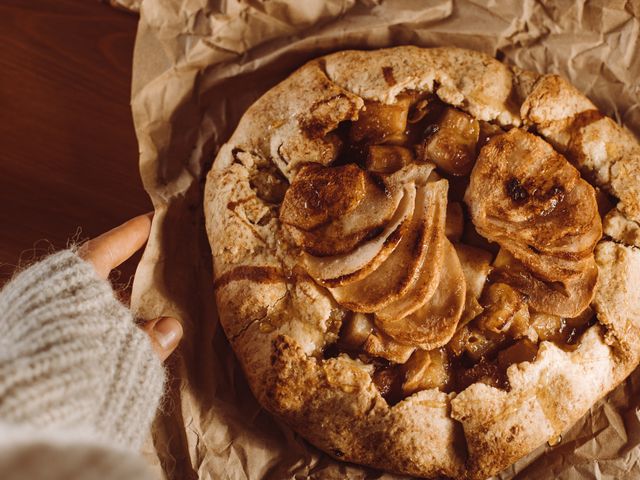
Holiday Roasted Chestnut and Brown Butter Discard Tart
A rustic French-style tart that transforms sourdough discard into a tender, slightly tangy crust, filled with caramelized roasted chestnuts, silky brown butter custard, and finished with a drizzle of thyme-infused honey. The deep, nutty brown butter balances the earthiness of chestnuts and the subtle fermented notes of the discard, making this an elegant holiday centerpiece.
- Prep
- 25 min
- Cook
- 50 min
- Wait
- 1 hr 30 min
- Total
- 2 hr 45 min
- Makes
- 1 tart (8 slices)
Steps
Before you start
- Preheat oven to 400°F (200°C) 15 minutes before baking the crust
- Have your sourdough discard at room temperature (75–78°F / 24–26°C)
- Toast your chestnuts in the oven for 8–10 minutes at 375°F (190°C) if using raw; already-roasted store-bought are fine
- Pull out a 9- or 10-inch (23–25 cm) loose-bottom tart pan and have it ready
Mix the dough
- In a large mixing bowl, combine the sourdough discard (1 cup / 240 ml), cold cubed butter (6 tablespoons / 85 g), flour (1.25 cups / 150 g), salt (½ teaspoon / 3 g), and sugar (1 tablespoon / 13 g).
- Using a wooden spoon or your fingertips, work the butter and discard together until the mixture resembles coarse breadcrumbs with some pea-sized pieces of butter still visible.
- This should take 2–3 minutes.
- Add the ice water (2 tablespoons / 30 ml) only if the dough feels too dry to come together; it should be shaggy and slightly sticky, not wet.
+ Show details− Hide details
Ready when: Dough is shaggy and just holds together when squeezed.
Tip: Do not overwork the dough or the crust will be tough. Keep the butter visible for a flaky texture.
Chill and shape the crust
- Gather the dough into a rough disk, wrap in plastic wrap, and refrigerate for at least 30 minutes (or up to 2 hours).
- Once chilled, remove from the fridge and let it sit at room temperature for 5 minutes to soften slightly.
- On a lightly floured surface, gently roll out the dough to a thickness of about ⅛ inch (3 mm), working from the center outward.
- It should be large enough to fit your 9- or 10-inch (23–25 cm) tart pan with about ½ inch (1.25 cm) overhang.
- Transfer to the pan and gently press it into the bottom and sides, then fold the overhang inward and crimp the edges with a fork.
- Dock the bottom with a fork to prevent puffing.
+ Show details− Hide details
Ready when: Crust is even thickness and fits snugly in the pan.
Tip: If the dough tears, pinch it back together. Don't stress about perfection—slight cracks will seal as it bakes.
Blind bake the crustOven 400°F / 205°C
- Preheat the oven to 400°F (200°C).
- Line the unbaked crust with parchment paper and fill with pie weights, dried beans, or rice to prevent it from puffing.
- Blind bake (par-bake) for 12–15 minutes until the edges are set and lightly golden but the bottom is still pale.
- Remove the weights and parchment and bake for another 2–3 minutes until the bottom is dry but not colored.
- Let cool slightly while you prepare the filling.
+ Show details− Hide details
Ready when: Edges are set and pale golden; bottom is dry to the touch.
Tip: Save your pie weights in a jar for future use, or reuse the same dried beans.
Brown the butter
- In a small saucepan, melt the 6 tablespoons (85 g) of butter over medium heat.
- Swirl occasionally (don't stir constantly) and watch as the milk solids settle to the bottom.
- The butter will foam, then gradually turn golden, then hazel-nut brown.
- This takes 5–8 minutes total.
- You'll see dark specks in the bottom and smell a rich, nutty aroma.
- Pour into a clean bowl and let cool for 5 minutes, then strain through a fine-mesh sieve to remove the darkened milk solids if desired (this is optional but gives a cleaner flavor).
- Set aside to cool to just warm (about 110°F / 43°C).
+ Show details− Hide details
Ready when: Butter is hazel-nut brown with a rich nutty aroma and visible dark specks.
Tip: Watch carefully toward the end—brown butter can turn black and bitter in seconds. If it starts to smell burnt, discard and start again.
Make the custard filling
- In a medium mixing bowl, whisk together the egg yolks (3), sugar (3 tablespoons / 38 g), and salt (¼ teaspoon / 1.5 g) until the mixture is pale and falls in ribbons from the whisk, about 2 minutes.
- Add the vanilla extract (½ teaspoon / 2.5 ml) and whisk to combine.
- Slowly pour in the cooled brown butter (about 110°F / 43°C) while whisking constantly to emulsify.
- Once combined, gently fold in the heavy cream (¾ cup / 180 ml) with a whisk or spatula until no streaks remain.
- The filling should be smooth, pale, and silky.
+ Show details− Hide details
Ready when: Custard is smooth, emulsified, and pale; no streaks of cream remain.
Tip: If adding cold brown butter, it may seize and form lumps. Let it cool to exactly warm (110°F / 43°C) and add very slowly while whisking hard.
Arrange chestnuts and fill
- Scatter the roasted chestnut halves (1.5 cups / 225 g) evenly over the par-baked crust.
- Pour the brown butter custard filling over and around the chestnuts, dividing evenly.
- The filling should reach about three-quarters of the way up the sides of the crust.
+ Show details− Hide details
Ready when: Chestnuts are arranged and custard is evenly distributed.
Tip: If your custard has lumps, strain it through a fine sieve before pouring.
Bake the tartOven 375°F / 190°C
- Place the filled tart on a baking sheet (to catch any drips) and bake at 375°F (190°C) for 25–30 minutes until the custard is just set at the edges but still slightly jiggly in the very center (about 1 inch / 2.5 cm diameter).
- The crust should be golden brown, and the filling should register 175–180°F (79–82°C) on an instant-read thermometer when you insert it near the edge (not the very center).
- If the crust edges are browning too fast, tent loosely with foil.
+ Show details− Hide details
Ready when: Edges are set and pull away slightly from the pan; center jiggles gently like panna cotta. Crust is golden.
Tip: Overbaking will result in a firm, dry filling. A slightly underdone center will continue to cook as it cools.
Cool and infuse honey
- Remove the tart from the oven and transfer to a cooling rack.
- Let it cool at room temperature for 15 minutes, then refrigerate for at least 45 minutes to set the custard completely.
- While the tart cools, warm the honey (3 tablespoons / 45 g) in a small saucepan over low heat and stir in the finely chopped fresh thyme leaves (4 sprigs, chopped).
- Let the thyme infuse for 2–3 minutes off the heat, then strain through a fine sieve if you prefer a smooth honey (or leave the thyme for rustic effect).
+ Show details− Hide details
Ready when: Tart is cool to the touch and custard is set; honey is fragrant with thyme.
Tip: Refrigerating the tart makes it much easier to slice without the filling spilling.
Finish and serve
- Just before serving, drizzle the warm thyme-infused honey over the tart in a light crisscross pattern.
- Sprinkle lightly with fleur de sel or Maldon sea salt if using.
- Slice with a warm, wet knife (wipe between cuts) to get clean slices.
- Serve at room temperature or lightly chilled.
+ Show details− Hide details
Ready when: Tart is glazed and ready to plate.
Tip: Warming the honey makes it flow smoothly; warm your knife under hot water and dry it for the cleanest slices.
Good to know
Tips
- Sourdough discard brings a subtle tang and tender crumb to the crust without requiring a long fermentation. Use discard that's actively bubbly or recently fed, not overly ripe or hooch-covered.
- Brown butter is crucial to this tart's identity—the nutty, caramelized notes elevate the roasted chestnuts and complement the fermented whisper of sourdough.
- For foolproof custard, strain it through a fine-mesh sieve after whisking if you see any tiny lumps or cooked egg bits from over-whisking.
- Chestnuts are naturally sweet and mealy; if you find whole ones in the shell, roast at 375°F (190°C) for 8–10 minutes, then peel while warm. Store-bought roasted chestnuts are convenient and work beautifully.
Make ahead
The unbaked crust can be wrapped tightly and refrigerated for up to 2 days or frozen for up to 3 months. The complete tart keeps refrigerated for up to 2 days in an airtight container. Do not freeze after baking; the custard texture will become grainy.
Storage & reheating
Room temperature (up to 4 hours): Cover loosely with foil. Refrigerator (up to 2 days): Store in an airtight container; serve chilled or bring to room temperature for 15 minutes before serving. Freezer: Not recommended after baking due to custard texture. Frozen unbaked dough lasts 3 months; thaw overnight in the fridge before using.
Substitutions
- roasted chestnuts → Roasted hazelnuts, walnuts, or candied pecans. Maintains the nutty, earthy character; halve or roughly chop so they're evenly distributed.
- unsalted butter → Clarified butter or ghee, heated until light brown; or use 6 tablespoons (85 g) regular unsalted butter. Browning adds depth and nuttiness; using plain butter will make the filling lighter and less complex.
- fresh thyme sprigs → Fresh sage, rosemary, or lavender; or 1 teaspoon (1 g) dried thyme. Adjust quantities based on intensity; dried herbs are more concentrated, so use about half the amount.
- honey → Warm apricot jam thinned with 1 tablespoon (15 ml) water, or a maple glaze. Provides sweetness and shine; less herbal than honey, so the thyme infusion becomes optional.