Peach Galette with Flaky Pie Crust
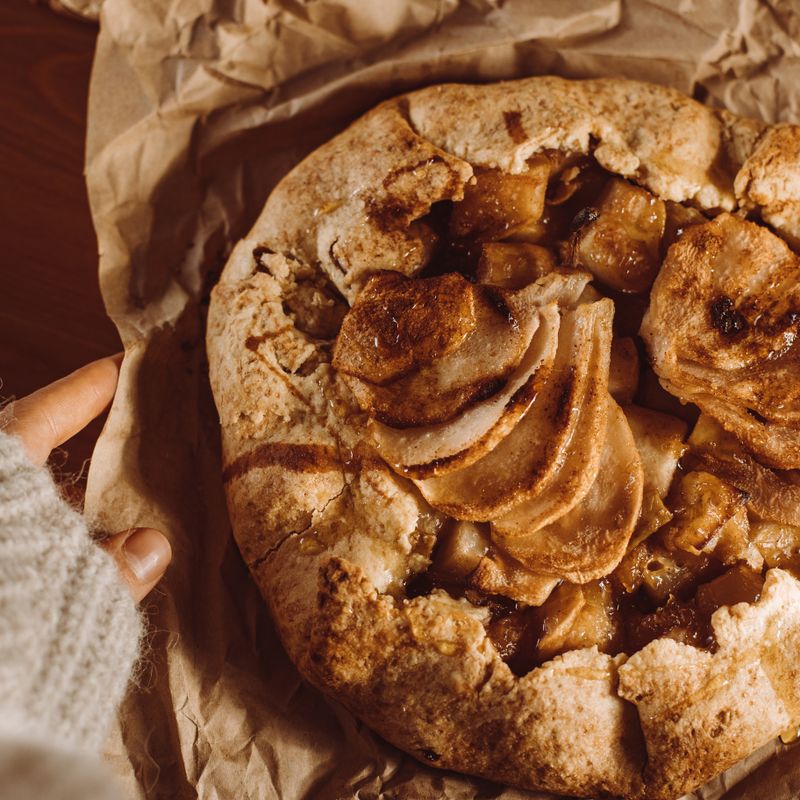
A rustic French-inspired galette with a tender, flaky butter crust and a simple filling of caramelized peaches, brown sugar, and lemon. The free-form design makes it forgiving and beautiful—the pastry edges fold up around the filling, creating a golden, jammy dessert that's as much about the crust as the fruit.
- Prep
- 35 min
- Cook
- 50 min
- Wait
- 1 hr 15 min
- Total
- 2 hr 40 min
- Makes
- 1 galette (6 slices)
Steps
Before you start
- Cut the butter into cubes and chill for at least 15 minutes before making the dough
- Peel and slice peaches no more than 1 hour before assembly so they don't brown
- Preheat your oven to 400°F (200°C) at least 15 minutes before baking
Make the dough
- In a food processor, combine the flour, salt, and sugar.
- Add the cold butter cubes and pulse 8–10 times until the mixture resembles coarse sand with some pea-sized butter pieces still visible (don't overwork).
- Transfer to a large bowl.
- Add the ice water a few tablespoons at a time, tossing gently with a fork until the dough just comes together in shaggy clumps—it should not be smooth.
- Shape into a disk about ½ inch thick, wrap in plastic wrap, and refrigerate for at least 45 minutes.
- (The dough can chill for up to 2 days.)
+ Show details− Hide details
Ready when: Dough is chilled and firm but not rock-hard; it bends slightly without cracking when you press the edge
Tip: Keep everything cold—warm butter will melt into the flour and result in a tough, dense crust instead of flaky layers
Prepare the peaches
- Bring a pot of water to a boil.
- Score an X on the bottom of each peach, then place them in the boiling water for 30 seconds.
- Transfer to a bowl of ice water and let cool for 1 minute.
- Peel off the skin using a small knife—it should slip away easily.
- Halve each peach along the seam, remove the pit, and cut into ¼-inch-thick wedges.
- You should have about 5 cups of sliced peaches.
+ Show details− Hide details
Ready when: Peach skin separates from the flesh cleanly
Tip: Don't skip the ice bath—it stops the peaches from cooking and makes peeling much easier
Combine the filling
- In a large bowl, toss the peach slices with the brown sugar, lemon juice, vanilla, and cornstarch.
- Mix gently but thoroughly to coat all the peaches.
- Let sit for 5 minutes so the peaches release their juices and the mixture becomes slightly syrupy.
+ Show details− Hide details
Ready when: Peaches are evenly coated and liquid has pooled at the bottom of the bowl
Tip: Toss gently to avoid bruising the peaches; the goal is to coat them, not mash them
Roll out the crust
- Remove the dough from the refrigerator and let it sit for 2–3 minutes until it's cool but pliable enough to roll without cracking.
- On a sheet of parchment paper, roll the dough into a ¼-inch-thick round about 13 inches in diameter.
- If the dough cracks at the edges, simply pinch it back together.
+ Show details− Hide details
Ready when: Dough is ¼ inch thick and roughly 13 inches wide; edges are pliable but not warm
Tip: Rolling on parchment paper makes it easy to transfer the galette to the baking sheet without tearing. If the dough becomes too warm and sticky, chill it again for 5 minutes
Assemble the galette
- Transfer the parchment with the dough to the baking sheet.
- Leaving a 2-inch border, arrange the peach slices in a concentric pattern or casual mound in the center.
- Drizzle the syrup from the bowl over the filling.
- Dot the peaches with the butter pieces.
- Fold the edges of the dough up and over the filling, pleating as needed to create a rustic border—the center of the galette will remain open.
+ Show details− Hide details
Ready when: Dough border is neatly folded and peaches are evenly distributed
Tip: Don't worry about making it perfectly round or symmetrical—the rustic, casual look is part of the galette's charm. Work quickly so the dough doesn't warm up
Chill before bakingOven 400°F / 205°C
- Refrigerate the assembled galette on the baking sheet for 15 minutes while you preheat the oven to 400°F (200°C).
- This helps the crust firm up and stay flaky during baking.
+ Show details− Hide details
Ready when: Crust is firm to the touch
Tip: Don't skip this step—it's the difference between a flaky crust and one that shrinks away from the fruit
Brush and top
- Remove the galette from the refrigerator.
- In a small bowl, whisk together the egg yolk and water to make an egg wash.
- Brush the dough border generously with the egg wash.
- If using coarse sugar, sprinkle it evenly over the pastry border.
+ Show details− Hide details
Ready when: Border is evenly coated with egg wash and sugar crystals are visible
Tip: Use a pastry brush or the back of a spoon to apply the egg wash evenly; it ensures an even golden-brown finish
Bake the galetteOven 400°F / 205°C
- Place the baking sheet in the preheated 400°F (200°C) oven and bake for 40–50 minutes, until the crust is deep golden brown and the peach filling has begun to caramelize at the edges.
- You may see some juice bubbling around the crust—this is fine and adds to the rustic look.
- Rotate the baking sheet halfway through if the galette is browning unevenly.
+ Show details− Hide details
Ready when: Crust is deep golden brown; the exposed fruit edges show caramelized brown spots and juice may bubble around the tart
Tip: Watch starting at 35 minutes—ovens vary. If the crust is browning too fast but the peaches need more time, loosely tent with foil
Cool before serving
- Remove the galette from the oven and let it cool on the baking sheet for at least 15 minutes before transferring to a wire rack or serving platter.
- The filling will firm up as it cools, making the galette easier to slice.
+ Show details− Hide details
Ready when: Galette is still warm to the touch but the filling is no longer liquid
Tip: Even though it's tempting to dig in immediately, the cooling time is essential so your slice stays intact
Good to know
Tips
- The key to a flaky crust is keeping the butter cold and visible in the dough. If your kitchen is warm, chill the flour and mixing bowl before you start.
- Don't overwork the dough—lumps of butter are your friend. Overworked dough becomes tough and dense.
- Fresh, ripe peaches make all the difference. If peaches are mealy or underripe, the galette will be disappointing. Choose ones that yield slightly to pressure and smell fragrant.
- This galette is forgiving and improves with a rustic, slightly imperfect appearance. Embrace the wrinkles and uneven edges—they're part of its charm and signal a handmade dessert.
Make ahead
The dough can be made up to 2 days ahead and refrigerated, or frozen for up to 1 month. The assembled galette (uncooked) can be chilled for up to 12 hours before baking; if chilled overnight, add 5–10 minutes to the baking time.
Storage & reheating
Store covered at room temperature for up to 2 days. Reheat in a 300°F (150°C) oven for 10 minutes to restore crispness. The galette does not freeze well once baked, but the raw dough freezes well for up to 1 month.
Substitutions
- fresh peaches, ripe but firm → Nectarines or plums (use 2 lbs / 900 g total). Nectarines don't require peeling. Plums will yield less juice; reduce cornstarch to 2 tsp. Both have slightly different sweetness, so taste and adjust brown sugar if needed.
- packed brown sugar → Granulated white sugar. Use the same amount. The galette will be slightly less rich in flavor and color, but the texture will be the same.
- vanilla extract → Almond extract (use ¼ tsp) or omit entirely. Almond adds a subtle nuttiness; omitting it leaves a clean peach flavor.
- coarse sugar (demerara or sanding sugar) → Granulated white sugar or omit. Coarse sugar gives a beautiful sparkle and texture, but it's optional. White sugar will melt into the crust. Omitting it yields a plainer appearance but doesn't affect flavor.