French Tarte Normande with Apple and Crème Anglaise
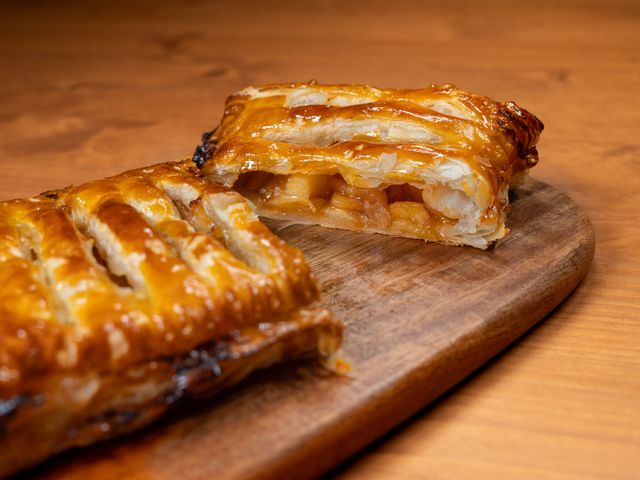
A showstopping French tart featuring buttery puff pastry topped with silky pastry cream, fanned apple slices, and a drizzle of warm crème anglaise. This elegant dessert combines the crisp texture of caramelized apples with the luxurious creaminess of classic French custard sauces. Perfect for special occasions or when you want to impress.
- Prep
- 45 min
- Cook
- 45 min
- Wait
- 1 hr 15 min
- Total
- 2 hr 45 min
- Makes
- 1 tart (8 slices)
Steps
Before you start
- Chill the pastry cream and crème anglaise base before assembly
- Have all ingredients measured and ready
- Preheat your oven to 400°F (200°C) 15 minutes before baking
- Use a mandoline or very sharp knife for uniform apple slices
Make the pastry cream
- Heat the milk in a medium saucepan over medium heat until it steams and small bubbles form around the edges, about 4 minutes.
- In a bowl, whisk together the egg yolks and sugar until pale, about 2 minutes.
- Sift the cornstarch, flour, and salt together into the yolk mixture and whisk until smooth.
- Slowly pour the hot milk into the yolk mixture while whisking constantly to temper the yolks.
- Return the mixture to the saucepan and cook over medium heat, stirring constantly with a wooden spoon, until it thickens and comes to a gentle boil, about 3–4 minutes.
- The mixture should coat the back of the spoon and fall off slowly when you drag your finger across it.
- Remove from heat, whisk in the vanilla, then add the cold cubed butter and whisk until smooth.
+ Show details− Hide details
Ready when: Mixture thickens, coats a spoon, and comes to a gentle boil
Tip: Whisk constantly to prevent lumps and ensure the mixture thickens evenly without scorching.
Chill the pastry cream
- Press a piece of plastic wrap directly onto the surface of the pastry cream to prevent a skin from forming.
- Refrigerate for at least 30 minutes until chilled and firm enough to spread.
+ Show details− Hide details
Ready when: Cream is cold and holds its shape when stirred
Tip: Pressing plastic wrap directly on the surface prevents oxidation and a tough skin from forming.
Prepare the tart baseOven 400°F / 205°C
- Preheat your oven to 400°F (200°C).
- Place the thawed puff pastry sheet in a 9-inch (23 cm) round tart tin with a removable bottom.
- Gently press it into the corners and up the sides, letting it extend slightly above the rim.
- Prick the bottom all over with a fork to prevent puffing.
- Brush lightly with melted butter.
- Line with parchment paper and fill with pie weights or dried beans.
- Bake for 15 minutes until the pastry is light golden and begins to set.
+ Show details− Hide details
Ready when: Pastry is light golden and set but not fully baked
Tip: Pricking the pastry and using pie weights prevents it from puffing up and creating an uneven surface for the filling.
Brush the pastry and arrange apples
- Remove the tart from the oven and carefully lift away the parchment and weights.
- Brush the entire interior of the pastry case with beaten egg wash.
- Spread the chilled pastry cream evenly over the base in an even layer, leaving a thin border.
- Arrange the apple slices in overlapping concentric circles, starting from the outside edge and working toward the center, pressing them gently into the cream.
- The apples should be arranged in a neat, professional-looking pattern.
+ Show details− Hide details
Ready when: Apples are arranged in neat overlapping circles and sit on a smooth cream base
Tip: Work quickly after removing from the oven so the pastry is still warm when you brush the egg wash. The overlapping arrangement both looks beautiful and ensures even baking.
Bake the tartOven 400°F / 205°C
- Return the tart to the 400°F (200°C) oven and bake for 20–25 minutes until the apple edges are caramelized and golden and the pastry is deep golden brown.
- The apples should be tender and lightly charred at the tips.
+ Show details− Hide details
Ready when: Pastry is deep golden brown, apple edges are caramelized and lightly charred, apples are tender
Tip: If the pastry edge browns too quickly, loosely tent it with foil for the final 10 minutes.
Make the apple glaze
- While the tart bakes, melt the butter in a small saucepan over medium heat.
- Add the sugar and stir until it dissolves.
- Add the apricot jam and whisk until smooth and combined, about 1–2 minutes.
- Remove from heat and keep warm.
+ Show details− Hide details
Ready when: Glaze is smooth, shiny, and warm
Tip: Making the glaze while the tart bakes ensures it's warm and pourable when needed.
Glaze the tart
- Remove the tart from the oven and immediately brush the warm apple glaze evenly over the apples and exposed pastry edges.
- Work quickly so the glaze sets with a nice sheen while the apples are still warm.
+ Show details− Hide details
Ready when: Tart is evenly coated with a glossy apricot glaze
Tip: Apply the glaze while the tart is hot so it sets smoothly and creates a professional finish.
Prepare the crème anglaiseOven 170°F / 75°C
- Heat the milk in a medium saucepan over medium heat until it steams and small bubbles form around the edges, about 4 minutes.
- In a separate bowl, whisk together the egg yolks and sugar until pale, about 2 minutes.
- Slowly pour the hot milk into the yolk mixture while whisking constantly to temper the yolks.
- Return the mixture to the saucepan and cook over medium heat, stirring constantly with a wooden spoon, until the sauce reaches 170°F (77°C) and coats the back of the spoon.
- Remove from heat immediately, strain through a fine-mesh sieve, and whisk in the vanilla and salt.
+ Show details− Hide details
Ready when: Sauce reaches 170°F (77°C) and coats the back of a spoon; no curdling visible
Tip: Use a thermometer for accuracy; don't let the temperature exceed 180°F (82°C) or the sauce will curdle. Strain immediately to remove any cooked egg bits.
Cool and serve
- Allow the tart to cool for 15–20 minutes at room temperature until the pastry is crisp and the apples have slightly firmed.
- Serve warm or at room temperature.
- Pour or spoon the warm (or room-temperature) crème anglaise around the tart slices just before serving, or offer it on the side.
+ Show details− Hide details
Ready when: Pastry is crisp, filling is set, tart is warm or room temperature
Tip: The tart is most beautiful when served warm with warm crème anglaise, but it also holds well at room temperature for a few hours.
Good to know
Tips
- Use a sharp mandoline or slicing blade to cut apples uniformly so they bake evenly. Uniform thickness is key to an elegant, professional appearance.
- Arrange apple slices as you peel and slice them to minimize oxidation. If prepping ahead, toss sliced apples gently with a small amount of lemon juice to prevent browning.
- The key to a crisp pastry base is partial baking with weights and a quick, hot oven. Don't skip the initial 15-minute bake with pie weights—it keeps the base from puffing unevenly.
- Serve the crème anglaise warm if possible; it's silkier and more luxurious. If made ahead, reheat gently in a double boiler, stirring often, until it reaches 140–150°F (60–65°C).
Make ahead
The pastry cream and crème anglaise can be made up to 2 days ahead and refrigerated in airtight containers. The tart base can be partially baked 4 hours ahead, cooled, and left uncovered at room temperature. Complete assembly and final baking should be done no more than 2 hours before serving for best pastry crispness.
Storage & reheating
Store leftover tart covered loosely with plastic wrap at room temperature for up to 2 days. The pastry will soften slightly. Do not refrigerate as this accelerates moisture loss and makes the pastry tough. To refresh, warm gently in a 300°F (150°C) oven for 10 minutes. Crème anglaise keeps refrigerated in an airtight container for up to 3 days; warm gently in a double boiler or microwave in 20-second bursts before serving.
Substitutions
- Honeycrisp or Granny Smith apples → Tarte Tatin-style apples or pears. Pears work beautifully arranged the same way. They're slightly more delicate, so handle carefully. Slice slightly thicker to prevent them from becoming too soft.
- apricot jam → Apple jelly or clear honey. Apple jelly creates a lighter glaze; honey adds deeper caramel notes. Both give a similar glossy finish.
- frozen all-butter puff pastry → Homemade puff pastry or all-butter pie dough. All-butter dough gives a less puffed, more tender base. If using, roll out and dock as directed. Homemade puff pastry requires 2–3 hours of resting.
- vanilla extract → Vanilla bean paste or 1 vanilla pod, split and scraped. Real vanilla beans add beautiful black flecks and deeper flavor. Scrape the seeds directly into the hot cream before chilling.