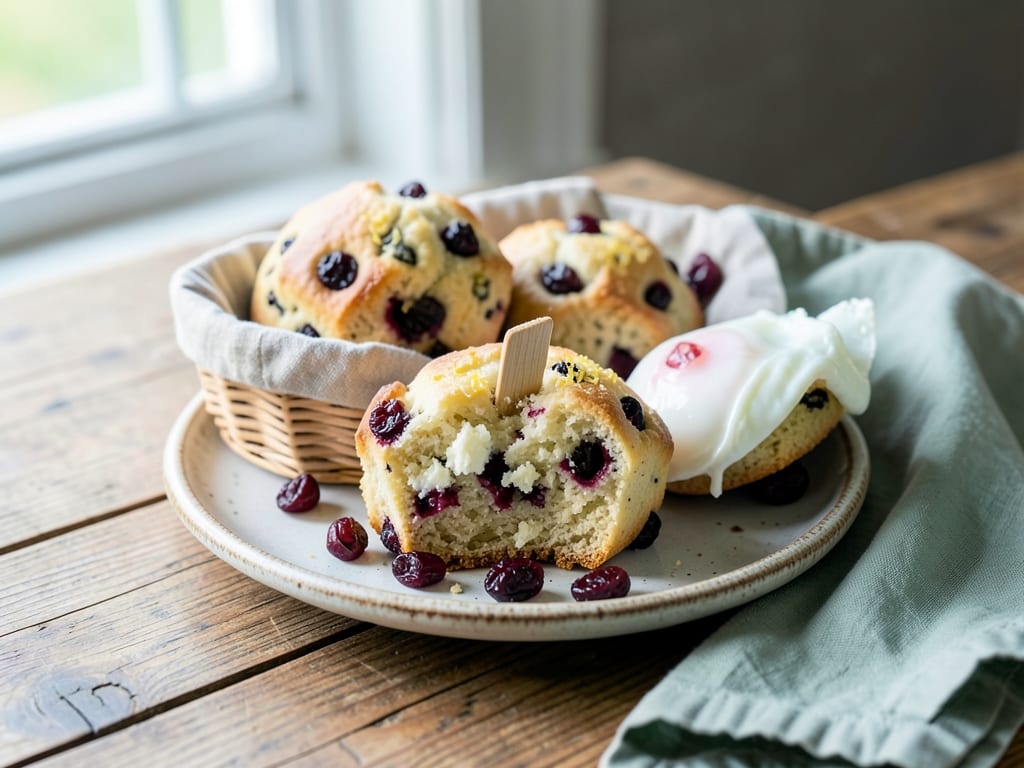
Goat Cheese and Cranberry Scones
Tender, flaky scones studded with tart-sweet dried cranberries and creamy goat cheese, brightened with lemon zest. Built on the traditional method of rubbing cold butter into flour, these scones are lightly mixed to preserve a delicate crumb and finished with a gentle egg wash for a golden exterior. Serve warm with butter, jam, honey, or clotted cream.
Steps
Before you start
- Cut butter into cubes and keep it cold (use it straight from the refrigerator or freezer).
- Preheat your oven to 400°F (200°C) when you're ready to shape and bake.
- Have all dry ingredients measured and ready before you start mixing.
- Read through all steps so you understand the minimal-mixing method before starting.
Mix dry ingredients
- In a large bowl, whisk together all-purpose flour (250g), baking powder (2 teaspoons / 8g), fine sea salt (½ teaspoon / 3g), and granulated sugar (3 tablespoons / 38g).
- Use a whisk to ensure the baking powder and salt are evenly distributed with no lumps throughout the flour—this prevents pockets of unactivated leavener in the baked scones.
+ Show details− Hide details
Ready when: Dry ingredients are combined evenly with no lumps visible.
Tip: Breaking up any clumps in the baking powder is crucial—old or damp baking powder loses potency, so sift it separately if needed.
Incorporate cold butter
- Cut 6 tablespoons (85g) cold unsalted butter into ½-inch cubes.
- Add to the dry mixture and, using your fingertips, rub the butter into the flour until the mixture resembles coarse breadcrumbs with some pea-sized pieces of butter still visible.
- Work quickly to keep the butter cold—cold fat creates steam pockets during baking that make scones light and flaky.
+ Show details− Hide details
Ready when: Mixture resembles coarse breadcrumbs with some pea-sized butter pieces still visible.
Tip: If the butter begins to warm and soften, place the bowl in the freezer for 2–3 minutes before continuing to keep the mixture cold.
Fold in goat cheese and cranberries
- Crumble ½ cup (115g) fresh goat cheese into small pieces and add to the flour mixture along with ¾ cup (100g) dried cranberries.
- Using a spatula, gently fold these in until evenly distributed throughout, taking care not to overwork the dough.
- The goat cheese will be crumbly and soft at this point, which is perfect—you want visible pieces, not a smooth mixture.
+ Show details− Hide details
Ready when: Goat cheese and cranberries are evenly scattered throughout the dry mixture with no dry flour visible.
Tip: Work gently and avoid kneading or smashing the goat cheese, which will make the scones tough and dense instead of tender and flaky.
Prepare wet ingredients
- Separate 1 large egg, reserving the white in a small bowl for later egg wash.
- In the same small bowl or another, whisk together the egg yolk with ½ cup (120ml) heavy cream and 1 teaspoon (3g) fresh lemon zest.
- The lemon adds a subtle citrus brightness that complements both the tangy goat cheese and tart cranberries.
+ Show details− Hide details
Ready when: Egg yolk, cream, and zest are fully combined and uniform in color.
Tip: Use a microplane to zest the lemon, capturing only the bright yellow outer layer, not the bitter white pith underneath.
Bring dough together
- Pour the egg yolk and cream mixture into the center of the flour mixture.
- Using a fork or wooden spoon, gently stir and fold the wet into the dry until the dough just comes together.
- Stop as soon as no dry flour remains—a shaggy, lumpy dough is exactly what you want.
- Do not overmix or knead, which will toughen the scones.
+ Show details− Hide details
Ready when: Dough just comes together with no visible dry flour, but the texture is still shaggy and lumpy.
Tip: Mixing by hand with a fork gives you a better feel for when to stop—it's harder to overmix by hand than with an electric mixer or vigorous stirring.
Chill dough before shaping
- Turn the dough onto a lightly floured surface and gently pat it into a ¾-inch-thick disk about 6 inches (15 cm) in diameter.
- Wrap tightly in plastic wrap and refrigerate for 15 minutes.
- Cold dough bakes taller and more evenly, and the chilling helps the baking powder work more effectively to lift the scones.
+ Show details− Hide details
Ready when: Dough is formed into a ¾-inch-thick disk and thoroughly chilled.
Tip: If your kitchen is very warm or humid, extend the chill to 20 minutes to ensure the dough stays firm.
Cut and arrange sconesOven 400°F / 205°C
- Preheat your oven to 400°F (200°C).
- On a lightly floured surface, remove the chilled dough and cut it into 8 equal wedges (like cutting a pizza) or use a 2.5-inch (6 cm) round biscuit cutter to cut out rounds, rerolling scraps very gently if needed.
- Place the scones on an ungreased or parchment-lined baking sheet, spacing them about 2 inches (5 cm) apart.
+ Show details− Hide details
Ready when: Scones are cut into 8 pieces and arranged on the baking sheet with even spacing.
Tip: When using a biscuit cutter, press straight down and lift straight up without twisting—twisting seals the edges and prevents the scones from rising evenly.
Egg wash and bakeOven 400°F / 205°C
- Whisk the reserved egg white with 2 tablespoons (30ml) heavy cream or milk until combined.
- Brush this mixture lightly over the top of each scone.
- Bake at 400°F (200°C) for 15–18 minutes, until the tops are golden brown and a wooden pick inserted into the center of one scone comes out with just a few moist crumbs.
- The scones will smell buttery and rich when ready.
+ Show details− Hide details
Ready when: Scone tops are golden brown and a wooden pick inserted in the center comes out with just a few moist crumbs.
Tip: Don't overbake—the interior should still be slightly moist to remain tender and flaky. Overbaking dries them out. They continue to cook on the hot baking sheet as they cool.
Good to know
Tips
- Keep everything cold: Use cold butter, a cold bowl, and work quickly. Cold fat creates the steam pockets that make scones flaky. If your kitchen is warm, keep tools in the freezer.
- Never skip the chill before baking: This is the foundation of tender, risen scones. It relaxes the gluten and allows the leavener to work properly.
- Serve warm and fresh: Scones are best the day they're made, served warm or at room temperature with clotted cream, jam, honey, or fresh butter. Reheating slightly (300°F oven for 5 minutes) restores warmth and softness.
- Gentle mixing is everything: Overmixing develops gluten and makes scones tough. Use a fork or your fingertips and stop the moment the dough comes together. Lumpy dough makes better scones than smooth dough.
Make ahead
Unbaked scones can be frozen on a baking sheet for up to 2 weeks, then baked directly from frozen, adding 2–3 minutes to the baking time. Alternatively, bake scones fully, cool completely, and store as directed below. Dough can also be prepared through step 6, wrapped tightly, and refrigerated for up to 8 hours before shaping and baking.
Storage & reheating
Room temperature: Store in an airtight container for up to 2 days; scones are best eaten the day they're made. Refrigerator: Up to 4 days in an airtight container; reheat gently in a 300°F (150°C) oven for 5 minutes. Freezer: Up to 2 weeks in an airtight container; thaw at room temperature for 1 hour or reheat directly in a 300°F (150°C) oven for 10 minutes until warmed through.
Substitutions
- fresh goat cheese → Softened cream cheese or ricotta cheese. Use the same weight (115g). Cream cheese will be milder and less tangy; ricotta is closer to goat cheese in texture and acidity.
- dried cranberries → Dried tart cherries, dried blueberries, or chopped dried apricots. Maintain the same weight (100g). Any tart or slightly sweet dried fruit works well; adjust to your preference.
- lemon zest, fresh → Orange zest or omit entirely. Orange zest is slightly sweeter and works beautifully. If omitted, the scones will be neutral and still delicious.
- heavy cream (or whole milk) → Whole milk or buttermilk. Whole milk makes slightly less rich scones. Buttermilk adds tang that complements the goat cheese exceptionally well.
More scones & biscuits
See all →

Find more like this
- Meal
- Breakfast
- Cuisine
- Mediterranean
- Main ingredient
- Cheese
- Diet
- Halal
- Quick & Easy
- Easy