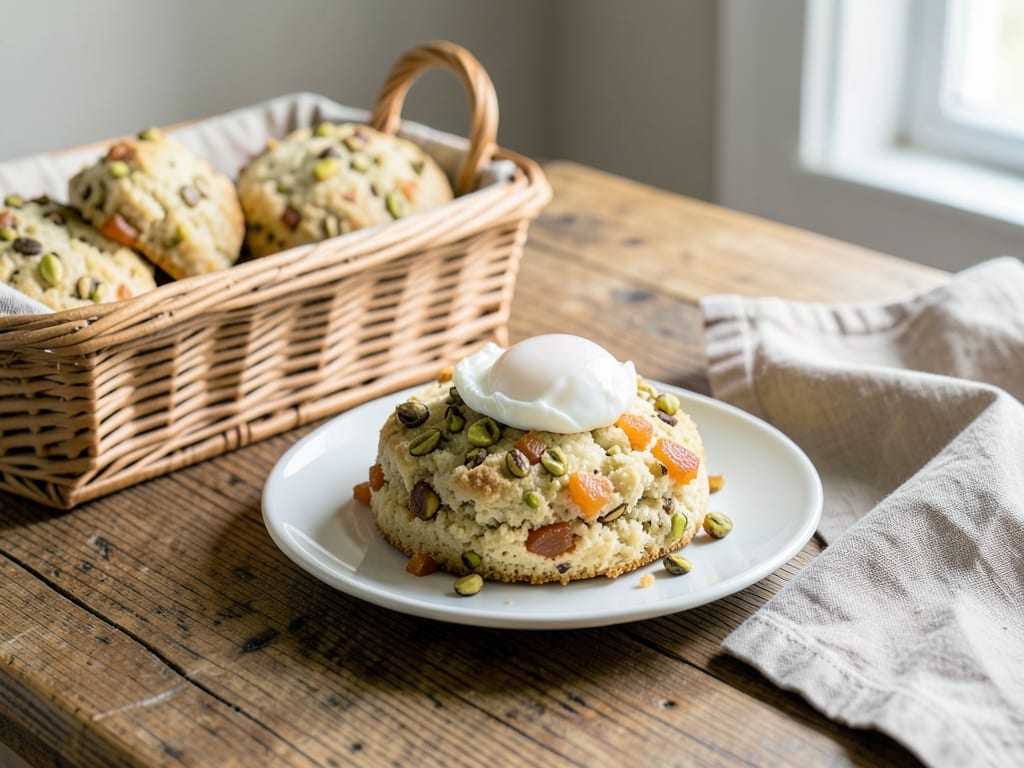
Apricot and Pistachio Scones
Tender, crumbly scones bursting with tart-sweet dried apricots and roasted pistachios, inspired by Mediterranean flavors. The cold-butter-in-flour technique ensures a light, delicate crumb that melts in your mouth, while the warm vanilla and bright fruit make these perfect for breakfast or afternoon tea. Best served warm with clotted cream, jam, or honey butter.
Steps
Before you start
- Preheat oven to 400°F (200°C)
- Keep all ingredients cold, especially butter—chill your mixing bowl if possible
- Roughly chop dried apricots into ¼-inch pieces and pistachios before you start
- Have a lightly floured surface ready for shaping the dough
Mix dry ingredients
- In a large mixing bowl, whisk together 2 cups (250g) all-purpose flour, 2 tablespoons (25g) granulated sugar, 1½ teaspoons (6.5g) baking powder, and ¼ teaspoon (1.5g) fine sea salt until evenly combined.
- Using a whisk rather than stirring ensures the leavening is distributed uniformly throughout the flour.
+ Show details− Hide details
Ready when: Mixture is evenly combined with no visible lumps of baking powder
Tip: Use a whisk for quick, even distribution, or sift if your baking powder has lumps.
Work in cold butter
- Add 6 tablespoons (85g) of cold butter cubes to the flour mixture.
- Using a pastry blender, two forks, or your fingertips, work the butter into the flour until the mixture resembles coarse breadcrumbs with some pea-sized pieces of butter still visibly throughout.
- This should take about 4 minutes of light work.
+ Show details− Hide details
Ready when: Texture resembles coarse breadcrumbs with visible butter pieces throughout
Tip: Keep your hands as cool as possible and work quickly so the butter stays cold. Cold butter creates steam pockets that give scones their signature tender, crumbly crumb.
Fold in apricots and pistachios
- Gently fold in ⅔ cup (100g) roughly chopped dried apricots and ½ cup (60g) roughly chopped roasted salted pistachios using a spatula or wooden spoon.
- Combine until evenly distributed throughout the mixture without crushing the fruit.
+ Show details− Hide details
Ready when: Apricots and pistachios are evenly distributed throughout
Add milk and vanilla
- Make a well in the center of the dry mixture.
- Pour in ⅔ cup (160ml) whole milk at room temperature and ½ teaspoon (2.5ml) vanilla extract.
- Using a fork or wooden spoon, gently stir until just barely combined.
- The dough should look shaggy and slightly wet, with some dry flour still visible—this is exactly right.
+ Show details− Hide details
Ready when: Dough is barely combined, still shaggy with visible streaks of flour
Tip: Do not overmix. Lumps and pockets of dry flour are better than a smooth, fully mixed dough. Overmixing develops gluten and makes scones tough and dense.
Form into disk
- Turn the dough out onto a lightly floured surface.
- Gently press and fold it together with your hands a few times—about 6–8 folds total—until the dough barely comes together as a cohesive mass.
- Do not knead.
- Shape into a roughly 7-inch (18cm) diameter disk about 1 inch (2.5cm) thick.
+ Show details− Hide details
Ready when: Dough is gently formed into a compact 7-inch disk
Tip: Overworking the dough is the enemy of tender scones. Your goal is to bring it together gently, not to make it smooth or homogeneous.
Cut scones into wedges
- Using a sharp chef's knife, cut the disk into 8 equal wedges like a pizza pie.
- Wipe the blade clean between cuts for neat edges.
- Transfer each wedge to the prepared baking sheet lined with parchment paper, spacing them about 2 inches (5cm) apart.
- The space between them allows them to bake evenly and develop nice, even browning on all sides.
+ Show details− Hide details
Ready when: Scones are cut into 8 equal wedges and arranged on baking sheet
Brush with egg wash and bakeOven 400°F / 205°C
- If using, beat 1 large egg (50g) with 1 tablespoon water and brush the top of each scone lightly with a pastry brush.
- Sprinkle with 1 tablespoon (12g) coarse sugar if desired for a subtle sparkle and crunch.
- Bake at 400°F (200°C) for 14–18 minutes, until the tops are light golden brown and a skewer inserted into the center comes out with a few moist crumbs still clinging to it.
- The tops should feel lightly firm to the touch when you gently press them.
+ Show details− Hide details
Ready when: Tops are light golden brown, skewer comes out with moist crumbs, tops feel lightly firm
Tip: Don't overbake—scones continue to set slightly as they cool, and an overbaked scone is dry and dense rather than tender and moist. Start checking at 14 minutes.
Cool briefly before serving
- Transfer the scones to a wire cooling rack using a spatula and let them cool for 5–10 minutes.
- They'll set up slightly and be easier to handle, but serving them while still warm (not hot) gives the best flavor and texture.
- The crumb will firm up as it cools.
+ Show details− Hide details
Ready when: Scones have set slightly but are still warm to the touch
Good to know
Tips
- The cold-butter-in-flour technique is crucial for tender, crumbly scones—keep everything as cold as possible and avoid overmixing. If your kitchen is very warm, freeze the mixing bowl and butter cubes for 30 minutes before starting.
- Scones are best eaten fresh but still delicious at room temperature the next day. Serve with clotted cream and apricot jam, or with honey butter for a Mediterranean touch.
- For extra moisture and luxury, slice scones horizontally and fill them with whipped cream and apricot jam, just like a traditional cream tea.
- Use a sharp knife and wipe it clean between cuts to achieve neat, clean edges on your scones.
Make ahead
Scone dough can be prepared through step 5 and refrigerated for up to 2 hours before baking. Alternatively, baked scones keep in an airtight container at room temperature for 2 days.
Storage & reheating
Room temperature: Store in an airtight container for up to 2 days. Refrigerator: Keep in an airtight container for up to 5 days; serve at room temperature or warm gently. Freezer: Baked scones freeze for up to 3 months; thaw at room temperature for 1 hour, or warm directly in a 300°F (150°C) oven for 5–7 minutes.
Substitutions
- dried apricots → Dried figs, dates, or dried cherries. Use the same amount. Figs and dates are slightly moister, so you may use 2–3 tablespoons less milk if substituting with those.
- roasted salted pistachios, shelled → Sliced almonds, chopped walnuts, or hazelnuts. Use the same amount. Unsalted nuts work too if you prefer less saltiness; adjust overall salt if needed.
- whole milk, at room temperature → Buttermilk or Greek yogurt thinned with milk. Use the same amount total. Scones will be slightly more tender and have a subtle tang.
- vanilla extract → Almond extract or omit entirely. If using almond extract, use only ¼ teaspoon as it is more potent. Omitting vanilla produces a cleaner, more fruity scone.
More scones & biscuits
See all →





Find more like this
- Meal
- Breakfast
- Cuisine
- Mediterranean
- Diet
- VegetarianHalal
- Quick & Easy
- Easy