French Omelette with Herbs de Provence and Gruyère
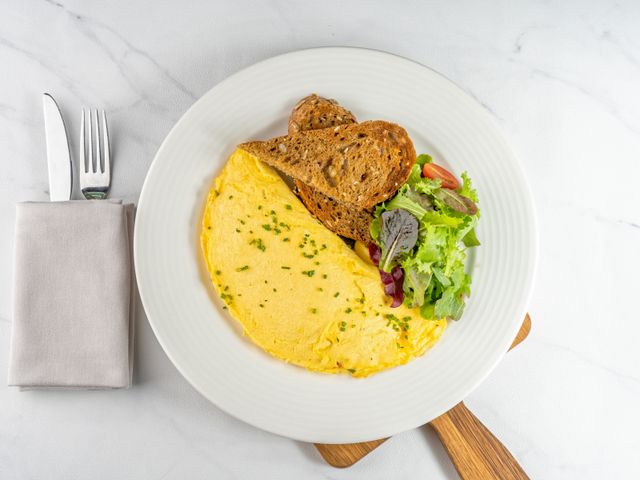
A classic French omelette with a silky, barely set custard-like interior and a delicate fold. The omelette is flavored with Herbs de Provence and finished with melted Gruyère cheese for a subtle nutty richness. This technique requires attention and confidence—the pan temperature and timing are critical to achieve the signature creamy texture that defines a true French omelette.
Steps
Before you start
- Have all ingredients measured and ready at the stovetop—this cooks fast
- Use eggs at room temperature for the smoothest texture
- Choose a nonstick 8-inch (20 cm) pan; cast iron or stainless steel are harder to handle for a French omelette
Whisk the eggs
- Crack the 3 eggs into a small bowl.
- Add a pinch of salt and pepper, then whisk vigorously with a fork for 15–20 seconds until the mixture is pale, foamy, and fully combined.
- Add the ¼ teaspoon (0.5 g) Herbs de Provence and whisk briefly to distribute evenly.
+ Show details− Hide details
Ready when: Mixture is pale and foamy, with no visible streaks of egg white
Tip: Don't skip the whisking—this incorporates air and creates a creamier texture.
Heat the pan
- Place the 8-inch (20 cm) nonstick skillet over medium heat.
- Let it warm for about 1 minute until it is hot but not smoking.
- The pan temperature is critical: too cool and the eggs won't set; too hot and they'll toughen.
+ Show details− Hide details
Ready when: Pan is hot enough that a droplet of water sizzles slightly and evaporates in 1–2 seconds
Tip: Medium heat—not medium-high—is essential. A properly tempered pan prevents the eggs from cooking too fast on the bottom.
Add butter and swirl
- Add the 1.5 tablespoons (21 g) butter pieces to the hot pan.
- Immediately tilt and swirl the pan so the melting butter coats the entire bottom and sides evenly.
- This should take about 10–15 seconds.
+ Show details− Hide details
Ready when: Butter is melted and foaming, with a light blonde color; it should not brown
Tip: Use cold butter pieces so you have time to swirl the pan before it fully melts. If the butter browns, your pan is too hot—reduce to medium-low and wait a moment before proceeding.
Pour in the eggs
- Pour the whisked egg mixture into the center of the pan all at once.
- Immediately, using a silicone spatula or wooden spoon, start pushing the cooked egg from the edges toward the center, tilting the pan slightly so uncooked egg flows to the hot edges.
- This should take about 15–20 seconds, and the pan should always be in motion.
+ Show details− Hide details
Ready when: Most of the egg is opaque and beginning to set, with some wet, shiny egg still visible on top
Tip: Constant, gentle motion is key. Don't press hard or stir aggressively—you're coaxing the eggs to cook evenly, not scrambling them.
Cook until custard-like
- Stop stirring when the egg is mostly set but still very moist and slightly runny on top, about 30–45 seconds of total cooking.
- The bottom should be set but not brown, and the top should look like a soft custard—barely cooked.
- The residual heat will continue cooking the omelette even after it's off the stove.
+ Show details− Hide details
Ready when: Top surface still glistens and trembles slightly when you move the pan; a light touch reveals a just-set, creamy interior
Tip: This is the signature of a French omelette—it's almost too runny to seem done, but it will continue cooking off the heat. Better to undercook slightly than to overcook.
Add cheese and fold
- Sprinkle the ⅓ cup (40 g) grated Gruyère down the center third of the omelette.
- Tilt the pan away from you slightly and use your spatula to fold the bottom third of the omelette over the cheese.
- Then fold the top third over the middle, creating a three-fold envelope shape.
- The omelette should still look lightly runny on the outside but will be creamy inside.
+ Show details− Hide details
Ready when: Omelette is folded into a neat envelope; cheese has softened and begun to melt from the residual heat
Tip: Work quickly—if the pan cools too long, the omelette becomes stiff and hard to fold. If you hesitate, the cheese won't melt into the egg.
Serve immediately
- Slide the folded omelette onto a warm plate immediately.
- The omelette will be silky, tender, and slightly runny inside, with the Gruyère melted into the creamy egg.
- Season the outside lightly with extra salt and pepper if desired.
+ Show details− Hide details
Ready when: Omelette is transferred to the plate and still steaming
Tip: Do not hold the omelette in the pan—it will continue cooking and dry out. Serve immediately for the best creamy texture.
Good to know
Tips
- Pan temperature and timing separate a true French omelette from scrambled eggs—the goal is a barely set, creamy interior, never firm or bouncy.
- This omelette requires a nonstick pan. If you don't have one, the eggs will stick and you won't achieve the gentle folds and tender texture.
- The fold is optional: you can also roll the omelette or simply serve it flat and folded in half.
- Practice makes perfect—if your first omelette seems too runny or too set, adjust your timing and heat on the next one.
Storage & reheating
French omelettes are best eaten immediately. Leftovers can be stored covered in the refrigerator for up to 2 days, but they will not have the same delicate, creamy texture. To reheat, place on a plate, cover loosely with a damp paper towel, and microwave for 20–30 seconds, or warm gently in a low oven at 300°F (150°C) for 5 minutes.
Substitutions
- Gruyère cheese → Emmental or Comté cheese. Use the same amount; these have a similar melt and nutty flavor profile.
- Herbs de Provence → Fresh chives, tarragon, or parsley. Use ½ teaspoon (0.5 g) fresh herbs, finely chopped, and add them just before folding for brighter flavor.
- unsalted butter → Unsalted butter with a small splash of neutral oil. If your butter tends to brown, use half butter and half oil for a higher smoke point.
- Gruyère cheese → Omit cheese entirely. A classic plain French omelette is just eggs, butter, salt, and herbs—equally delicious.