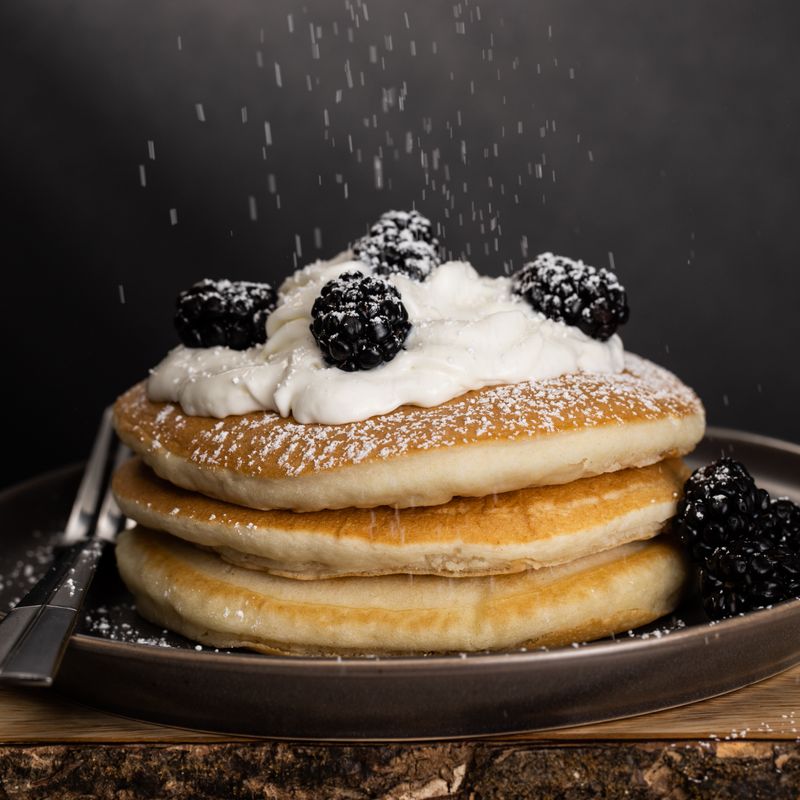
Fluffy Buttermilk Pancakes
Tall, tender, golden pancakes with a gentle tang from buttermilk. A short rest and a light hand with the batter give you a soft, airy crumb every time.
- Prep
- 10 min
- Cook
- 20 min
- Wait
- 10 min
- Total
- 40 min
- Makes
- About 12 pancakes (4-inch / 10 cm each)
Steps
Before you start
- Take the buttermilk and eggs out of the fridge about 20 minutes ahead so they are cool rather than cold; cold buttermilk will clump the melted butter.
- Plan for a 10-minute batter rest. Use that time to heat the griddle and the oven.
- Set a baking sheet with a wire rack in the oven so finished pancakes stay warm and crisp-edged instead of steaming.
- Have a thin, wide spatula and a ¼-cup (60 ml) measure ready before you start cooking.
Warm the ovenOven 200°F / 95°C
- Heat the oven to 200°F (95°C).
- Place a wire rack on a rimmed baking sheet and set it on the middle rack.
- This is where finished pancakes will wait while you cook the rest.
+ Show details− Hide details
Ready when: Oven reaches 200°F (95°C).
Tip: Don't go hotter; higher heat dries the pancakes out.
Whisk dry ingredients
- In the large bowl, whisk the flour, sugar, baking powder, baking soda and salt for 20 seconds until evenly combined with no streaks of leavener.
- Make a well in the center.
+ Show details− Hide details
Ready when: The mixture looks uniform and pale with no clumps.
Tip: Whisking spreads the baking soda and powder evenly so you avoid bitter, soapy spots.
Whisk wet ingredients
- In the medium bowl, whisk the buttermilk, eggs and vanilla (if using) until smooth.
- Slowly drizzle in the cooled melted butter while whisking so it blends in and doesn't form hard flecks.
+ Show details− Hide details
Ready when: The liquid is uniform, with no visible egg streaks or butter pools.
Tip: If the butter is hot it will scramble the eggs; let it cool 5 minutes first.
Fold batter together
- Pour the wet mixture into the well.
- With a rubber spatula, fold just until the flour disappears, about 12 to 15 strokes.
- The batter should be thick and lumpy, with some pea-sized lumps and a few small streaks of flour.
+ Show details− Hide details
Ready when: Batter is thick and lumpy, and it slowly plops off the spatula.
Tip: Overmixing develops gluten and makes pancakes tough and flat. Lumps are good.
Rest batter, heat griddle
- Let the batter rest 10 minutes.
- It will puff slightly and thicken as the flour hydrates and the leaveners start to work.
- Meanwhile, set the griddle or skillet over medium heat (about 350°F / 175°C) for 5 to 8 minutes.
+ Show details− Hide details
Ready when: A few drops of water flicked on the surface sizzle and skitter before evaporating, and the batter looks bubbly.
Tip: Don't stir the batter after resting; that knocks out the air.
Grease and pour
- Rub the cold griddle butter in a thin layer over the hot surface; it should foam but not brown.
- Pour batter by ¼-cup (60 ml) scoops, leaving 2 inches (5 cm) between pancakes.
- Don't spread the batter; it will settle into rounds about 4 inches (10 cm) wide.
+ Show details− Hide details
Ready when: Butter foams gently and doesn't smoke.
Tip: If the butter browns instantly, lower the heat a notch.
Cook first side
- Cook 2 to 3 minutes, undisturbed.
- Flip when bubbles form across the top and pop, leaving small holes that stay open, and the edges look dry and matte.
+ Show details− Hide details
Ready when: Bubbles on top have popped and left open holes; edges look set and the underside is golden.
Tip: Flipping too early gives a gummy center and a pale, uneven surface.
Flip and finish
- Flip each pancake once with the wide spatula and cook 1 to 2 minutes more, until the second side is golden brown and the pancake feels springy when pressed gently in the center.
- Don't press down with the spatula.
+ Show details− Hide details
Ready when: Both sides are golden brown and the center springs back when touched.
Tip: Pressing flattens the pancake and squeezes out the air you worked to keep in.
Keep warm, repeatOven 200°F / 95°C
- Move finished pancakes in a single layer onto the rack in the oven.
- Wipe the griddle if there are dark bits, re-grease with a little butter, and cook the remaining batter in 2 more batches (about 12 pancakes total).
- Adjust the heat down slightly if the first pancakes brown faster than 2 minutes per side.
+ Show details− Hide details
Ready when: All batter used, pancakes evenly golden.
Tip: Don't stack warm pancakes; they steam and turn soggy.
Serve
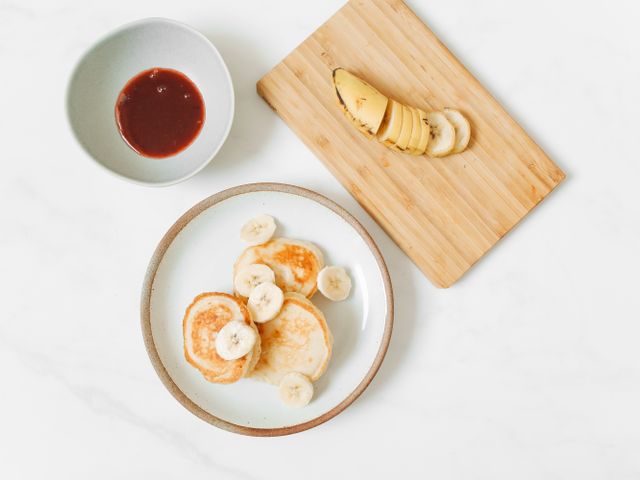
- Serve right away, stacked 3 per plate, with the warmed maple syrup and extra butter if you like.
Good to know
Tips
- Measure flour by spooning it into the cup and leveling it, or weigh it; packed flour makes dense pancakes.
- Your first pancake is a test: adjust the heat and the pour size based on how it browns.
- For add-ins like blueberries or chocolate chips, sprinkle about 1 tablespoon on each pancake right after pouring rather than stirring into the batter.
- If the batter thickens too much after resting, thin it with 1 to 2 tablespoons buttermilk.
Make ahead
"Whisk the dry ingredients and store airtight for up to 1 week. Mix the wet ingredients separately and refrigerate up to 12 hours, then combine and rest 10 minutes before cooking. Cooked pancakes freeze well (see storage)."
Storage & reheating
"Room temperature: up to 2 hours. Fridge: cool completely, then keep airtight up to 3 days. Freezer: freeze in a single layer on a sheet, then bag for up to 2 months. Reheat from fridge in a toaster or a 350°F (175°C) oven for 5 minutes; reheat from frozen in a toaster or a 350°F (175°C) oven for 8 to 10 minutes."
Substitutions
- full-fat buttermilk → 1¾ cups (420 ml) whole milk plus 2 tablespoons lemon juice or white vinegar. Stir and let stand 10 minutes until slightly curdled; pancakes will be a little less tangy and thick.
- all-purpose flour → Half whole wheat flour (125 g) and half all-purpose flour (125 g). Results in a nuttier, denser pancake; rest the batter the full 10 minutes.
- unsalted butter → Neutral oil such as canola, 1 tablespoon (15 ml). Higher smoke point and less browning, but less buttery flavor.
- unsalted butter → Neutral oil, 4 tablespoons (60 ml). Makes a slightly more tender crumb with less buttery flavor.
More pancakes & waffles
See all →

Find more like this
- Meal
- Breakfast
- Cuisine
- American
- Diet
- VegetarianHalal
- Quick & Easy
- Easy