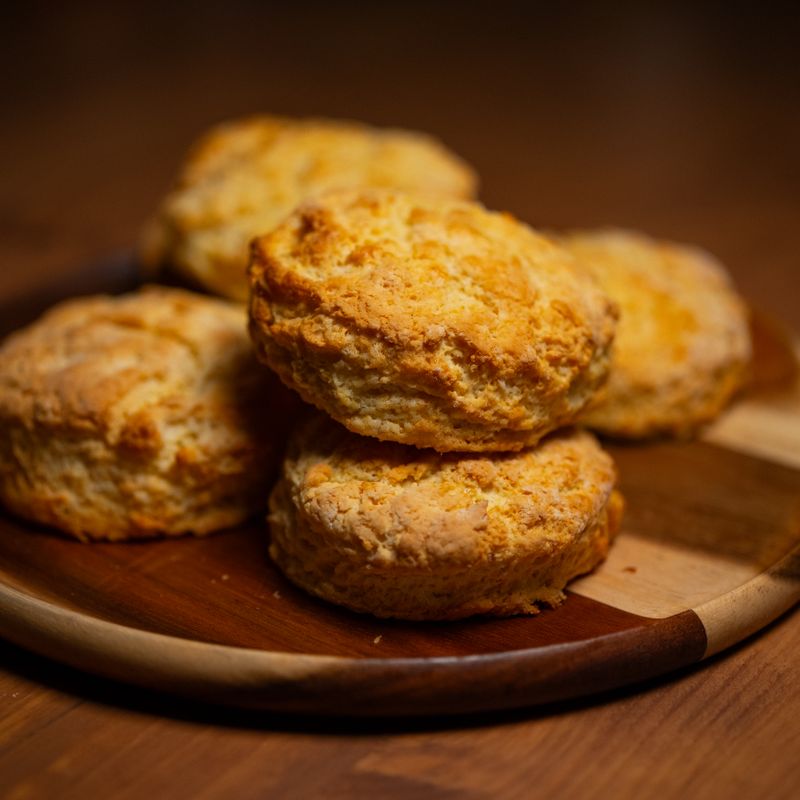
Flaky Buttermilk Biscuits
Tall, tender biscuits with buttery flaky layers and a crisp golden top. A simple fold-and-pat technique and very cold butter create the rise, and a brush of melted butter finishes them.
- Prep
- 20 min
- Cook
- 15 min
- Wait
- 20 min
- Total
- 55 min
- Makes
- 8 biscuits (2½-inch / 6 cm)
Steps
Before you start
- Cut the butter into cubes and chill it in the freezer for at least 15 minutes. Keep the buttermilk in the fridge until you use it.
- Position an oven rack in the center and preheat the oven to 450°F (230°C) with a heavy baking sheet inside if you want extra-crisp bottoms. This is optional.
- Measure flour by spooning it into the cup and leveling it, or use the gram weights. Packed flour makes dry, dense biscuits.
- Use a sharp round cutter and press straight down without twisting. Twisting seals the edges and stops the biscuits from rising.
Preheat and prepOven 450°F / 230°C
- Place an oven rack in the center and heat the oven to 450°F (230°C).
- Line a rimmed baking sheet with parchment paper.
- Cube the butter and place it in the freezer for 15 minutes while you gather the other ingredients.
+ Show details− Hide details
Ready when: Butter cubes feel hard and very cold to the touch
Tip: Cold butter melts during baking and releases steam, which creates the flaky layers.
Whisk dry ingredients
- In a large bowl, whisk together 2½ cups (300 g) flour, the baking powder, baking soda, sugar, and salt for about 30 seconds until evenly combined with no clumps of baking soda.
+ Show details− Hide details
Ready when: Mixture looks uniform and pale
Cut in butter
- Add the frozen butter cubes.
- Toss to coat, then press and flatten each cube between your fingertips into thin flakes, or use a pastry cutter.
- Work quickly for about 2 minutes, stopping when you have a mix of pea-sized and almond-sized pieces of butter coated in flour.
+ Show details− Hide details
Ready when: Butter pieces range from pea-size to flat flakes; the flour looks shaggy, not sandy
Tip: If the butter feels soft or greasy, chill the bowl in the freezer for 10 minutes before continuing.
Add buttermilk
- Make a well in the center.
- Pour in the cold buttermilk and stir with a spatula or fork about 15 strokes, just until the flour is mostly moistened and a shaggy, sticky dough forms with a few dry patches.
+ Show details− Hide details
Ready when: Dough clumps together in a shaggy mass with a few dry bits remaining
Tip: Overmixing develops gluten and makes tough biscuits. Stop while it still looks a bit rough.
Pat out dough
- Turn the dough onto a lightly floured counter.
- Dust your hands and pat it into a rough rectangle about 8×10 inches (20×25 cm) and ¾ inch (2 cm) thick, pressing in any dry bits.
- Use only as much extra flour as needed to prevent sticking.
+ Show details− Hide details
Ready when: Dough holds together in a rough rectangle with visible butter streaks
Fold for layers
- Using a bench scraper, fold the rectangle in thirds like a letter.
- Rotate 90 degrees, pat out again to about 8×10 inches, and fold in thirds once more.
- Pat the dough to a final thickness of 1 inch (2.5 cm), about 6×8 inches.
+ Show details− Hide details
Ready when: Dough is 1 inch thick with visible layers along the edges
Tip: Fold only twice. More folds warm the butter and toughen the dough.
Cut biscuits
- Dip a 2½-inch (6 cm) cutter in flour.
- Press straight down firmly without twisting, and lift straight up.
- Cut as many rounds as you can close together, then gently press the scraps together once (do not knead) and cut the remaining biscuits to make 8 total.
+ Show details− Hide details
Ready when: 8 rounds with clean, straight sides
Tip: Biscuits from rerolled scraps will be a little less tall, so bake them separately if you like.
Arrange and chill
- Place the biscuits on the lined sheet so they touch, with sides about ¼ inch (6 mm) apart or just touching, which helps them rise tall.
- Brush the tops with half of the melted butter.
- Chill the tray in the freezer for 5 minutes while the oven finishes heating.
+ Show details− Hide details
Ready when: Biscuits feel firm and cool
Tip: Reserve the remaining melted butter for brushing after baking.
BakeOven 450°F / 230°C
- Bake at 450°F (230°C) for 13 to 16 minutes, rotating the pan front to back after 8 minutes, until the biscuits have risen about double and are deep golden brown on top and lightly browned on the bottom.
+ Show details− Hide details
Ready when: Tops are deep golden and the sides feel set and dry when tapped
Tip: Do not open the oven in the first 8 minutes, or the rise may suffer.
Finish and serve
- Immediately brush the hot biscuits with the remaining melted butter and sprinkle with flaky salt if using.
- Cool on the tray for 5 minutes so the interiors set, then serve warm.
+ Show details− Hide details
Ready when: Biscuits split open with steamy, tender, layered interiors
Tip: Pull biscuits apart by hand rather than cutting with a knife to keep the layers fluffy.
Good to know
Tips
- Keep everything cold. If the dough becomes sticky or the butter softens, chill it for 10 minutes before continuing.
- Press the cutter straight down and lift straight up. Twisting seals the edges and reduces rise.
- Placing the biscuits touching each other makes them climb upward; spaced apart they spread more and rise less.
- Check your baking powder's date. Old baking powder is the most common reason for flat biscuits.
Make ahead
"Cut the biscuits, place them on a parchment-lined tray, and freeze solid (about 1 hour). Transfer to a freezer bag for up to 2 months. Bake straight from frozen at 425°F (220°C) for 18 to 22 minutes. You can also refrigerate the cut, unbaked biscuits, covered, for up to 8 hours and bake as directed."
Storage & reheating
"Room temperature: airtight container up to 1 day. Refrigerator: up to 4 days. Freezer: baked biscuits, wrapped well, up to 2 months. Reheat at 350°F (175°C) for 8 to 10 minutes (15 minutes from frozen, loosely covered with foil) until warmed through and crisp on the outside."
Substitutions
- buttermilk → 1 cup (240 ml) whole milk plus 1 tablespoon lemon juice or white vinegar. Stir and let sit 5 minutes until slightly curdled, then chill before using. The flavor is a bit milder.
- all-purpose flour → Soft Southern-style flour such as White Lily, same weight. Gives an even more tender crumb. You may need a splash less buttermilk.
- unsalted butter → Cold vegetable shortening, same weight or volume. Gives tall biscuits but less buttery flavor. Using half butter and half shortening is a good compromise.
- fine salt → 1½ teaspoons Diamond Crystal kosher salt. Use this if you do not have fine salt. Morton kosher is saltier, so use 1 teaspoon.