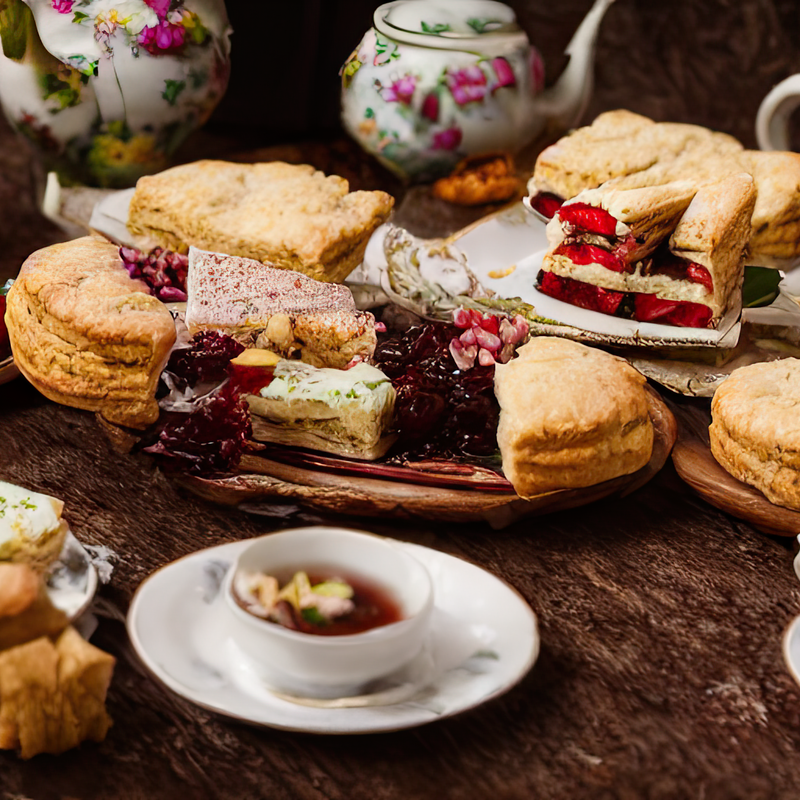
Classic Cream Scones
Tall, tender British-style scones with a golden crust and a soft, flaky crumb, made with cold heavy cream and a little butter. They are quick to mix, and you cut them into wedges, so there is no rerolling. Serve them warm with jam and clotted or whipped cream.
- Prep
- 25 min
- Cook
- 17 min
- Wait
- 30 min
- Total
- 1 hr 12 min
- Makes
- 8 scones
Steps
Before you start
- Keep the butter, heavy cream and eggs in the fridge until the moment you use them. Cold fat is what makes scones rise tall and flaky.
- Position an oven rack in the center of the oven. Preheat to 425°F (220°C) while the dough chills, not before.
- Measure the flour by spooning it into the cup and leveling it off, or better, weigh it. Packed flour makes dry, heavy scones.
- Plan on about 70 minutes from start to finish, including 15 minutes of chilling and 15 minutes of cooling.
Prepare the pan
- Line a large rimmed baking sheet with parchment paper.
- Make sure the oven rack is in the center position.
- Do not turn the oven on yet.
+ Show details− Hide details
Ready when: Pan is lined and ready next to your work surface.
Whisk dry ingredients
- In a large bowl, whisk together the flour, sugar, baking powder and salt for about 30 seconds, until evenly combined with no clumps of baking powder.
+ Show details− Hide details
Ready when: Mixture looks uniform and pale.
Cut in the butter
- Add the cold butter cubes to the flour mixture.
- Use a pastry cutter, or rub with your fingertips, to work the butter in.
- Toss and press for 2 to 3 minutes.
- Stop when most of the butter is the size of small peas and the rest looks like coarse crumbs.
+ Show details− Hide details
Ready when: Mixture looks like coarse crumbs with visible pea-sized butter pieces.
Tip: If the butter starts to feel soft or greasy, put the bowl in the freezer for 5 minutes before continuing.
Mix the wet ingredients
- In a medium bowl or large measuring cup, whisk the beaten egg and the ¾ cup (180 ml) cold heavy cream until smooth and uniform in color.
+ Show details− Hide details
Ready when: No streaks of egg remain.
Form the dough
- Make a well in the center of the flour mixture and pour in the cream mixture.
- Stir with a fork or spatula for about 20 seconds, only until the dry flour is mostly moistened and a shaggy, slightly sticky dough forms.
- Use your hands to gently press in any dry bits at the bottom of the bowl.
+ Show details− Hide details
Ready when: Dough holds together when pressed, with a few dry spots at most. It is shaggy, not smooth.
Tip: Don't knead or overmix. Overworked dough turns tough instead of tender.
Shape and cut
- Turn the dough out onto a lightly floured counter and dust your hands with flour.
- Gently pat and fold it over on itself 2 or 3 times to bring it together.
- Then pat it into a round about 7 inches (18 cm) across and 1 inch (2.5 cm) thick.
- Use a sharp knife or bench scraper dipped in flour to cut the round into 8 equal wedges.
- Press straight down rather than sawing.
- Transfer the wedges to the lined baking sheet, spacing them about 2 inches (5 cm) apart.
+ Show details− Hide details
Ready when: 8 even wedges, each about 1 inch thick.
Tip: Cutting straight down, without twisting, keeps the edges open so the scones rise evenly.
Chill the sconesOven 425°F / 220°C
- Refrigerate the baking sheet, uncovered, for 15 minutes.
- About 5 minutes before the end, preheat the oven to 425°F (220°C) with the rack in the center.
+ Show details− Hide details
Ready when: Scones feel firm to a light touch, and the oven has reached 425°F (220°C).
Apply the glaze
- In a small bowl, whisk the egg yolk with the 1 tablespoon (15 ml) heavy cream.
- Brush a thin layer over the tops of the scones.
- Keep the glaze off the cut sides, because it can glue the layers together and stop them rising.
- Sprinkle with coarse sugar if using.
+ Show details− Hide details
Ready when: Tops are evenly shiny, with no puddles around the base.
Tip: Brush gently and avoid letting glaze drip down the sides.
Bake the sconesOven 425°F / 220°C
- Bake at 425°F (220°C) for 15 to 18 minutes, rotating the pan front to back after 10 minutes, until the scones are risen and deep golden brown on top and lightly golden on the bottoms.
- They should sound slightly hollow when tapped on the base.
+ Show details− Hide details
Ready when: Deep golden tops, golden bottoms, and no raw dough visible in the cracks at the sides.
Tip: Ovens vary. Check at 15 minutes, and if the tops brown too fast, tent loosely with foil.
Cool briefly and serve
- Move the scones to a wire rack and let them cool for at least 15 minutes.
- This lets the crumb finish setting.
- Serve warm or at room temperature with jam and clotted or whipped cream.
+ Show details− Hide details
Ready when: Scones are warm, not hot, to the touch and the crumb is set.
Tip: For the best texture, split them by hand along the natural seam instead of cutting.
Good to know
Tips
- Keep everything cold. If your kitchen is warm, chill the flour mixture and bowl for 10 minutes before adding the cream.
- Handle the dough as little as possible. A slightly shaggy, sticky dough gives the most tender scones.
- Cut the dough straight down without twisting the cutter or knife. Twisting seals the edges and limits the rise.
- Add 1/2 cup (75 g) currants or raisins to the dry mixture, or 1 teaspoon vanilla to the cream, for a variation.
Make ahead
"Shape and cut the scones, then freeze them on the lined baking sheet until solid, about 1 hour. Transfer to a freezer bag for up to 1 month. Bake from frozen: glaze, then bake at 425°F (220°C) for 18 to 22 minutes. You can skip the 15-minute chill. Alternatively, cover the cut, unbaked scones and refrigerate for up to 12 hours before glazing and baking."
Storage & reheating
"Room temperature: keep in an airtight container for up to 2 days. Fridge: not recommended, because it dries them out. Freezer: wrap baked, cooled scones tightly and freeze for up to 2 months. Reheat room-temperature or thawed scones on a baking sheet in a 350°F (175°C) oven for 5 to 8 minutes, or frozen ones for 10 to 12 minutes, until warmed through and the crust feels crisp."
Substitutions
- all-purpose flour → Pastry flour, or 2 cups (250 g) all-purpose flour plus ½ cup (60 g) cake flour. Gives an even more tender crumb. Don't use bread flour, which makes the scones chewy.
- heavy cream → Cold whole milk plus an extra 2 tablespoons (28 g) cold butter. Scones will be a little less rich and slightly less tender. Use 3/4 cup (180 ml) milk and cut in the added butter.
- baking powder → ¼ teaspoon baking soda plus ¾ teaspoon cream of tartar per 1 teaspoon of baking powder. Mix thoroughly with the flour. For this recipe, use ⅔ teaspoon baking soda and 1¾ teaspoons cream of tartar.
- coarse sugar or turbinado sugar → Regular granulated sugar. It will melt into a thinner glaze with less crunch, but the flavor is the same.
More scones & biscuits
See all →
Find more like this
- Meal
- Breakfast
- Diet
- VegetarianHalal
- Method
- Oven
- Quick & Easy
- Easy