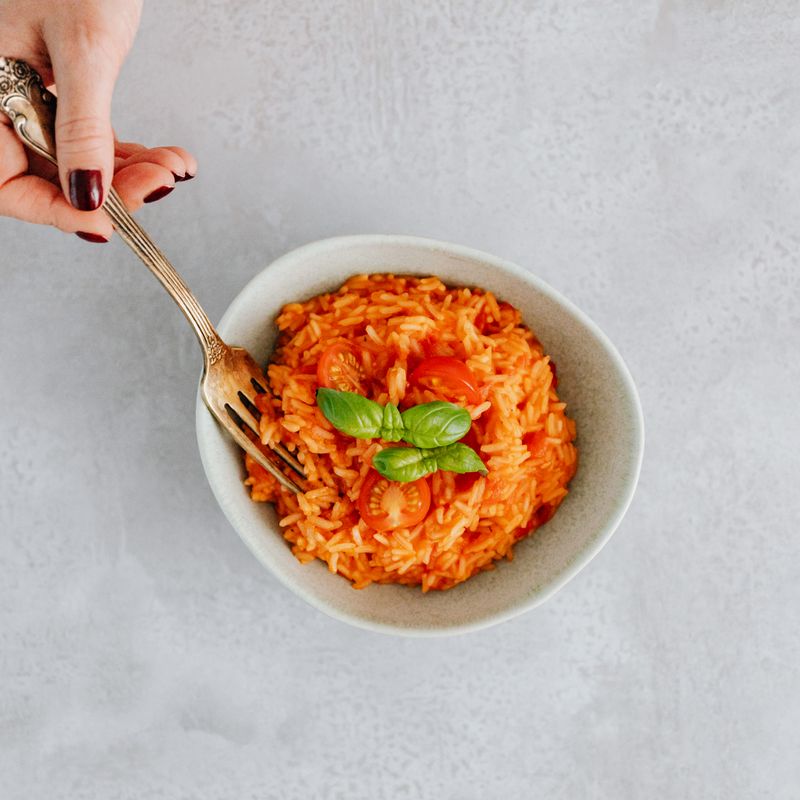
Creamy Tomato Basil Risotto
A silky, stovetop arborio risotto simmered with onion, white wine and crushed tomatoes, then finished with Parmesan, butter and a handful of fresh basil. Bright, rich and fully vegetarian.
- Prep
- 15 min
- Cook
- 35 min
- Wait
- 2 min
- Total
- 52 min
- Makes
- 4 main-course servings (about 6 cups / 1.4 L)
Steps
Before you start
- Grate the Parmesan and chop the onion and garlic before you turn on the heat; once the rice goes in, you need to stay at the stove.
- Keep the broth hot in a saucepan over low heat the whole time. Cold broth stalls cooking and makes the rice gummy.
- Do not rinse the arborio rice. The surface starch is what makes the risotto creamy.
- Check your broth label: if it is salted, hold back on added salt until the end.
Heat the broth
- Pour the broth into a 2-quart saucepan and bring to a bare simmer over medium-low heat.
- Whisk the tomato paste into the crushed tomatoes in a small bowl and set beside the stove.
- Keep the broth hot, with small bubbles at the edges, for the whole recipe.
+ Show details− Hide details
Ready when: Small bubbles break at the edges of the pan, but the broth is not boiling hard.
Tip: Cover the pot with a lid to limit evaporation so your broth amount stays accurate.
Soften the onion
- Set a 12-inch deep skillet or 4-quart pot over medium heat.
- Add the olive oil and 1 tablespoon butter.
- When the butter foams, add the onion and ¼ teaspoon of the salt.
- Cook, stirring often, for 5 to 6 minutes.
- Add the garlic and cook 30 seconds more.
+ Show details− Hide details
Ready when: Onion is soft and translucent with no brown edges; garlic smells fragrant.
Tip: If the onion starts to brown, lower the heat. Browned onion turns the risotto bitter instead of sweet.
Toast the rice
- Add the rice to the pot.
- Stir constantly for 2 to 3 minutes so every grain is coated in fat and heated through.
+ Show details− Hide details
Ready when: The edges of the grains turn translucent while the centers stay opaque white, and you hear a faint clicking against the pan.
Add the wine
- Pour in the wine.
- Stir steadily until the pan is nearly dry and the sharp alcohol smell has faded, about 2 minutes.
+ Show details− Hide details
Ready when: Liquid is almost completely absorbed and a spoon dragged across the bottom leaves a clear trail.
Stir in tomatoes
- Add the tomato mixture and the remaining ½ teaspoon salt.
- Stir for about 2 minutes, until the tomato darkens slightly and clings to the rice and the pan is nearly dry again.
+ Show details− Hide details
Ready when: The tomato looks thick and jammy, coating the rice rather than pooling.
Tip: Cooking the tomato briefly before adding broth removes its raw, tinny edge.
Add broth gradually
- Add 1 cup (240 ml) hot broth.
- Stir often, adjusting the heat so the mixture bubbles gently, not violently.
- When the spoon leaves a trail that slowly closes and the rice looks almost dry, add another ½ cup (120 ml) ladleful.
- Repeat, stirring frequently, for 18 to 22 minutes in total.
- Keep about ½ cup (120 ml) broth in reserve.
+ Show details− Hide details
Ready when: Rice is creamy and loose like thick porridge. Taste a grain: it should be tender outside with a slight firm bite (al dente) in the center, with no chalky white dot.
Tip: You may not need all the broth. If the rice is still hard after it is used up, add hot water ¼ cup at a time.
Finish off heat
- Remove the pot from the heat.
- Stir in the Parmesan, the cold butter cubes, and the basil.
- Add a splash of the reserved broth if needed so the risotto flows slowly when the pan is tilted.
- Season with pepper, more salt as needed, and the lemon juice if using.
+ Show details− Hide details
Ready when: Risotto looks glossy and creamy, and it spreads into a loose mound when spooned onto a plate.
Tip: Adding the basil off the heat keeps it bright green and fragrant instead of dark and dull.
Rest and serve
- Cover the pot and let it rest for 2 minutes so the rice relaxes and thickens slightly.
- Stir once, then spoon into warm shallow bowls.
- Top with extra Parmesan, small basil leaves, and black pepper.
- Serve immediately.
+ Show details− Hide details
Ready when: Risotto holds a soft shape but still slowly spreads on the plate.
Tip: Risotto firms up quickly as it cools, so serve right away.
Good to know
Tips
- Stir often, not nonstop. Regular stirring rubs starch off the grains, which creates the creaminess.
- Taste the rice for doneness starting at 16 minutes; cook times vary with pot width and heat.
- Risotto should be slightly looser than you want it on the plate, since it thickens as it sits.
- Use a wide pan so the liquid evaporates evenly and the rice cooks in a shallow layer.
Make ahead
"For a head start, dice the onion, mince the garlic, and grate the Parmesan up to 1 day ahead and refrigerate in separate covered containers. Risotto itself is best made fresh."
Storage & reheating
"Room temperature: up to 1 hour (do not leave cooked rice out longer). Refrigerator: cool quickly and store in an airtight container up to 3 days. Freezer: not recommended, as the texture turns grainy. Reheat in a skillet over medium-low heat with a splash of broth or water, stirring until hot and creamy, about 4 to 5 minutes."
Substitutions
- dry white wine → Additional vegetable broth plus 1 teaspoon white wine vinegar or lemon juice. Gives similar acidity without alcohol.
- Parmesan cheese → Pecorino Romano. Saltier and sharper; reduce added salt slightly. For strict vegetarians, check that the cheese uses non-animal rennet.
- arborio rice → Carnaroli or vialone nano rice. Same quantity; both make excellent risotto and are slightly more forgiving.
- unsalted butter → Extra-virgin olive oil or vegan butter. Use the same amount for a dairy-lighter finish.