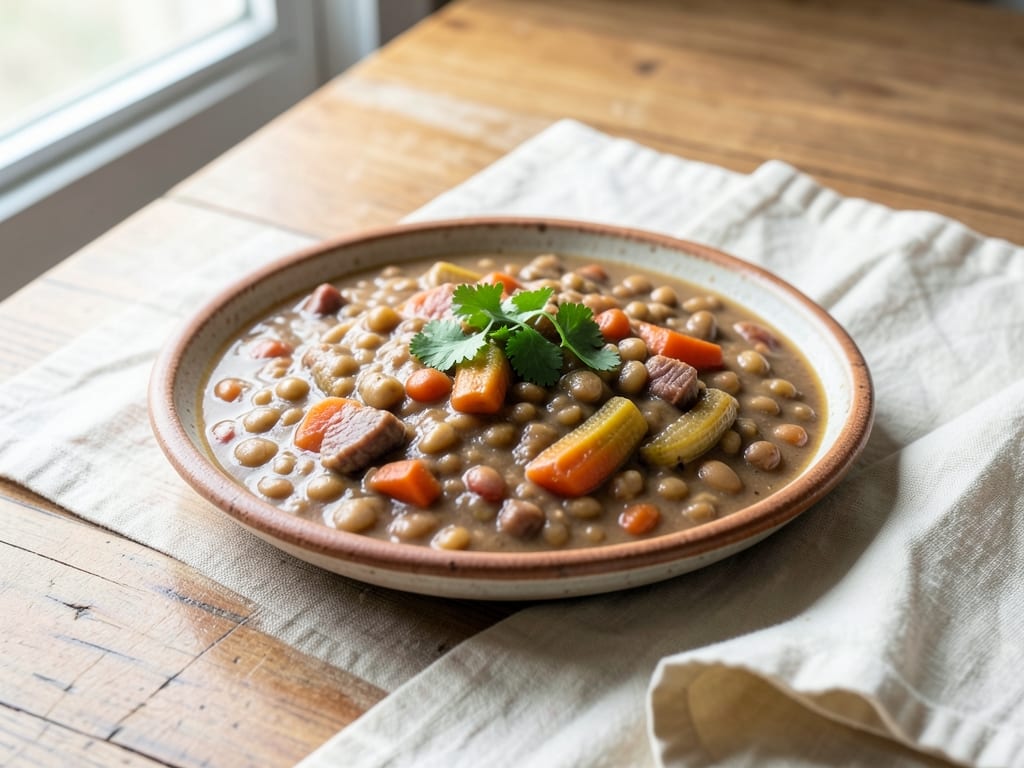
Colombian Frijoles Antioqueños
A hearty, comforting bean stew from Colombia's Antioquia region. Tender pork belly simmers with cargamanto beans, plantain, and carrot in a rich broth infused with cilantro and the aromatic Colombian sofrito called hogao. The starch from plantains naturally thickens the stew into a creamy, deeply flavorful dish. This traditional comida corriente component is satisfying enough to serve as a main dish any time of day.
- Prep
- 20 min
- Cook
- 35 min
- Wait
- 1 hr 20 min
- Total
- 2 hr 15 min
- Makes
- 8 servings (about 6 to 7 cups)
Steps
Before you start
- Soak dried cargamanto beans 8 hours or overnight in plenty of cold water
- Gather and prep all vegetables before starting to cook so you can work smoothly
- Read the entire recipe to understand the timing: about 2.5 hours total with roughly 40 minutes hands-on work and 80 minutes of unattended simmering
Brown the pork belly
- Heat 2 tablespoons of vegetable oil in a large heavy pot (5–6 quart) or Dutch oven over medium-high heat.
- While the oil heats, pat the pork chunks dry with paper towels and season generously on all sides with kosher salt and black pepper.
- Once the oil is shimmering and just beginning to smoke, add the pork in batches (do not overcrowd the pot—work in 2–3 batches if needed) and cook for 3–4 minutes per side until the surfaces are deep golden brown.
- Avoid stirring the pieces during the first 2–3 minutes; let them sit to develop color.
- As each batch finishes, transfer it to a plate using tongs.
- The entire browning process takes about 15 minutes.
+ Show details− Hide details
Ready when: Pork is deep golden brown on all sides with rendered fat pooled in the pot
Tip: Do not skip browning—it develops fond (browned bits) that builds the stew's complex, savory foundation. The rendered pork fat also flavors the hogao.
Make the colombian hogao
- Add the diced onion and minced garlic to the same pot (do not clean it—the fond adds depth).
- Reduce heat to medium and sauté, stirring often, for 2 minutes until the onion begins to soften and becomes translucent.
- Add the finely diced tomatoes and chopped cilantro, and continue cooking for 5 minutes more, stirring occasionally, until the tomatoes soften, break down, and become a thick, sauce-like consistency.
- The mixture should smell deeply aromatic.
- Stir in the ground cumin and cook for 30 seconds until very fragrant.
+ Show details− Hide details
Ready when: Tomatoes have broken down into a thick, cohesive sauce; mixture is aromatic and darkened
Tip: This hogao (Colombian sofrito) is the soul of the stew—don't rush it. The flavors need time to marry and deepen.
Add beans and broth, start simmering
- Return the browned pork to the pot along with any juices that accumulated on the plate.
- Add the drained and rinsed soaked beans and 6 cups of beef broth.
- Stir well with a wooden spoon to combine everything and submerge the beans.
- Increase heat to medium-high and bring to a boil, stirring occasionally, about 3–4 minutes.
- Once boiling, reduce heat to medium-low, place the lid on the pot, and simmer gently.
- The liquid should bubble occasionally but not boil hard.
- Simmer covered for 45 minutes, stirring once or twice, until the beans are nearly tender (they should yield easily to pressure from a spoon) and the pork is very tender when pierced with a fork.
+ Show details− Hide details
Ready when: Beans are nearly tender but not falling apart; pork shreds easily; broth is rich and aromatic
Tip: Keep the heat at medium-low for a gentle simmer—a hard boil will break beans unevenly and make the stew mushy.
Add plantains and carrots, finish simmering
- After 45 minutes of simmering, carefully add the peeled, chunked green plantain and the carrot rounds to the pot.
- Stir gently to submerge the vegetables.
- Keep the lid on and continue simmering over medium-low heat for 35 more minutes, stirring very gently every 10–12 minutes.
- The stew is finished when the plantain chunks are very soft and some pieces are starting to break apart into the broth, the carrots are completely tender, the pork is falling-apart tender, and the stew looks thick and creamy from the plantain starch that has released into the liquid.
+ Show details− Hide details
Ready when: Plantain is very soft and partially broken down; carrots are completely tender; stew is thick and creamy, not watery
Tip: Stir very gently after adding plantains—they break apart easily and partially melting into the broth is expected and desired. It creates the stew's signature creamy texture.
Taste and finish to serve
- Turn off the heat and let the stew rest for 1 minute.
- Taste a spoonful of broth and stew.
- Add kosher salt and black pepper to taste (start with 1/2 teaspoon salt and 1/4 teaspoon pepper, taste, then adjust).
- The flavors should taste savory and rich, with hints of cilantro and cumin woven through.
- Ladle into bowls and serve piping hot.
- Frijoles antioqueños traditionally appears as the centerpiece of a Colombian breakfast plate (comida corriente) alongside white rice, a fried egg, corn arepas, and fresh fruit, but it is equally delicious as a main dish any time of day.
+ Show details− Hide details
Ready when: Flavors are well-balanced and savory; stew is piping hot
Tip: Taste before adding more salt during browning—you can always add salt at the end, but you cannot remove it.
Good to know
Tips
- Browning the pork is not optional—it creates fond (browned bits) that build the stew's savory depth and give it authentic flavor. Don't skip this step.
- Plantains break down naturally as the stew cooks, releasing starch that thickens the broth into a creamy, luxurious texture. Gentle stirring is key; some breakdown is desired and expected.
- Frijoles antioqueños improves in flavor the next day as the beans absorb more broth and flavors deepen. Make it ahead for an easy, impressive meal.
- Serve traditionally with white rice, a fried egg, corn arepas, fresh tomato salad, and sliced avocado for an authentic Colombian comida corriente breakfast.
Make ahead
Frijoles antioqueños tastes even better the next day as flavors meld and deepen. Prepare up to 2 days ahead and refrigerate in an airtight container. Reheat gently on the stovetop over medium heat, stirring occasionally, about 10–15 minutes. Add a splash of water if the stew seems too thick after cooling.
Storage & reheating
Refrigerate in airtight containers for up to 3 days. Freeze in freezer bags or containers for up to 3 months. To reheat refrigerated stew: warm gently on the stovetop over medium heat, stirring occasionally, about 10–15 minutes, adding water if needed. To reheat from frozen: thaw overnight in the fridge, then warm as above.
Substitutions
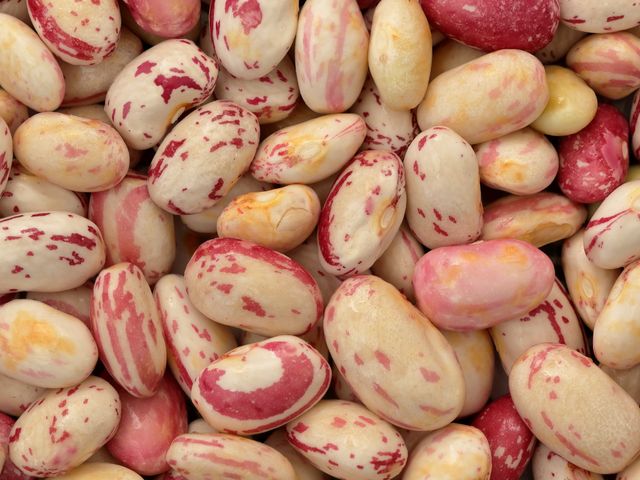
- cargamanto beans → Red beans or pinto beans. Use the same weight or volume; cooking time remains the same. The stew will taste slightly different but equally delicious.
- pork belly → Pork shoulder, pork spare ribs, or beef chuck. Pork shoulder and ribs need no extra cooking time. Beef chuck may need an additional 15–20 minutes of simmering to become very tender.
- cargamanto beans → 4 cans (15 oz/425 g each) drained and rinsed red beans or white beans. Skip soaking; reduce total bean simmering time to 20–25 minutes since canned beans are already cooked. Reduce overall recipe time by about 50 minutes.
- fresh cilantro → Parsley or culantro (recao). Parsley will be milder in flavor. Culantro (recao) offers a stronger, more authentic Colombian flavor.
More stews
See all →

Find more like this
- Meal
- Lunch
- Main ingredient
- PorkBeans & Lentils
- Method
- Stovetop