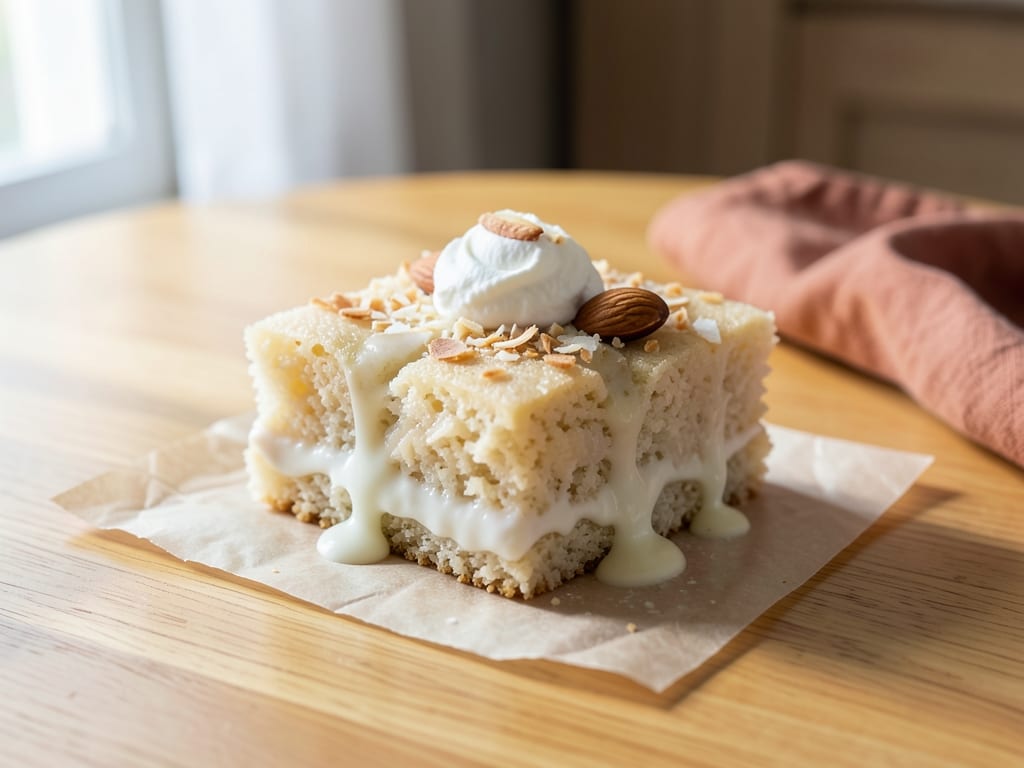
Coconut Tres Leches Basbousa
A fusion dessert that marries the Middle Eastern tradition of basbousa—a semolina and coconut cake—with the Latin American tres leches technique of soaking a cake in three types of milk. Instead of the traditional sweet syrup, this version uses a three-milk mixture featuring evaporated milk, condensed milk, and full-fat coconut milk, which complements the basbousa's inherent coconut flavor while creating a moist, tender crumb with a custardy interior. The result is a delicate, lightly sweet cake with complex coconut notes and deep soaking throughout.
- Prep
- 11 min
- Cook
- 30 min
- Wait
- 2 hr 47 min
- Total
- 3 hr 28 min
- Makes
- One 9×13-inch cake (12 servings)
Steps
Before you start
- Preheat your oven to 350°F (175°C)
- Have all ingredients at room temperature, especially Greek yogurt and coconut oil
- Line a 9×13-inch baking pan with parchment paper
- Measure out the three milk types before baking so you're ready to pour immediately when the cake comes out hot
Mix the basbousa batter
- Combine 2 cups (160g) unsweetened shredded coconut, 1½ cups (180g) fine semolina flour, ¼ cup (50g) granulated sugar, and 1 tablespoon (15g) baking powder in a medium bowl.
- Whisk together until evenly mixed.
- Add ¾ cup (180ml) sweetened condensed milk, ½ cup (120g) Greek yogurt at room temperature, 2 tablespoons (30ml) melted coconut oil, 1 teaspoon (5ml) vanilla extract, and ½ teaspoon (3g) salt.
- Stir with a spatula or your hand until the mixture forms a uniform, slightly sticky dough.
- The texture should resemble wet sand that holds together when squeezed.
+ Show details− Hide details
Ready when: Mixture is uniform and slightly sticky, holds together when squeezed
Tip: Don't overmix after adding wet ingredients or the cake will be tough—just combine until no dry streaks remain.
Spread and score the cakeOven 350°F / 175°C
- Preheat your oven to 350°F (175°C).
- Line a 9×13-inch (23×33 cm) baking pan with parchment paper.
- Transfer the batter to the pan and dampen your hands slightly.
- Press the batter evenly across the bottom and into all corners to about ½-inch thickness.
- Using a sharp fork, pierce the entire surface with small holes—this helps the milk soak absorb evenly throughout.
- With a sharp knife, score the cake into 12 equal pieces (3 rows by 4 columns, or adjust to preference), cutting three-quarters of the way through to the bottom layer but not all the way through.
- The scoring lines should be clean and straight for neat serving pieces.
+ Show details− Hide details
Ready when: Batter is evenly spread to ½-inch thickness; surface is evenly pierced and scored in 12 neat pieces
Tip: Dampen your hands to prevent sticking and ensure even, smooth pressing. Score while the batter is still soft for the cleanest lines.
Bake the basbousaOven 350°F / 175°C
- Place the scored pan in the preheated 350°F (175°C) oven on the middle rack.
- Bake for 28 to 32 minutes until the top is light golden brown and a toothpick inserted into the center comes out clean or with just a few moist crumbs.
- The edges should pull slightly away from the sides of the pan.
- Do not overbake or the cake will be too dry to absorb the milk properly.
+ Show details− Hide details
Ready when: Top is light golden brown; toothpick comes out clean or with just a few moist crumbs; edges pull slightly from pan sides
Tip: Underbaking slightly is better than overbaking for tres leches—a tender, slightly moist crumb absorbs milk better than a dense one.
Prepare the tres leches mixture
- While the cake bakes, whisk together 1 cup (240ml) evaporated milk, ¾ cup (180ml) sweetened condensed milk, ¾ cup (180ml) full-fat coconut milk, 1 tablespoon (15ml) vanilla extract, and a pinch (2g) of fine salt in a small bowl or liquid measuring cup.
- Whisk until smooth and well combined.
- Set aside.
- The mixture should be consistent with no lumps.
+ Show details− Hide details
Ready when: Mixture is smooth, well combined, with no lumps
Tip: Make sure the condensed milk is fully whisked in—small lumps won't dissolve once poured on the hot cake.
Soak the hot cake
- Remove the basbousa from the oven and let it rest on the countertop for 2 to 3 minutes—it should still be hot but not steaming.
- Using a fork, carefully pierce the entire surface all over, going deeper than the initial piercing (about ¼-inch to ½-inch depth) but not cutting through to the bottom.
- You want to create a network of small channels for milk to travel through.
- Slowly pour the entire tres leches mixture over the hot cake, starting from the outer edges and working steadily toward the center.
- Pour in a thin stream to allow even absorption rather than having liquid pool.
- The surface will look quite wet; this is normal.
- After pouring, let the cake sit undisturbed for 1 to 2 minutes so the milk begins absorbing.
- Then, if there are obvious pools of liquid, gently tilt the pan to redistribute toward drier areas.
+ Show details− Hide details
Ready when: Entire surface is pierced; milk is poured evenly and beginning to absorb; visible pools are minimal
Tip: The cake must be hot when you pour the milk so it absorbs more efficiently. If it cools too much, the milk may sit on top rather than soaking through. Pour slowly to avoid waste and ensure even distribution.
Cool and chill the cake
- Set the pan aside on a wire rack or clean countertop to cool to room temperature, about 30 to 45 minutes.
- Once cooled, cover the pan loosely with plastic wrap or foil (loosely so condensation doesn't drip back onto the cake) and refrigerate for at least 2 hours, or preferably overnight.
- During this time, the milk continues to be absorbed into the crumb, and the flavors meld and develop.
- The cake should be fully chilled and have a custardy, moist texture when ready to serve.
+ Show details− Hide details
Ready when: Cake has cooled to room temperature and chilled until cold and fully soaked (minimum 2 hours)
Tip: Don't skip the chilling time—it's essential for proper milk absorption and texture. The cake actually tastes better the next day as flavors continue to meld and deepen.
Finish and serve
- Remove the cake from the refrigerator about 10 minutes before serving to let it come close to room temperature, or serve it chilled if you prefer.
- Using a sharp knife dipped in hot water and wiped clean, cut along the scored lines to separate pieces.
- Transfer each piece to a plate.
- Top with a generous dollop (about 2 to 3 tablespoons per piece) of whipped cream.
- Garnish with toasted coconut flakes and whole or halved roasted almonds.
- Serve chilled or at room temperature, based on preference.
+ Show details− Hide details
Tip: A hot knife dipped in hot water and wiped clean makes cutting through the creamy cake much easier and produces clean, neat pieces.
Good to know
Tips
- The key to a great tres leches cake is the texture of the base—it should be tender and spongy enough to absorb milk without collapsing. Don't overbake the basbousa; a toothpick with a few moist crumbs is ideal. You want the cake slightly underbaked rather than bone-dry so it can fully absorb the milk.
- Always pierce the hot cake, never a cooled one. Hot cake absorbs liquid more efficiently through osmosis. If you wait until it cools, the milk may sit on top rather than soaking through to the center.
- Whipped cream is traditional, but coconut whipped cream (made from chilled canned coconut milk) is a beautiful alternative that enhances the coconut theme and pairs beautifully with this dessert.
- This dessert is best served cold or at room temperature for the most pronounced custardy texture and refreshing flavor. You can also serve it slightly warmed—warm gently in a 300°F (150°C) oven for 5–10 minutes and serve without whipped cream for a different experience.
Make ahead
The cake actually improves after a day of soaking—flavors deepen and the texture becomes more custardy. Bake through Step 6 (chilling) up to 2 days ahead. Store covered in the refrigerator. Whipped cream and toppings should be added just before serving.
Storage & reheating
Room temperature (up to 4 hours): Cover loosely with foil. The cake will remain moist and delicious. Refrigerator (up to 3 days): Cover tightly with plastic wrap or foil. The cake keeps exceptionally well and flavors deepen. Bring to room temperature 15–20 minutes before serving, or serve chilled. Freezer (up to 1 month): Wrap the entire cake tightly in plastic wrap then foil. Thaw overnight in the refrigerator before serving. Do not freeze whipped cream separately; apply it after thawing and use immediately. Reheating: This cake does not need reheating and is best served chilled or at room temperature straight from storage.
Substitutions
- evaporated milk → Whole milk. Use the same amount. The texture will be slightly less rich and creamy but still delicious. Avoid skim milk as it won't provide enough body to the soak.
- full-fat coconut milk → Heavy cream, or a blend of heavy cream and whole milk. Use ¾ cup heavy cream alone for a traditional tres leches, or ½ cup cream + ¼ cup whole milk for a lighter version with less coconut flavor. The all-cream version will be richer.
- Greek yogurt → Sour cream, or buttermilk with butter. Use ½ cup sour cream for a slightly tangier cake. Or use ⅜ cup buttermilk + 2 tablespoons melted unsalted butter (to compensate for fat loss) for a more delicate crumb.
- coconut oil → Unsalted butter, or neutral vegetable oil. Use the same amount melted. Butter will give a richer, more traditional cake flavor. Neutral oil will produce a lighter cake but you'll lose the subtle coconut aroma.
More cakes
See all →
Find more like this
- Meal
- Dessert
- Cuisine
- Middle Eastern
- Diet
- VegetarianHalal
- Method
- Oven