
Cinnamon Sugar Scones
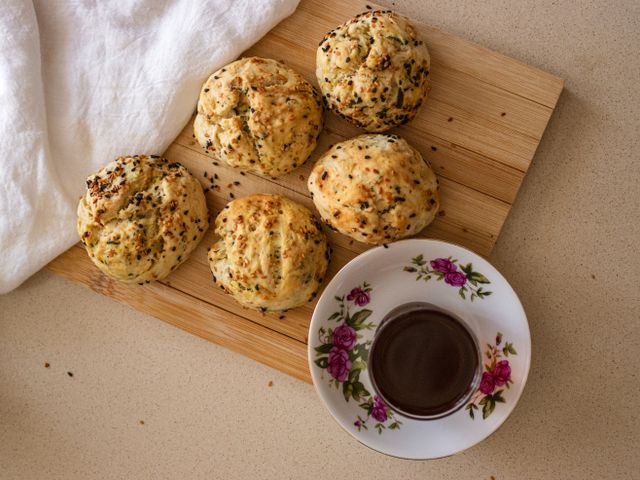
Tender, buttery scones with a sweet cinnamon-sugar coating that crackles when you bite into them. These are made with cold butter cut directly into the dry ingredients, creating a light, crumbly crumb. The exterior has a thin crust of cinnamon sugar that caramelizes slightly in the oven, while the interior stays soft and flaky. Perfect for breakfast or afternoon tea, best served warm.
Steps
Before you start
- Use cold butter straight from the refrigerator—this is essential for flaky scones
- Preheat your oven to 400°F (200°C) 15 minutes before baking
- Line a baking sheet with parchment paper
- Have all dry ingredients measured and ready to mix
Mix dry ingredients
- In a large bowl, whisk together 2¼ cups (280 g) flour, ¼ cup (50 g) sugar, 2½ teaspoons (12 g) baking powder, and ½ teaspoon (3 g) salt.
- Make sure there are no lumps of baking powder.
+ Show details− Hide details
Ready when: mixture is evenly combined and resembles coarse sand
Tip: Whisking the leavening agent separately prevents dense spots in the scones
Cut in cold butter
- Add 6 tablespoons (85 g) of cold butter cubes to the dry mixture.
- Using a pastry cutter, two forks, or your fingertips, work the butter into the flour until the mixture resembles coarse breadcrumbs with some pea-sized butter pieces still visible.
- This should take 2–3 minutes.
- Don't overmix; the visible butter creates pockets that become flaky layers.
+ Show details− Hide details
Ready when: mixture has the texture of coarse breadcrumbs with pea-sized butter visible throughout
Tip: If your kitchen is warm, chill the bowl for 10 minutes before this step to keep the butter from melting
Add wet ingredients
- Pour ¾ cup (180 ml) of cold heavy cream and 1 room-temperature egg yolk directly into the flour mixture.
- Using a fork or bench scraper, gently stir just until the mixture comes together into a shaggy dough.
- Do not knead or overmix; some flour streaks are fine and will disappear as you shape the scones.
+ Show details− Hide details
Ready when: dough is just barely combined with no dry flour visible at the bottom of the bowl
Tip: Overworking develops gluten and creates tough, dense scones; stop as soon as you can't see dry flour
Make cinnamon-sugar coating
- In a small bowl, mix 2 tablespoons (25 g) granulated sugar with ¾ teaspoon (1.5 g) ground cinnamon.
- Set aside.
+ Show details− Hide details
Ready when: cinnamon is evenly distributed throughout the sugar
Turn out and flatten dough
- Turn the dough out onto a lightly floured work surface and gently gather it into a ball using your hands—handle it as little as possible.
- Pat or gently roll it into a ¾-inch (2 cm) thick round, roughly 7 inches (18 cm) in diameter.
- The dough should be just thick enough that you can see some butter streaks in it.
+ Show details− Hide details
Ready when: dough is an even thickness about ¾ inch (2 cm) thick
Tip: If the dough is too warm or sticky, slide it onto a baking sheet and refrigerate for 5 minutes before cutting
Cut scones into wedges
- Using a sharp knife dipped in cold water, cut the round of dough into 12 equal wedges, like a pizza.
- Place each wedge point-up on your lined baking sheet, spacing them 2 inches (5 cm) apart so they can rise without touching.
+ Show details− Hide details
Ready when: 12 evenly cut wedges are arranged on the baking sheet
Tip: Wetting the knife with cold water prevents dough from sticking and gives you cleaner cuts
Brush and coat scones
- Lightly brush the top of each scone with cold water or a little of the remaining egg white (if you have it).
- Immediately sprinkle the cinnamon-sugar mixture evenly over each scone, pressing gently so it adheres.
+ Show details− Hide details
Ready when: all scones are coated with a thin, even layer of cinnamon sugar
Tip: Don't skip the egg or water wash—it helps the sugar stick and caramelize in the oven
Bake sconesOven 400°F / 205°C
- Bake at 400°F (200°C) for 14–16 minutes, until the tops are pale golden brown and the edges are firm.
- The scones should still feel slightly soft in the center when pressed lightly.
- Do not overbake or they will become dry.
+ Show details− Hide details
Ready when: tops are pale golden brown, edges are set, and centers feel just barely soft when lightly pressed
Tip: If you have an oven thermometer, verify your oven temperature; scones are very sensitive to heat
Cool slightly and serve
- Remove the baking sheet from the oven and let the scones rest on the pan for 5 minutes.
- They will continue to set slightly.
- Serve warm, ideally within 1 hour of baking, with clotted cream, jam, or butter.
+ Show details− Hide details
Ready when: scones are warm and set enough to handle without breaking, but still soft inside
Tip: Serve immediately for the best texture; scones are best eaten the day they are made
Good to know
Tips
- Measure flour by spooning it into a measuring cup and leveling the top, or weigh it. Scooping directly from the bag compacts the flour and results in tough scones.
- Cold butter is your secret to flaky scones. If your kitchen is warm, chill all your equipment and ingredients beforehand.
- Don't knead or overwork the dough once you add the wet ingredients. A few flour streaks are fine and disappear during shaping.
- For extra-tender scones, chill the shaped dough for 15–20 minutes before baking, but don't skip the oven preheat.
Make ahead
You can prepare the dry mixture the night before and store it in an airtight container. On the day of baking, add the cold butter and cream, form, and bake as directed. Alternatively, shape the scones, coat with cinnamon sugar, place on a baking sheet, cover with plastic wrap, and refrigerate for up to 8 hours before baking—add 2–3 minutes to the bake time if baking from cold.
Storage & reheating
Store room temperature in an airtight container for up to 2 days. Scones are best eaten the day they are made. To reheat, wrap in foil and warm in a 325°F (160°C) oven for 8–10 minutes. Freeze baked scones for up to 3 months in a freezer-safe bag; thaw at room temperature for 2 hours, then reheat as above. Do not refrigerate unbaked scones; the butter will separate.
Substitutions
- heavy cream → Whole milk or Greek yogurt thinned with a little milk. Scones will be slightly less rich but still tender; reduce the amount by 1–2 tablespoons since milk is thinner than cream
- unsalted butter → Cold coconut oil or vegetable shortening. Scones will be slightly less flaky but still good; use the same amount measured in grams
- ground cinnamon → Ground cardamom, ground ginger, or a mix of cinnamon and nutmeg. Use the same amount for an entirely different flavor profile
- large egg yolk → 2 tablespoons heavy cream. Omit the water/egg wash brushing; the scones will be slightly less shiny but still delicious
More scones & biscuits
See all →




Find more like this
- Meal
- Breakfast
- Diet
- VegetarianHalal
- Method
- Oven
- Quick & Easy
- Easy