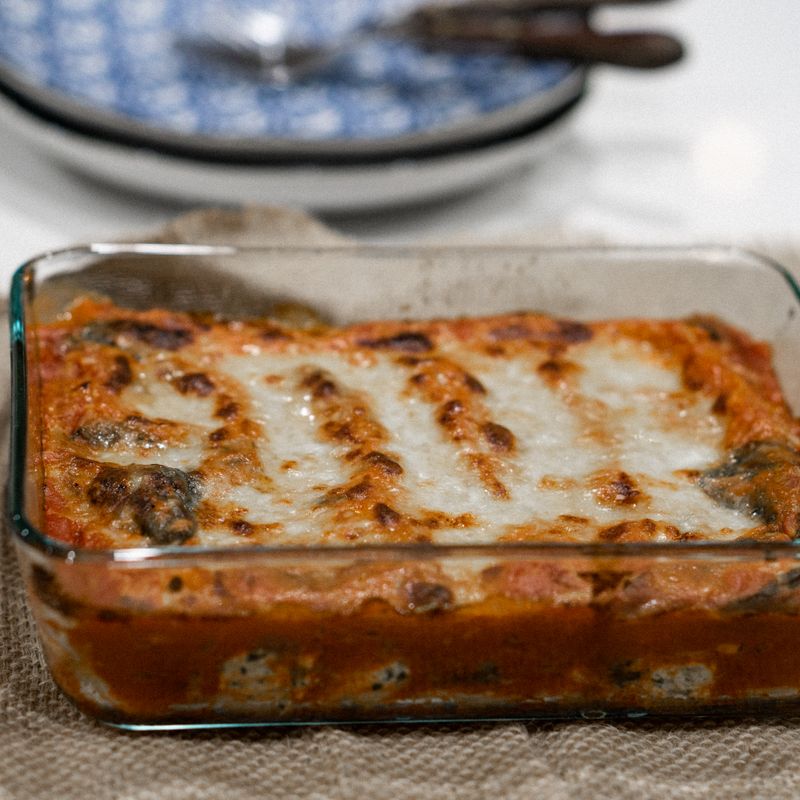
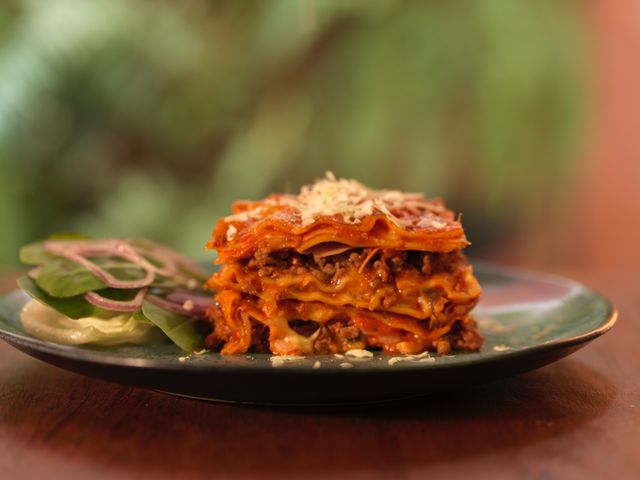
Christmas Baked Lasagna with Truffle and Sage
A luxurious holiday lasagna featuring layers of seasoned ground beef, creamy ricotta and béchamel, fresh sage, and a hint of truffle oil for an elegant festive finish. This make-ahead classic is perfect for Christmas dinners and special celebrations.
- Prep
- 30 min
- Cook
- 50 min
- Wait
- 40 min
- Total
- 2 hr
- Makes
- 1 lasagna (8 servings)
Steps
Before you start
- Preheat oven to 375°F (190°C) 15 minutes before baking
- Have all ingredients measured and prepped—the assembly moves quickly
- If using fresh lasagna noodles, skip boiling; if using dried, cook and drain ahead
- Make the béchamel while the meat sauce simmers to save time
Brown the Beef
- In a large heavy-bottomed saucepan (3-quart), heat over medium-high.
- Add the ground beef and break it apart with a wooden spoon, cooking for 5–6 minutes until deeply browned and most of the liquid has evaporated.
- Drain excess fat if needed, leaving 1 tablespoon.
+ Show details− Hide details
Ready when: Beef is deeply browned with no pink and most liquid has cooked off
Tip: Don't stir too often; let the meat develop a brown crust for deeper flavor.
Build the Meat Sauce
- Add the diced onion to the beef and cook over medium heat for 3 minutes, stirring, until softened.
- Add the minced garlic and cook for 30 seconds until fragrant.
- Stir in the tomato paste and cook for 1 minute to remove the raw taste.
- Pour in the red wine and beef broth, then add the crushed tomatoes, salt, pepper, and oregano.
- Stir well to combine.
+ Show details− Hide details
Ready when: All ingredients are well combined and the sauce is simmering gently
Tip: Toast the tomato paste briefly to deepen the sauce flavor—this takes just 1 minute.
Simmer the Meat Sauce
- Reduce heat to medium-low and simmer, uncovered, for 20 minutes, stirring occasionally.
- The sauce should bubble gently at the edges.
- Taste and adjust salt and pepper as needed.
- The sauce should be rich, slightly thickened, and coat the back of a spoon.
+ Show details− Hide details
Ready when: Sauce has reduced slightly, is rich and glossy, and coats a spoon
Tip: Simmer gently—aggressive boiling will cause the sauce to reduce too quickly and become acrid.
Make the Béchamel
- While the meat sauce simmers, melt the butter in a medium saucepan (2-quart) over medium heat.
- Add the flour and whisk constantly for 1 minute to create a blonde roux (it should smell toasty, not raw).
- Slowly pour in the warm milk while whisking constantly to prevent lumps.
- Continue whisking for 3–4 minutes until the sauce thickens enough to coat the back of a spoon.
- Remove from heat and whisk in the nutmeg, salt, and white pepper to taste.
+ Show details− Hide details
Ready when: Sauce coats the back of a spoon and is smooth with no lumps
Tip: Use warmed milk to prevent the roux from seizing and causing lumps—cold milk can shock the hot roux.
Prepare the Ricotta Filling
- In a medium bowl, combine the ricotta, grated Parmigiano-Reggiano, egg, fresh chopped sage, salt, and pepper.
- Stir until smooth and evenly mixed.
- Do not overmix or the filling will become grainy.
+ Show details− Hide details
Ready when: All ingredients are evenly combined and filling is smooth
Tip: Chop the sage finely so its flavor distributes evenly without chunks of leaf.
Layer the Lasagna
- Spread a thin layer of meat sauce (about ½ cup) over the bottom of a 9×13-inch baking dish.
- Arrange a layer of cooked lasagna noodles to cover the sauce (about 3–4 noodles, overlapping slightly).
- Spread half the ricotta filling evenly over the noodles.
- Spoon one-third of the remaining meat sauce over the ricotta layer.
- Add another layer of noodles, then the remaining ricotta filling, followed by another layer of noodles.
- Pour the remaining meat sauce over the top, then spread the béchamel sauce in an even layer over everything.
- Sprinkle the shredded mozzarella evenly over the béchamel, covering it completely.
+ Show details− Hide details
Ready when: All layers are evenly distributed with mozzarella covering the entire top
Tip: Don't press down on the layers—gently settle them so the sauce can bubble up and keep everything moist during baking.
Bake the LasagnaOven 375°F / 190°C
- Cover the baking dish loosely with aluminum foil (tent it so the foil doesn't stick to the mozzarella).
- Bake in a preheated 375°F (190°C) oven for 30 minutes covered.
- Remove the foil and bake for another 15–20 minutes until the cheese on top is melted, bubbly, and light golden brown.
- The edges should bubble gently around the sides.
- Cooking time may vary depending on your oven; start checking at 40 minutes total.
+ Show details− Hide details
Ready when: Mozzarella is melted and bubbly with light golden-brown spots; sauce bubbles at the edges
Tip: Tenting with foil prevents the cheese from browning too much before the inside heats through. If browning too quickly, cover loosely for the second part of baking.
Rest and Finish
- Remove from the oven and let rest for 5–10 minutes (this helps the layers set so they cut cleanly without sliding).
- While the lasagna rests, drizzle the truffle oil over the top in a light zigzag pattern.
- Garnish with fresh sage leaves if desired.
- Serve hot, cutting into 8 even portions.
+ Show details− Hide details
Ready when: Lasagna is set enough to cut into portions without sliding; top is still hot
Tip: Don't skip the rest—it allows the cheese to firm up just enough to hold the layers together when you cut and serve.
Good to know
Tips
- Make the meat sauce and béchamel ahead during a calm moment, then assemble the lasagna when you're ready—this breaks the recipe into manageable chunks.
- Don't skimp on cooking the meat sauce; 20 minutes of simmering lets the flavors meld and allows the sauce to thicken naturally, which prevents a watery lasagna.
- Use cooked noodles that are patted dry or laid flat on parchment so they don't tear when layering. Freshly cooked noodles are easier to handle than cold ones.
- The truffle oil is drizzled after baking so its delicate flavor is not lost to heat—add it just before serving for maximum aroma and taste.
Make ahead
You can assemble the lasagna up to 24 hours ahead. Cover with foil and refrigerate. Bake straight from the refrigerator, adding 10–15 minutes to the total baking time. You can also freeze the unbaked lasagna for up to 3 months; thaw overnight in the refrigerator before baking, or bake frozen, adding 20–30 minutes to the baking time.
Storage & reheating
Store leftovers covered in the refrigerator for up to 4 days. Reheat individual portions in the microwave (2–3 minutes) or cover loosely with foil and warm in a 350°F (175°C) oven for 12–15 minutes until heated through. Freeze cut portions in an airtight container for up to 3 months; thaw overnight and reheat gently so the cheese doesn't dry out.
Substitutions
- truffle oil → 1 tablespoon of good quality extra-virgin olive oil mixed with ¼ teaspoon of truffle salt. If you cannot find truffle oil or prefer a subtler truffle note, this combination provides similar earthy flavor at less cost.
- fresh sage leaves, finely chopped → ½ teaspoon of dried sage. Dried sage has a more concentrated flavor, so use less. Fresh sage adds a brighter, more delicate herbaceous note.
- dry red wine, such as Chianti or Cabernet → ½ cup of beef broth. If you prefer to avoid alcohol, substitute with additional beef broth for depth (total beef broth would be 1 cup), though the sauce will lack the wine's complexity.
- whole-milk ricotta cheese → 1 cup (225 g) of creamy goat cheese blended with 3 tablespoons of plain Greek yogurt. This creates a tangier filling with a similar texture; reduce the Parmigiano slightly (use ¾ cup) to balance the tang.
More lasagna
See all →


Find more like this
- Meal
- Dinner
- Cuisine
- Italian
- Main ingredient
- Ground BeefMozzarella
- Diet
- Sugar-Free
- Method
- Oven
- Quick & Easy
- Make Ahead
- Occasion
- ChristmasFamily Gatherings