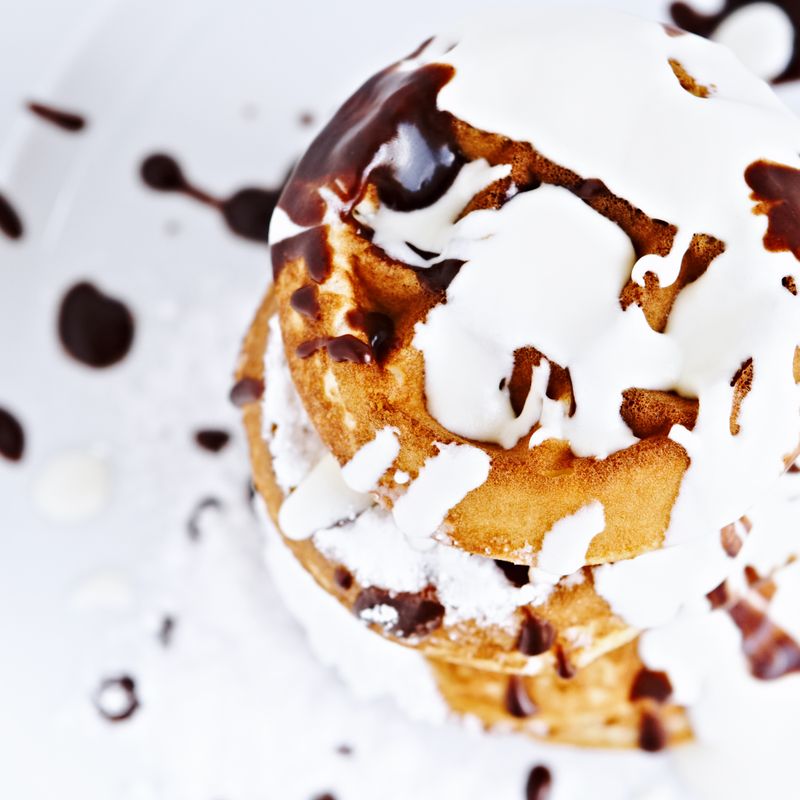
Chocolate Profiteroles with Whipped Cream
Light, airy choux pastry puffs filled with whipped cream and topped with a silky dark chocolate glaze. These elegant French pastries are made from scratch—the choux dough is piped and baked until golden and crispy, then filled and coated with homemade chocolate sauce. Perfect for entertaining or a special dessert.
- Prep
- 30 min
- Cook
- 45 min
- Wait
- 30 min
- Total
- 1 hr 45 min
- Makes
- 24 small profiteroles (12 servings of 2 each)
Steps
Before you start
- Preheat oven to 400 °F (200 °C) at least 15 minutes ahead
- Line two large baking sheets with parchment paper
- Have all ingredients measured and ready before you start the choux dough—it comes together quickly
- Use room-temperature eggs for a smoother dough
Make the choux dough
- In a medium saucepan, combine the water, butter, salt, and sugar.
- Set the pan over medium heat and bring to a gentle boil, stirring occasionally with a wooden spoon.
- Once the butter is completely melted and the mixture boils, remove from heat.
- Immediately add all the flour at once and stir vigorously until the dough comes together into a ball, about 1–2 minutes.
- The mixture will look like thick mashed potatoes and should pull away from the sides of the pan.
+ Show details− Hide details
Ready when: Dough pulls away from the pan sides and forms a cohesive ball
Tip: Work quickly once you add the flour—the heat helps cook out the flour taste and prepare it to absorb the eggs.
Cool dough slightly
- Let the choux dough cool in the pan for 2–3 minutes, stirring occasionally.
- You want it warm but not so hot that it cooks the eggs when you add them.
- It should feel warm to the touch but not steaming.
+ Show details− Hide details
Ready when: Dough is warm but not steaming
Tip: If the dough is too hot, the eggs will scramble; if too cool, they won't incorporate smoothly.
Add eggs to dough
- Crack one egg into the warm dough and stir with the wooden spoon until fully incorporated, about 1–2 minutes.
- The dough will look broken and shiny at first, then come back together.
- Add the remaining three eggs one at a time, stirring well after each addition.
- By the final egg, the dough should be glossy, smooth, and fall slowly from a spoon when lifted.
+ Show details− Hide details
Ready when: Dough is glossy, smooth, and falls slowly from a spoon
Tip: Add eggs slowly—rushing this step can result in lumpy dough. Patience here pays off in light, airy puffs.
Pipe profiteroles
- Transfer the choux dough to a pastry bag fitted with a medium round piping tip (½-inch / 1.3 cm opening).
- Pipe mounds about the size of a walnut (roughly 1 inch / 2.5 cm in diameter) onto the prepared baking sheets, spacing them about 2 inches (5 cm) apart.
- You should get about 24 puffs.
- If desired, lightly flatten the tip of each mound with a moistened finger to smooth the peak.
+ Show details− Hide details
Ready when: Dough is piped into evenly sized mounds
Tip: Keep even spacing so all puffs bake uniformly. Uneven piping leads to some burning before others are done.
Bake profiterolesOven 400°F / 205°C
- Place baking sheets in the preheated 400 °F (200 °C) oven.
- Bake for 25–30 minutes until the profiteroles are puffed, golden brown, and firm to the touch.
- Do not open the oven door during the first 20 minutes—drafts can cause them to collapse.
- They are done when they sound hollow if you tap one gently and the exterior is crispy.
+ Show details− Hide details
Ready when: Puffs are golden brown, firm, and sound hollow when tapped
Tip: Resist peeking—opening the oven drops the temperature and can cause deflation. A fully golden color and hollow sound are your best signs of doneness.
Cool profiterolesOven 300°F / 150°C
- Transfer the hot baking sheets to a wire rack and let the profiteroles cool for 10–15 minutes on the sheet.
- Once they are cool enough to handle (still slightly warm), you can transfer them to a serving platter.
- If they soften as they cool, return them to a 300 °F (150 °C) oven for 3–5 minutes to re-crisp them, then cool again on the rack.
+ Show details− Hide details
Ready when: Profiteroles are cool enough to handle and have a crispy shell
Tip: Slightly warm profiteroles are easier to split for filling. If they've cooled too much and hardened completely, they're harder to split without cracking.
Whip the cream filling
- In a large mixing bowl, combine the cold heavy cream, sugar, and vanilla extract.
- Using an electric mixer on medium-high speed, whip until stiff peaks form, about 2–3 minutes.
- The cream should be thick and hold its shape.
- Stop before it turns into butter.
+ Show details− Hide details
Ready when: Cream forms stiff peaks and holds its shape
Tip: Keep the bowl and beaters cold; warm equipment causes cream to separate. Stop as soon as stiff peaks form—a few seconds of over-whipping leads to grainy, separated cream.
Make chocolate glaze
- Combine the chopped dark chocolate and butter in a medium heatproof bowl.
- Heat the heavy cream in a small saucepan until it just begins to steam (do not boil).
- Pour the hot cream over the chocolate and butter, let sit for 1 minute, then whisk until smooth and glossy.
- If small pieces of chocolate remain, set the bowl over a pot of gently simmering water (a double boiler setup) and whisk for 1–2 minutes more until completely melted and uniform.
+ Show details− Hide details
Ready when: Glaze is smooth, glossy, and pourable
Tip: Do not overheat the cream—it should be steamy, not boiling, or the chocolate may seize. Letting it rest 1 minute before whisking ensures even melting.
Fill profiteroles
- Once the profiteroles are completely cool, carefully slice each one in half horizontally using a serrated knife or by gently pulling apart if they split naturally.
- Spoon or pipe a generous dollop of whipped cream into the bottom half of each profiterole.
- Place the top half back on, pressing gently so the cream peeks out slightly.
+ Show details− Hide details
Ready when: Profiteroles are split and filled with cream
Tip: Work gently—the shells are delicate. If a profiterole cracks while splitting, it's still delicious; just fill it carefully. You can also poke a small hole in the bottom and pipe cream in without splitting.
Coat with chocolate
- Working quickly while the chocolate glaze is still warm but not hot (around 100–110 °F / 38–43 °C if you have a thermometer), dip the top of each filled profiterole into the glaze, letting excess drip off, then place on a serving platter.
- Alternatively, spoon a small amount of glaze onto the top of each profiterole.
- Work in batches if needed; if the glaze cools and thickens, gently reheat it over the double boiler.
+ Show details− Hide details
Ready when: Profiteroles are evenly coated with chocolate glaze
Tip: Glaze that is too cool will be thick and lumpy; too hot will slide off the puff. The sweet spot is warm enough to flow but cool enough to set quickly.
Chill and serve
- Arrange the finished profiteroles on a serving platter.
- If you have time, chill them in the refrigerator for 15–30 minutes before serving so the chocolate sets fully and the cream is well chilled.
- Serve cold or at room temperature.
+ Show details− Hide details
Ready when: Chocolate is set and profiteroles are chilled
Tip: Chilling also makes the profiteroles more stable and easier to eat without collapsing. They can be served immediately after coating if you prefer them slightly warmer.
Good to know
Tips
- Choux pastry is all about technique and timing: cold dough, a proper boil, quick flour stirring, and careful egg incorporation. Each step matters.
- If your profiteroles sink or collapse after baking, the oven may not be hot enough, the dough may have been over-mixed, or you opened the door too early. Make sure your oven is calibrated and fully preheated.
- For the most elegant presentation, pipe the whipped cream filling using a pastry bag and small round or star tip, rather than spooning. This creates uniform, attractive mounds.
- If your chocolate glaze is too thick after cooling, whisk in a teaspoon of warm heavy cream or butter at a time. If it's too thin, let it cool at room temperature for a few minutes.
Make ahead
You can make the unfilled profiterole shells up to 2 days ahead. Bake them, cool completely, and store in an airtight container at room temperature. On the day of serving, fill and coat with chocolate glaze. You can also prepare the chocolate glaze up to 3 days ahead, cover it, and refrigerate; reheat gently before using.
Storage & reheating
Filled profiteroles are best served the day they are assembled. Store any leftovers in an airtight container in the refrigerator for up to 1 day (the shells will soften slightly). Do not freeze filled profiteroles, as the whipped cream separates when thawed. Unfilled baked shells can be frozen in an airtight freezer bag for up to 1 month; thaw at room temperature for 1 hour, then optionally re-crisp in a 300 °F (150 °C) oven for 5 minutes.
Substitutions
- dark chocolate (70% cacao), finely chopped → milk chocolate (50% cacao) or semi-sweet chocolate. Use the same weight. Milk chocolate will be sweeter and less intense; adjust your preference.
- heavy cream, cold → crème fraîche or Greek yogurt (strained). Whip the same amount. These will add a tangy flavor and slightly denser texture but work beautifully.
- vanilla extract → almond extract, rum, or Grand Marnier (liqueur). Use 0.25–0.5 tsp to taste. These add sophistication; use less as they are stronger than vanilla.
- heavy cream → light cream, whole milk, or coconut cream. Use the same amount. The glaze will be slightly less rich but still smooth. Avoid skim milk.
More desserts
See all →


Find more like this
- Meal
- Dessert
- Diet
- VegetarianHalal
- Method
- Oven