Chinese Mooncake with Lotus Paste and Salted Yolk
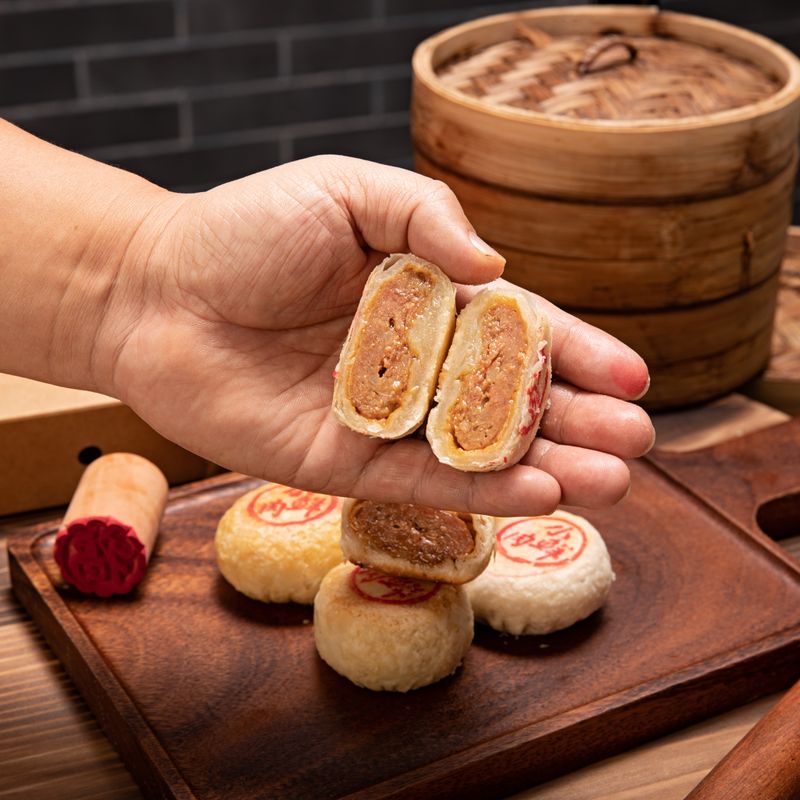
Traditional Chinese mooncakes filled with smooth lotus paste and a rich salted egg yolk center. These pressed pastries feature a tender, slightly crisp exterior with a golden-brown surface stamped with decorative patterns. A classic treat for Mid-Autumn Festival celebrations.
Steps
Before you start
- Have all ingredients at room temperature (lotus paste, vegetable oil, eggs)
- Line a baking sheet with parchment paper
- If using a mooncake mold, dust it lightly with flour before each press
- Salted egg yolks should be separated from whites before baking the mooncakes
Mix the dough
- In a mixing bowl, combine the mooncake flour, invert sugar syrup, vegetable oil, alkaline water, and salt.
- Stir with a wooden spoon or spatula until the ingredients come together into a soft, slightly sticky dough, about 1–2 minutes.
- The dough should feel pliable and smooth, not crumbly.
+ Show details− Hide details
Ready when: Dough comes together into a cohesive, smooth ball
Tip: Do not overwork the dough; gentle mixing prevents toughness and ensures a tender crumb
Rest the dough
- Cover the bowl with plastic wrap or a damp kitchen towel and let the dough rest at room temperature for 30 minutes.
- This relaxes the gluten and allows the flour to fully hydrate, making the dough easier to work with and improving texture.
+ Show details− Hide details
Ready when: Dough is softer and less elastic when poked
Tip: Resting time is crucial; skipping this step results in dough that cracks when pressed in the mold
Prepare filling portions
- While the dough rests, divide the lotus paste into 8 equal portions of about 30 grams (1 oz) each.
- Roll each portion into a smooth ball.
- For each mooncake, flatten one lotus ball into a thin disc about 2 inches (5 cm) across, place one salted egg yolk in the center, and wrap the lotus paste up and around the yolk to enclose it completely, forming a smooth ball.
- Set aside.
+ Show details− Hide details
Ready when: 8 smooth filling balls, each containing one yolk in the center
Tip: Keep your hands slightly moist to prevent the paste from sticking; work efficiently so the paste doesn't warm too much
Portion and shape dough
- Divide the rested dough into 8 equal portions of about 25 grams (0.9 oz) each.
- Roll each portion gently into a smooth ball.
- Working with one ball at a time, flatten it into a thin disc about 2.5 inches (6 cm) across.
- Place one lotus-yolk filling ball in the center, then fold and seal the edges of the dough disc over the filling, pinching gently to enclose it completely.
- Shape into a smooth ball by rolling lightly between your palms.
+ Show details− Hide details
Ready when: 8 smooth mooncake balls with filling fully sealed inside
Tip: If dough tears, pinch and smooth; avoid overstretching, which creates thin spots that burst during baking
Press mooncakes
- Dust a 50-gram mooncake mold lightly with flour, knocking out excess.
- Place one dough-filled ball into the mold and press firmly and evenly with both hands or using the mold's handle/lever to create a uniform disc with the decorative stamp clearly impressed on top.
- Press with confidence in one smooth motion rather than multiple presses, which can cause cracking.
- Gently ease the mooncake out of the mold onto a parchment-lined baking sheet.
- Repeat with remaining mooncakes, spacing them about 1 inch (2.5 cm) apart.
+ Show details− Hide details
Ready when: 8 pressed mooncakes with clear decorative imprints on top, edges intact
Tip: Flour the mold lightly before each press; too much flour causes the pattern to blur, too little causes sticking
Apply egg wash
- Brush the top of each mooncake lightly with the beaten egg yolk mixture, coating the stamped surface evenly.
- If using sesame seeds, sprinkle them sparingly onto the egg wash immediately.
- Wipe away any excess egg wash that may have dripped onto the parchment.
+ Show details− Hide details
Ready when: Mooncakes have a light, even egg wash coating; sesame seeds (if used) adhere
Tip: Apply egg wash sparingly; excess egg creates a thick, dull finish rather than a glossy sheen
Bake mooncakesOven 375°F / 190°C
- Preheat the oven to 375°F (190°C).
- Place the baking sheet in the center rack and bake for 14–16 minutes.
- The mooncakes are done when the top is golden brown and the stamp pattern is clearly defined.
- The edges should be set but the center may still feel very slightly soft to the touch.
+ Show details− Hide details
Ready when: Top is golden brown, stamp pattern is sharp, edges are firm; center yields slightly to gentle pressure
Tip: Oven temperatures vary; start checking at 13 minutes; overbaking dries out the mooncake, underbaking makes the dough taste raw
Cool on rack
- Remove the baking sheet from the oven and place on a heat-safe surface.
- Let the mooncakes cool on the baking sheet for 5 minutes to firm up, then use a thin spatula to transfer them carefully to a wire rack.
- Cool completely at room temperature, about 30 minutes.
- Do not eat while hot; the filling is extremely hot and the texture has not yet set.
+ Show details− Hide details
Ready when: Mooncakes are firm enough to move, fully cooled to room temperature
Tip: Resist the urge to eat immediately; as mooncakes cool, the filling sets to the proper texture and flavor develops
Rest overnight (optional but recommended)
- For best flavor and texture, transfer the cooled mooncakes to an airtight container and let them rest at room temperature for 24 hours before serving.
- This allows the flavors to meld and the dough to set properly.
- This step is called "returning the oil" and is traditional in mooncake preparation.
+ Show details− Hide details
Ready when: Mooncakes have developed deeper color and improved tenderness
Tip: This resting step is traditional and highly recommended, but mooncakes are safe to eat after they fully cool
Good to know
Tips
- Mooncake success depends on dough resting: do not skip the 30-minute rest after mixing, and ideally rest the filled, pressed mooncakes overnight before eating. These steps allow the texture to develop properly and flavors to deepen.
- If your mold is not 50 grams, scale dough and filling portions proportionally. A 25-gram mold requires half the dough and filling per mooncake; a 100-gram mold requires double. The ratio of dough to filling remains roughly 1:1.2 by weight.
- Salted egg yolks vary in size and moisture. If your yolks are very large (larger than 0.5 oz / 14 g), use only the amount that fits comfortably inside the lotus paste wrapper without causing the dough to tear.
- Mooncakes are best served at room temperature with hot tea. The contrast of warm, floral tea and the rich, cooling mooncake is traditional and balances the richness of the filling.
Make ahead
8 hours ahead: prepare filling portions. 2 hours ahead: divide and shape dough. Up to 3 days ahead: bake mooncakes completely, cool, and store in airtight container at room temperature. Flavor and texture improve with overnight resting.
Storage & reheating
Room temperature: in an airtight container for up to 7 days; flavor is best after the first day of resting. Refrigerator: up to 14 days in an airtight container; bring to room temperature for 30 minutes before eating. Freezer: up to 3 months in a freezer-safe airtight container; thaw at room temperature for 2–3 hours before serving. Do not reheat; serve at room temperature.
Substitutions
- invert sugar syrup (glucose syrup or light corn syrup can substitute) → Light corn syrup or glucose syrup (100% glucose syrup). Invert sugar creates the traditional texture, but corn or glucose syrup produces a very similar result with only slight differences in crumb structure. Use the same amount.
- mooncake flour (gluten-free wheat flour blend) → All-purpose flour (100 g / 0.75 cup) mixed with 5 g (1 tsp) cornstarch. Mooncake flour is a specialized low-gluten blend. All-purpose flour mixed with cornstarch approximates the texture, though the result will be slightly more tender and less crisp.
- lotus seed paste (canned or homemade) → Red bean paste, pandan paste, or taro paste. Each produces a different flavor and color but maintains the same creamy texture and sweetness level. Use the same weight.
- alkaline water (kansui solution), or 0.5 tsp baking soda dissolved in 1 tbsp water → 0.25 tsp (1.25 g) food-grade potassium carbonate dissolved in 1.5 tsp water, or omit entirely. Alkaline water creates the characteristic color and texture. Without it, mooncakes will be paler and slightly denser but still delicious. Do not substitute with baking powder or soda.