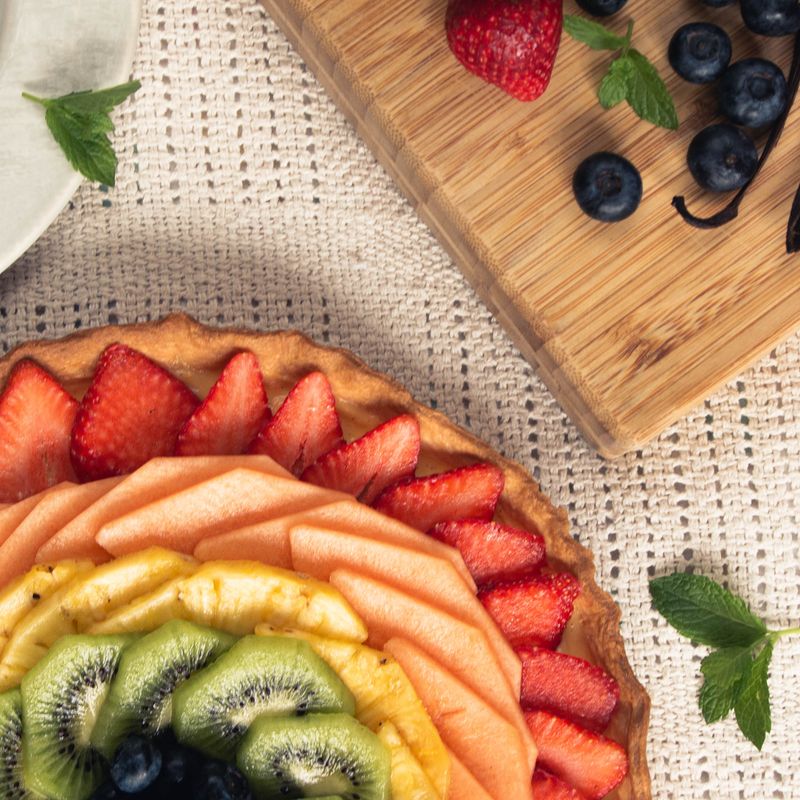
Chestnut and Shoyu Glaze Tart
A Middle Eastern-Japanese fusion tart featuring a crisp butter pastry shell filled with candied chestnuts and topped with a glossy soy sauce-honey glaze. The umami depth of shoyu balances sweetness, while roasted chestnuts provide earthiness and textural contrast. This elegant dessert works as an impressive dinner finale or afternoon tea accompaniment.
- Prep
- 35 min
- Cook
- 45 min
- Wait
- 1 hr 15 min
- Total
- 2 hr 35 min
- Makes
- 1 tart (8 slices)
Steps
Before you start
- Cut cold butter into cubes and chill for 15 minutes before starting the dough
- Preheat oven to 375°F (190°C) before you begin assembling the tart
- Have a 9-inch (23 cm) tart pan with a removable bottom ready
Make tart dough
- In a food processor, combine flour, sugar, and sea salt.
- Pulse 2–3 times until combined.
- Add cold butter cubes and pulse 8–10 times until the mixture resembles coarse breadcrumbs with pea-sized pieces of butter remaining.
- Add egg yolk and ice water, then pulse just until the dough comes together in a shaggy mass (do not overmix—stop while some loose flour specks remain).
- Turn the dough out onto plastic wrap, shape into a disk, wrap, and refrigerate for 30 minutes until firm.
+ Show details− Hide details
Ready when: Dough is cold, firm, and barely holds together when pressed
Tip: Chill your bowl and food processor blade if your kitchen is warm. Overworking the dough develops gluten and yields a tough, dense crust.
Line and blind bakeOven 375°F / 190°C
- Preheat oven to 375°F (190°C).
- On a floured surface, roll chilled dough into an 11-inch (28 cm) circle about ⅛ inch thick.
- Transfer to your 9-inch (23 cm) tart pan, pressing gently into the bottom and up the sides; trim excess.
- Prick the bottom all over with a fork.
- Line with parchment paper and fill with dried beans or pie weights.
- Blind bake for 12–14 minutes until the edges are light golden and the shell feels set but still pale.
- Remove beans and parchment; the bottom should look almost dry.
- Bake another 2–3 minutes if the bottom appears wet.
- Remove and let cool slightly in the pan.
+ Show details− Hide details
Ready when: Edges are light golden; bottom looks pale and dry, not wet or doughy
Tip: Prick the bottom thoroughly to prevent puffing. If the edges brown too fast, tent them with foil after the first 10 minutes.
Prepare chestnut filling
- While the shell bakes, gently warm honey with 2 tablespoons water in a small saucepan over medium-low heat, stirring occasionally, until the honey is fluid and thin (about 2–3 minutes).
- Place halved chestnuts in a mixing bowl and pour warm honey over them.
- Stir gently to coat evenly, taking care not to break the chestnuts.
- Let sit for 2–3 minutes so they absorb some honey and warm slightly.
+ Show details− Hide details
Ready when: Honey is thin and pourable, chestnuts are lightly coated and warm to touch
Tip: Warm honey makes it easier to coat the nuts evenly without tearing them. Do not boil the honey or it will caramelize.
Arrange chestnuts in shell
- Arrange honey-coated chestnut halves cut-side up in concentric circles, starting from the center of the partly cooled tart shell.
- Leave a light border around the edge.
- Drizzle any remaining honey from the bowl over and around the nuts.
- If needed, lightly brush a thin coat of honey on the interior of the pastry shell to help nuts adhere (optional but recommended).
+ Show details− Hide details
Ready when: Chestnuts are arranged in tidy, concentric rings; shell is dry and pale
Tip: Work quickly so the shell doesn't cool too much and become brittle. A light honey glaze on the shell helps the finished tart hold together.
Bake filled tartOven 375°F / 190°C
- Return the tart to the 375°F (190°C) oven and bake for 18–22 minutes until the pastry edges are deep golden brown and the chestnuts look lightly caramelized at their tips.
- The honey should look glossy and slightly darkened.
- Rotate the pan halfway through if the edges are browning unevenly.
- Remove from the oven and let cool in the pan for 10 minutes before unmolding.
+ Show details− Hide details
Ready when: Pastry edges are deep golden; chestnuts are lightly caramelized at tips; honey is glossy and darker
Tip: If the edges darken too quickly, cover with a foil tent. Slightly underbaking keeps the pastry crisper than overbaking.
Cool tart completely
- Transfer the tart (still in its pan) to a cooling rack and let sit for 10–15 minutes.
- Once cool enough to handle, gently push up the pan's removable bottom to release the tart, then slide it onto a serving plate or leave it on the tart base.
- Let cool to room temperature, about 20 minutes, before glazing.
- The tart will continue to firm up as it cools.
+ Show details− Hide details
Ready when: Tart is at room temperature; pastry and fillings are no longer warm to touch
Tip: Do not rush this step. A properly cooled tart is less likely to crack when the glaze is applied and will hold its shape when sliced.
Make shoyu glaze
- In a small saucepan over medium heat, combine 2 tablespoons butter with honey, soy sauce, rice vinegar, and sesame oil.
- Whisk constantly for 1–2 minutes until the mixture is smooth, warm, and glossy.
- The glaze should be pourable and homogeneous.
- Remove from heat and let cool for 1–2 minutes so it is warm but not hot—about 120°F (49°C) if measured, or cool enough to test on your inner wrist without discomfort.
+ Show details− Hide details
Ready when: Glaze is smooth, glossy, and pourable; barely warm to the touch
Tip: Too-hot glaze will cause the pastry to soften and become soggy. Let it cool to about body temperature for best results.
Apply and set glaze
- Using a pastry brush, carefully brush the warm shoyu glaze over the top of the cooled tart, covering the chestnuts and pastry edges evenly.
- Work from the center outward, using light, even strokes.
- If any glaze drips over the edge, brush it smooth.
- Let the tart sit on the cooling rack for 15–20 minutes to allow the glaze to set and become tacky but not sticky.
- The glaze will continue to set as the tart cools further.
+ Show details− Hide details
Ready when: Glaze is tacky to the touch, not dripping or running, and has a light sheen
Tip: Light, even strokes prevent puddles. If the glaze sets too fast (stiffens up), warm it very gently over low heat for 10–15 seconds.
Finish and serve
- Once the glaze has set, garnish the tart with a light sprinkle of fleur de sel (if using) and black sesame seeds scattered over the top.
- Let the tart sit at room temperature for 5 more minutes.
- Cut into 8 wedges using a sharp, warmed knife (dip the blade in hot water and wipe between cuts for clean slices).
- Serve at room temperature or slightly warmed.
+ Show details− Hide details
Ready when: Tart is firm, glaze is matte and set, garnishes are in place
Tip: A warm knife yields clean, neat slices without cracking the pastry or glaze. Wipe the blade after each cut.
Good to know
Tips
- If roasted and peeled chestnuts are hard to find, look for vacuum-packed or frozen roasted chestnuts in specialty markets or online. Canned roasted chestnuts in syrup can work—rinse and pat dry first, but they're softer and less flavorful than whole roasted nuts.
- The shoyu glaze is the key to the fusion: the soy sauce's umami depth offsets the sweetness of honey and pastry, while rice vinegar adds lift and sesame oil brings nuttiness. Do not skip any component.
- For a vegan version, substitute the egg yolk in the dough with 1 tablespoon aquafaba (liquid from canned chickpeas) and replace butter with cold vegan butter. The texture will be slightly less tender but still excellent.
- Fleur de sel (finishing salt) is worth seeking out—its mineral sweetness complements the umami and honey. If unavailable, use fine sea salt very sparingly, as it's much saltier.
Make ahead
"The tart dough can be made and wrapped up to 2 days ahead; refrigerate until ready to use. The baked, glazed tart (without garnish) can be prepared up to 6 hours before serving; store loosely covered at room temperature. Add the fleur de sel and sesame seed garnish just before serving. Do not refrigerate after glazing, as moisture will soften the pastry."
Storage & reheating
"Room temperature (covered loosely with foil or a cake dome): up to 8 hours. The pastry will soften slightly but remains pleasant. Do not refrigerate, as condensation will make the crust soggy. Freezer (unglazed baked shell with filling): wrap well in plastic and foil; keeps 3 months. Thaw overnight in the refrigerator, then apply the glaze and garnish before serving."
Substitutions
- roasted and peeled chestnuts → roasted and halved hazelnuts or roasted walnuts. Hazelnuts offer a milder earthiness; walnuts are more robust and less sweet. Both work beautifully, though the tart's name would change.
- low-sodium soy sauce → tamari or coconut aminos (gluten-free soy alternative). Tamari is darker and richer; coconut aminos are slightly less salty. Use the same amount. The umami depth may shift subtly.
- raw honey → maple syrup or agave nectar. Maple adds earthiness; agave is more neutral. Both are slightly more fluid, so you may need to add 1–2 teaspoons less water when warming in Step 3.
- toasted sesame oil → walnut oil or avocado oil. Walnut oil adds nuttiness; avocado oil is neutral and lighter. Both dilute the umami slightly but maintain a glossy finish.
More pies & tarts
See all →



Find more like this
- Meal
- Dessert
- Diet
- VegetarianHalal
- Method
- Oven