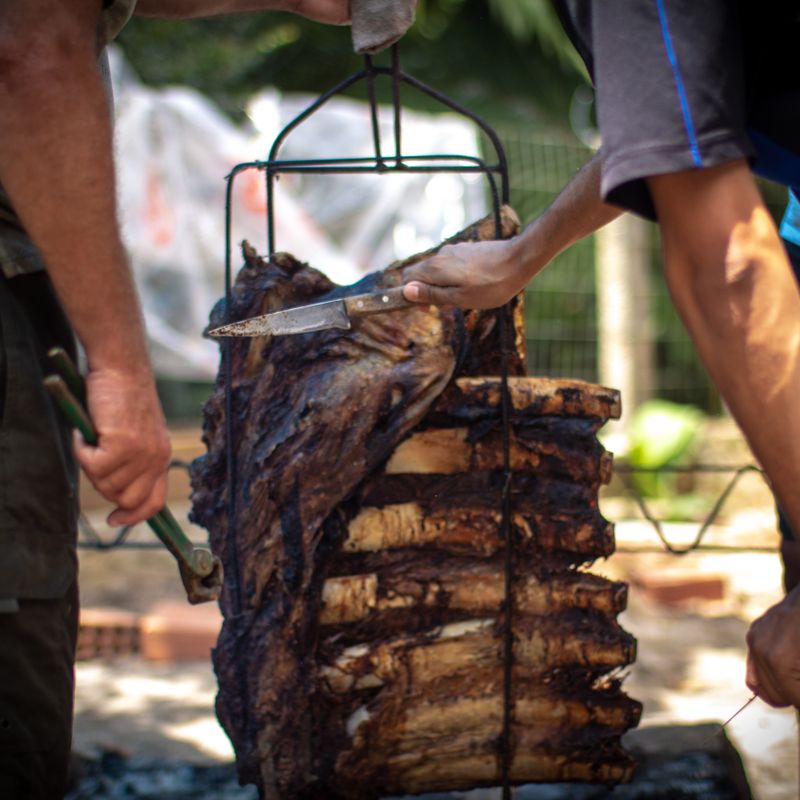
Brazilian Churrasco Beef Shawarma with Chimichurri
A bold fusion of Brazilian churrasco and Middle Eastern shawarma: thin-sliced beef sirloin marinated in garlic, oregano, and white wine vinegar, then layered and roasted on a vertical spit until caramelized. Served with vibrant fresh chimichurri sauce and warm flatbread. The meat is seasoned with cumin and smoked paprika for depth, creating a smoky, tangy, herb-forward experience that's traditional to both cuisines.
- Prep
- 30 min
- Cook
- 45 min
- Wait
- 4 hr
- Total
- 5 hr 15 min
- Makes
- 6 servings (18–20 oz meat per person, with chimichurri and bread)
Steps
Before you start
- Have a vertical spit roaster or shawarma machine ready; alternatively, use a rotisserie oven. Slice the beef sirloin into thin ¼-inch (6 mm) strips and partially freeze for 2–3 hours before slicing if using a whole roast. Plan for 4 hours of marinating time. Read through the layering and roasting steps to understand the technique.
- Bring all ingredients to room temperature 30 minutes before assembling the spit.
- Prepare the chimichurri sauce just before serving so the herbs stay bright and fresh.
Prepare the marinade
- In a large bowl, whisk together the minced garlic, white wine vinegar, olive oil, dried oregano, ground cumin, smoked paprika, kosher salt, and black pepper.
- Taste and adjust seasoning—it should be vibrant, tangy, and aromatic.
- The marinade flavors will carry through the meat as it cooks.
+ Show details− Hide details
Ready when: Marinade is evenly mixed with visible herb and spice particles suspended throughout
Tip: Don't skip the spices; they are essential to the churrasco flavor. If using fresh oregano instead of dried, double the amount and add it in the last step of marinating for brightness.
Marinate the beef
- Add the thinly sliced beef sirloin to the marinade, folding gently to coat each slice evenly.
- Cover the bowl with plastic wrap and refrigerate for 4 hours, or overnight if possible.
- Stir gently halfway through marinating to ensure even flavor distribution.
- The acid in the vinegar will begin to tenderize the meat.
+ Show details− Hide details
Ready when: Beef is evenly coated in marinade and has darkened slightly; no raw-looking patches visible
Tip: Don't over-marinate beyond 12 hours or the vinegar will make the meat mushy. If time is short, 2 hours is a functional minimum, but 4 hours is ideal.
Set up the spit roasterOven 400°F / 205°C
- Preheat your vertical spit roaster or shawarma machine to 400°F (200°C) according to manufacturer instructions.
- If using a rotisserie oven with a vertical spit, preheat to the same temperature.
- Allow the spit to heat for 10–15 minutes so the metal is hot and ready to help seal and cook the meat.
- Ensure your work area is clear and you have tongs or a slotted spoon for handling the beef.
+ Show details− Hide details
Ready when: Metal spit is hot enough that water droplets sizzle immediately on contact
Tip: If you don't have a shawarma machine, a vertical rotisserie oven works well. In a pinch, you can layer marinated beef slices on a horizontal rotisserie spit and cook it vertically by tilting, but results won't be quite the same.
Thread the beef onto the spit
- Remove the beef from the marinade, allowing excess marinade to drip back into the bowl (reserve the remaining marinade).
- Using tongs or a slotted spoon, begin threading the beef slices onto the hot spit, layering them slightly overlapped and compressed to build a solid log.
- Work methodically, layering beef vertically as the spit rotates if your machine rotates, or stacking in alternating directions if static.
- Aim to layer all the beef into a compact 4–5 inch (10–13 cm) tall cylindrical formation on the spit.
+ Show details− Hide details
Ready when: All beef is secured on the spit with no loose slices; the stack is compact and symmetrical
Tip: Work quickly so the spit stays hot. If slices stick together too much, use a knife to gently separate them slightly before threading. Compress the meat firmly as you layer—loose stacking will result in uneven cooking.
Begin roasting and basteOven 350°F / 175°C
- Place the loaded spit into the roaster and activate the rotation (if your machine rotates).
- The exterior should immediately begin to sear and caramelize.
- Roast at 400°F (200°C) for 10 minutes, then reduce heat to 350°F (175°C) and continue roasting for 25–35 minutes more.
- Every 5 minutes, use a brush or spoon to baste the rotating meat with the reserved marinade to keep it moist and build layers of flavor.
- Watch for the outer edges to turn deeply golden-brown and slightly charred in spots.
+ Show details− Hide details
Ready when: Outer crust is deep mahogany brown with some charred edges; juices run clear when a skewer pierces the center
Tip: Don't skip the basting—it prevents the outer meat from drying out and creates the signature shawarma texture. If the exterior chars too quickly, lower heat slightly and move the spit further from the heating element if your machine allows.
Check internal temperatureOven 350°F / 175°C
- Insert an instant-read meat thermometer into the thickest part of the beef stack (angling through one of the rotisserie holes or the center).
- The internal temperature should reach 130–135°F (54–57°C) for medium-rare, or 135–145°F (57–63°C) for medium, depending on preference.
- If the exterior is well-browned but the interior is below target, continue roasting for 5–10 minutes more at 350°F (175°C).
- If the interior is done but the crust needs more color, briefly increase heat to 400°F (200°C) for a final 2–3 minutes.
+ Show details− Hide details
Ready when: Internal temperature reads 130–145°F (54–63°C) depending on desired doneness
Tip: For a traditional churrasco experience, aim for medium-rare (130–135°F / 54–57°C); the residual heat will carry over after removal. Lean beef like sirloin can become tough if overcooked.
Rest the meat
- Once cooked, carefully remove the spit from the roaster and place it on a sturdy, heat-safe surface or in a horizontal cradle.
- Let the meat rest for 5–10 minutes while still on the spit to allow juices to redistribute.
- You can optionally tent it loosely with foil to keep it warm, but avoid covering it tightly or the crust will soften.
+ Show details− Hide details
Ready when: Meat is no longer steaming heavily; it feels firm but gives slightly when gently pressed
Tip: Resting is crucial—skipping it will result in dry, stringy slices. The residual heat continues to cook the interior slightly, so take that into account when checking doneness.
Shave the meatOven 300°F / 150°C
- Using a sharp, long knife (a carving knife is ideal) or an electric meat slicer, carefully shave thin slices from the outside of the meat stack, angling your blade at about 30 degrees to the spit.
- Work from top to bottom, allowing slices to fall onto a warm serving platter below.
- Each slice should be paper-thin to crispy-edged, with a tender, juicy interior.
- Continue until you reach the center of the spit.
- If meat becomes difficult to slice (cooling down), briefly return the spit to a 300°F (150°C) oven for 2–3 minutes to re-warm.
+ Show details− Hide details
Ready when: Slices are thin, uniform, and easily separate from the spit without tearing; the platter has a generous pile of meat
Tip: A sharp knife is non-negotiable; a dull knife will tear and shred the meat instead of shaving clean slices. If using an electric slicer, let the blade do the work—don't force the meat through too quickly.
Make the chimichurri sauce
- While the meat rests and you're shaving, prepare the chimichurri.
- In a food processor, combine the fresh parsley, cilantro, peeled garlic cloves, red wine vinegar, dried oregano, and red pepper flakes.
- Pulse until the herbs are finely chopped but not pureed—you want texture, not a smooth paste.
- Transfer to a bowl and stir in the extra-virgin olive oil and kosher salt.
- Taste and adjust vinegar, salt, or oil to balance heat, acidity, and richness.
- The sauce should taste bright, garlicky, and herbaceous.
- Serve at room temperature.
+ Show details− Hide details
Ready when: Herbs are finely chopped, oil is fully incorporated, and sauce is cohesive but textured
Tip: Don't over-process the chimichurri or the herbs will darken and lose their fresh character. Make it just before serving for the brightest flavor. If made in advance, store at room temperature for up to 2 hours.
Warm the flatbreadOven 300°F / 150°C
- While you're finishing the meat, warm the flatbread or pita.
- You can char it directly over a gas flame for 15–20 seconds per side, warm it in a dry skillet over medium heat for 1–2 minutes per side, or wrap a stack in foil and warm in a 300°F (150°C) oven for 5 minutes.
- The bread should be soft, warm, and pliable but not dried out.
+ Show details− Hide details
Ready when: Bread is warm to the touch, soft, and slightly steaming; charred spots (if using flame) are light brown
Tip: Warm bread makes a big difference in the eating experience. Cold bread will absorb juices and become dense. If using a skillet, don't use oil—a dry pan creates the best texture.
Assemble and serve
- Arrange the warm flatbread on a serving platter alongside the pile of shaved beef.
- Serve the chimichurri sauce in a small bowl on the side, along with optional fresh red onion slices and tomato slices.
- Let guests build their own wraps: place a few slices of beef on a piece of flatbread, top with sliced onion and tomato if desired, drizzle generously with chimichurri, fold, and enjoy.
+ Show details− Hide details
Ready when: All components are on the table, warm, and ready to assemble
Tip: Serve immediately while the meat is still warm. If you have leftover meat, it's delicious at room temperature or gently reheated the next day, but the crispy crust will soften over time.
Good to know
Tips
- A vertical spit roaster is essential for authentic shawarma; if you don't own one, check if your rotisserie oven has a vertical spit attachment, or rent/borrow a machine for the occasion. Cooking in a regular oven won't produce the same caramelized, crispy-edged result.
- Basting frequently is key to success—it builds up layers of flavor and prevents drying. Set a timer to remind yourself every 5 minutes.
- Slicing thinly is essential for that signature shawarma texture. A sharp carving knife or an electric meat slicer both work; dull knives will shred the meat.
- Serve the meat immediately after shaving while it's still warm. Room temperature or cold shawarma is delicious but lacks the textural magic of warm, tender-crispy slices.
Make ahead
The marinade can be made up to 2 days ahead and refrigerated. The beef can marinate for up to 12 hours ahead. Chimichurri can be made up to 2 hours before serving; don't make it earlier or the herbs will darken and lose brightness. The flatbread should be warmed just before serving.
Storage & reheating
Shaved beef keeps in an airtight container in the refrigerator for 3–4 days. Reheat gently in a 300°F (150°C) oven for 5–10 minutes, or place slices in a dry skillet over medium-low heat with a light basting of oil for 2–3 minutes. Chimichurri keeps refrigerated for up to 5 days (color will fade slightly but flavor remains good). Freeze chimichurri in ice cube trays for up to 3 months; thaw in the refrigerator before serving.
Substitutions
- beef sirloin strip (top sirloin), thinly sliced → beef tenderloin or beef rib-eye. Tenderloin will be more tender but less flavorful; rib-eye has more marbling and richness. Both work well; adjust cooking time slightly if using rib-eye (it may cook faster due to fat content).
- fresh flat-leaf parsley, packed → flat-leaf parsley replaced 50% with fresh basil. Basil adds an Italian herbaceousness. Don't use more than half basil or it will overpower the Argentine-style chimichurri profile.
- white wine vinegar → apple cider vinegar or fresh lemon juice. Apple cider vinegar adds slight sweetness; lemon juice is brighter and more acidic. Use lemon juice at a 1:1 ratio by volume.
- smoked paprika → sweet or hot Spanish paprika, or chipotle powder. Sweet paprika is milder; hot paprika adds heat. Chipotle powder (1 tsp) brings smokiness and a kick. Adjust to taste.
More shawarma & gyros
See all →

Find more like this
- Meal
- Lunch
- Method
- Grill & BBQ