Atchara (Filipino Pickled Green Papaya)
A sweet-tangy, crunchy Filipino pickle of shredded green papaya, carrot, ginger and raisins, salted to draw out moisture and then steeped in a spiced vinegar brine. Perfect alongside grilled meats, fried fish and lechon.
- Prep
- 35 min
- Cook
- 5 min
- Wait
- 1 days
- Total
- 1.1 days
- Makes
- About 2 quarts (1.9 L), 12 servings of ⅓ cup each
Steps
Before you start
- Choose a fully green, hard papaya with white flesh and no orange tint; ripe papaya will turn mushy.
- Wash two 1-quart (1 L) glass jars (or one 2-quart jar) with hot soapy water and rinse well.
- Plan ahead: the papaya salts for 1 hour, then the pickle needs at least 24 hours in the fridge for best flavor.
- Wear gloves if you have sensitive skin; green papaya releases a sticky latex when peeled.
Shred the papaya
- Peel the green papaya, halve lengthwise, and scrape out the seeds with a spoon.
- Shred the flesh on the large holes of a box grater into a large non-reactive bowl; you should have about 6 cups (900 g).
+ Show details− Hide details
Ready when: Shreds are pale white and about ⅛ inch thick, with no seeds or orange flesh.
Tip: Discard any ripe, orange flesh; it turns soft in the brine.
Salt the papaya
- Sprinkle the 2 tablespoons (36 g) kosher salt over the papaya and toss with your hands, massaging for 1 minute.
- Let it stand at room temperature for 1 hour.
+ Show details− Hide details
Ready when: A pool of cloudy liquid has collected at the bottom of the bowl and the shreds look limp.
Squeeze it dry
- Rinse the papaya briefly in a colander under cold water to remove excess salt.
- Working in two batches, wrap it in a clean towel and twist hard to wring out as much liquid as possible.
+ Show details− Hide details
Ready when: The squeezed papaya is a compact, damp (not dripping) clump and tastes lightly salty, not harsh.
Tip: Squeezing thoroughly is the key to crunchy atchara and a brine that doesn't get diluted.
Prep the vegetables
- While the papaya salts, shred the carrots, cut the ginger into matchsticks, slice the bell pepper, onion and garlic as listed.
- Add all of these plus the raisins to the squeezed papaya and toss until evenly mixed.
+ Show details− Hide details
Ready when: The mixture looks evenly speckled with orange, red and white.
Make the brine
- In a small non-reactive saucepan combine the vinegar, water, sugar, 2 teaspoons salt and peppercorns.
- Bring to a simmer over medium heat, stirring, and cook 3 to 4 minutes.
+ Show details− Hide details
Ready when: The sugar and salt are fully dissolved and the liquid is clear with small bubbles at the edges.
Tip: Open a window; hot vinegar fumes are sharp.
Cool the brine
- Remove the saucepan from the heat and let the brine cool until just warm, about 20 minutes.
+ Show details− Hide details
Ready when: The brine feels lukewarm to the touch of the pan's side.
Tip: Pouring boiling brine over the vegetables will soften them.
Pack the jars
- Pack the vegetable mixture firmly into two clean 1-quart (1 L) jars, pressing down with a spoon and leaving about 1 inch (2.5 cm) of space at the top.
- Pour the warm brine over, dividing it evenly, until the vegetables are just covered.
+ Show details− Hide details
Ready when: No air pockets remain and the liquid sits just above the vegetables.
Tip: Run a clean chopstick down the jar sides to release trapped air bubbles.
Pickle in the fridge
- Cool the jars to room temperature, then seal and refrigerate for at least 24 hours before serving.
- Shake or turn the jars once after the first few hours so the brine distributes evenly.
+ Show details− Hide details
Ready when: The raisins are plump, the carrots look slightly translucent, and the pickle tastes balanced sweet, tangy and gingery.
Tip: The flavor keeps improving for up to 3 days.
Good to know
Tips
- Squeeze the salted papaya as dry as you can; this is what keeps the pickle crisp for weeks.
- Use only non-reactive bowls, pans and lids (glass, stainless steel, plastic-lined lids) because the vinegar corrodes aluminum and bare metal.
- Always use a clean fork or spoon to remove atchara from the jar to keep the brine fresh.
- Serve with fried fish, grilled pork or chicken, longganisa or lechon to cut through the richness.
Make ahead
Atchara is best made 1 to 3 days before serving; the flavors deepen in the refrigerator.
Storage & reheating
Refrigerate in sealed jars with the vegetables submerged in brine for up to 4 weeks. Do not freeze (the papaya loses its crunch). Not shelf-stable as written; serve cold or at room temperature, straight from the jar.
Substitutions
- white distilled vinegar or cane vinegar (5% acidity) → Filipino cane vinegar (sukang maasim) or unseasoned rice vinegar. Cane vinegar gives the most traditional flavor; rice vinegar is milder, so reduce sugar to ¾ cup (150 g) if desired.
- raisins → Dried cranberries or golden raisins. Use the same weight; cranberries are tarter.
- green papaya → Kohlrabi or firm chayote, shredded. Salt and squeeze the same way; flavor is slightly different but crunch is similar.
- red bell pepper → Yellow or orange bell pepper. Any color works; add 1 sliced chile for heat if you like.
More pickles & chutneys
See all →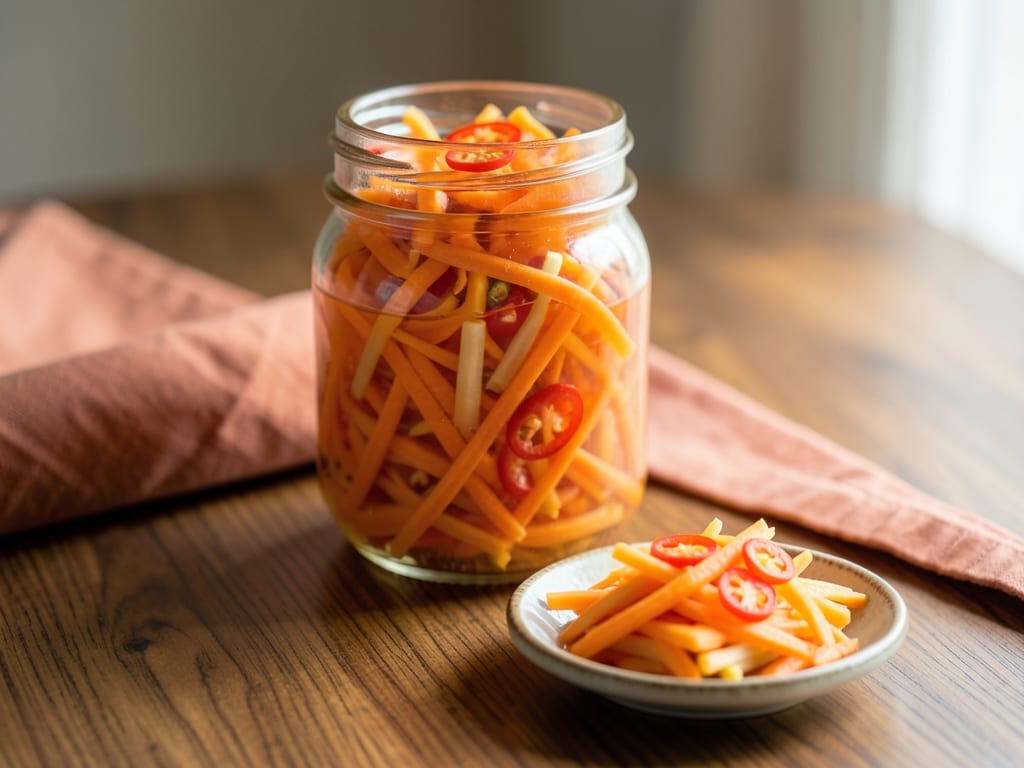
Find more like this
- Meal
- Dinner
- Main ingredient
- CarrotsBell Peppers
- Method
- Stovetop
- Quick & Easy
- EasyMake Ahead