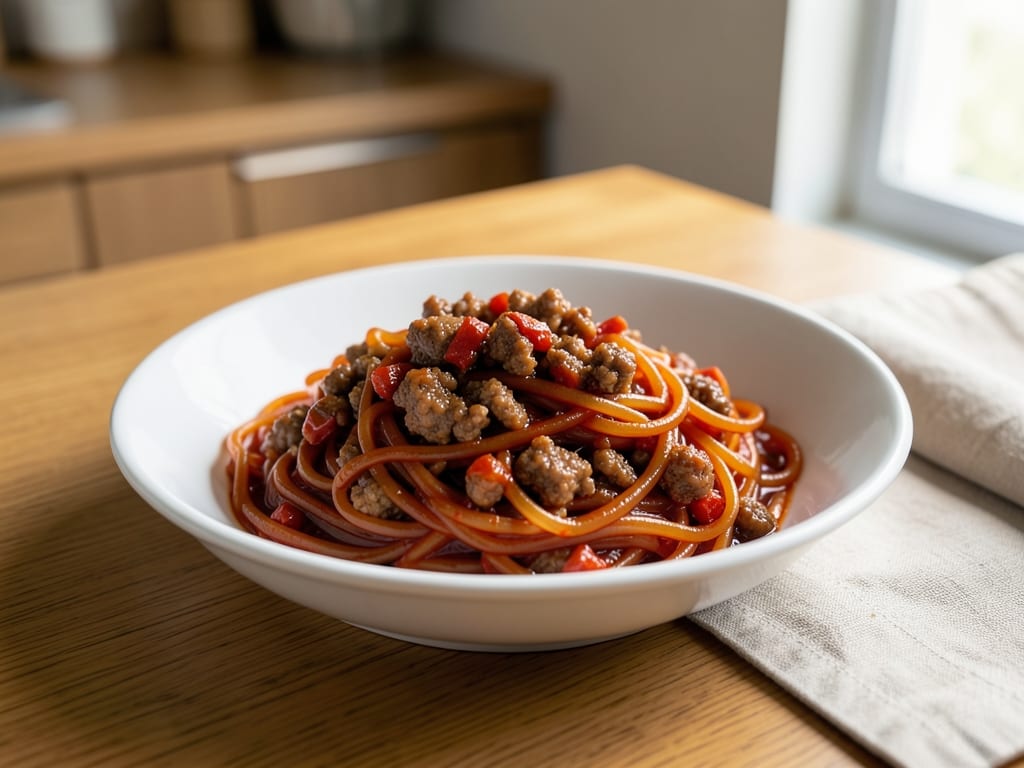
Ants Climbing a Tree (Sichuan Glass Noodles with Spicy Pork)
Chewy glass noodles braised in a savory, chili-red sauce studded with crumbly browned pork. Doubanjiang, garlic and ginger give deep Sichuan flavor, and the whole dish comes together in one wok in about 30 minutes.
- Prep
- 15 min
- Cook
- 15 min
- Wait
- 15 min
- Total
- 45 min
- Makes
- 4 servings as part of a shared meal (about 5 cups total)
Steps
Before you start
- Use sweet potato starch glass noodles (often labeled 'dang myeon' or 'fen tiao'); they stay chewy when braised. Mung bean noodles turn soft faster.
- Soak the noodles in warm tap water while you prep everything else; they need about 15 minutes.
- Doubanjiang is salty, so do not add extra salt until you taste at the end.
- Have all ingredients chopped and next to the stove before you heat the wok; the stir-fry moves quickly.
Soak the noodles
- Place the glass noodles in a large heatproof bowl and cover with warm tap water (about 100°F/40°C).
- Let soak 15 minutes, until the noodles are flexible and bend without snapping but still have a firm, white core.
- Drain well in a colander.
- Use kitchen scissors to cut the noodles once or twice into roughly 8-inch (20 cm) lengths so they are easy to stir and eat.
+ Show details− Hide details
Ready when: Noodles bend easily but are not fully soft or translucent
Tip: Do not use boiling water; it makes the noodles mushy once braised.
Prep the aromatics
- While the noodles soak, mince the garlic and ginger, slice the scallions and keep the white and green parts in separate piles.
- Chop the doubanjiang finely.
- In a measuring cup, stir together the stock, light soy sauce, dark soy sauce, sugar and white pepper to make the braising liquid.
+ Show details− Hide details
Ready when: Sugar is dissolved in the liquid
Brown the pork
- Heat a 14-inch wok over high heat until it just begins to smoke, about 1 minute.
- Add the neutral oil and swirl.
- Add the ground pork and spread it out.
- Let it sear without stirring for 1 minute, then break it into small pea-sized crumbles with the spatula.
- Cook 3 to 4 minutes total.
+ Show details− Hide details
Ready when: Pork is no longer pink, with browned edges and rendered fat pooling in the wok
Tip: Break up the meat finely; these crumbles are the 'ants' and should be small.
Fry the doubanjiang
- Push the pork to one side and reduce the heat to medium.
- Add the doubanjiang to the cleared, oily spot and fry 30 to 45 seconds, stirring and mashing it, until the oil turns deep red and smells toasty.
- Then stir it through the pork.
+ Show details− Hide details
Ready when: Oil is brick red and the paste smells fragrant, not burnt
Tip: Lower the heat if the paste sticks or darkens quickly; burnt paste tastes bitter.
Add the aromatics
- Add the garlic, ginger and scallion whites.
- Stir-fry 30 seconds until fragrant.
- Drizzle the Shaoxing wine around the edge of the wok, let it sizzle for 10 seconds, and stir.
+ Show details− Hide details
Ready when: Garlic is fragrant and pale golden, not brown
Add liquid and noodles
- Pour in the braising liquid and bring to a boil over high heat, about 1 minute.
- Add the drained noodles and use chopsticks or a spatula to push them down into the liquid and toss to coat.
+ Show details− Hide details
Ready when: Liquid is bubbling and noodles are submerged and starting to bend
Braise the noodles
- Reduce the heat to medium-low, cover, and simmer 4 minutes.
- Uncover and toss the noodles every minute or so for another 3 to 4 minutes, until they turn translucent and have absorbed nearly all the sauce.
+ Show details− Hide details
Ready when: Noodles are translucent, chewy-tender, and only a few spoonfuls of glossy sauce remain
Tip: If the pan looks dry before the noodles are tender, add 2 tablespoons water.
Finish and season
- Turn off the heat.
- Stir in the scallion greens, sesame oil and chili oil, if using.
- Taste and add a pinch of salt or splash of soy sauce only if needed.
- Serve immediately, since the noodles keep absorbing sauce as they sit.
+ Show details− Hide details
Ready when: Noodles are glossy, red-brown and evenly coated with pork
Tip: Serve right away; the noodles will clump as they cool.
Good to know
Tips
- Brands of doubanjiang vary a lot in salt and heat; Pixian brand is the classic. Start with 2 tablespoons and add more at the end only if you want it spicier.
- Do not oversoak the noodles; they finish cooking in the sauce and need a slight bite left.
- For a numbing Sichuan kick, add 1/2 teaspoon freshly ground Sichuan peppercorns with the sesame oil.
- Stir gently once the noodles are tender, as overworking can break them into short pieces.
Make ahead
"Soak and drain the noodles up to 2 hours ahead, tossed with 1 teaspoon oil to prevent sticking. The pork and sauce base (through step 5) can be cooked and refrigerated up to 2 days; reheat in the wok before adding liquid and noodles."
Storage & reheating
"Room temperature: up to 2 hours. Refrigerator: airtight container up to 3 days. Freezer: not recommended, since the noodles turn mushy. Reheat in a skillet over medium heat with 2 to 3 tablespoons water, tossing 2 to 3 minutes until hot and loosened (pork should reach 165°F/74°C), or microwave covered with a splash of water."
Substitutions
- ground pork → ground beef, ground chicken or crumbled firm tofu. Beef and chicken work at the same weight; for chicken add an extra teaspoon of oil. For tofu, fry until golden first.
- Shaoxing wine → dry sherry. Use the same amount.
- Sichuan doubanjiang (fermented chili bean paste) → Korean gochujang plus 1 tsp soy sauce. Gives a sweeter, less funky result; use 1.5 tbsp.
- low-sodium chicken stock → vegetable stock or water. Water gives a lighter flavor; add an extra 1/2 tsp light soy sauce.
More stir-fried noodles
See all →
Find more like this
- Meal
- Dinner
- Cuisine
- Sichuan
- Main ingredient
- Ground Pork
- Diet
- Dairy-Free
- Method
- Stovetop
- Quick & Easy
- Easy