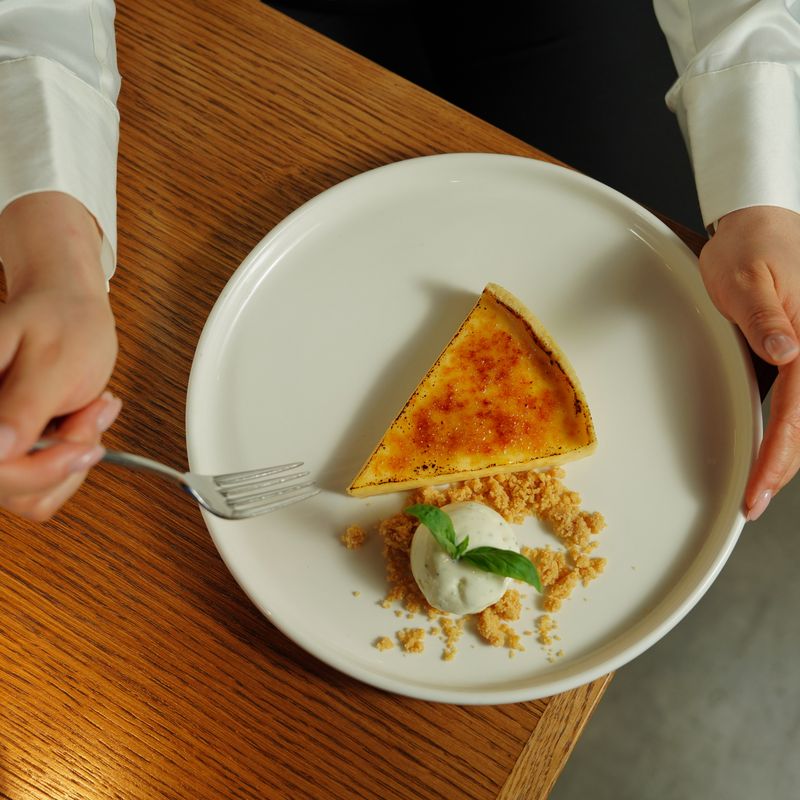
Almond Crème Brûlée with Malabi Rose Swirl
A luxurious custard dessert that marries French crème brûlée with Middle Eastern flavors. Silky almond-infused custard is topped with a vibrant rose-scented malabi layer and finished with a caramelized sugar crust. The delicate crunch of the brûléed top gives way to creamy almond custard beneath, with floral rose notes threading through each spoonful. This elegant dessert is perfect for special occasions and impresses with its visual appeal and complex flavor profile.
- Prep
- 20 min
- Cook
- 35 min
- Wait
- 4 hr
- Total
- 4 hr 55 min
- Makes
- 6 servings (¾-cup ramekins)
Steps
Before you start
- Separate eggs carefully so no yolk gets into whites
- Chill six 6-oz (180 ml) ramekins in the freezer for at least 30 minutes before filling
- Preheat oven to 325°F (163°C) and fill a larger roasting pan with hot water (you'll use this as a water bath)
- Have all ingredients measured and ready before you start cooking the custard
Heat cream and milk mixtureOven 170°F / 75°C
- Pour the cold heavy cream and cold whole milk into a large saucepan.
- Set over medium heat and warm gently, stirring occasionally, until it reaches about 170°F (77°C) or just before a simmer (you'll see wisps of steam and small bubbles at the edges, but it should not boil).
- This takes about 8–10 minutes.
- Remove from heat and stir in the almond extract and vanilla extract.
+ Show details− Hide details
Ready when: Cream mixture steams gently and reaches 170°F (77°C); small bubbles form at the edges
Tip: Do not boil the mixture or it may break when you add the egg yolks. A thermometer takes the guesswork out.
Whisk yolks with sugar
- While the cream heats, place the 5 egg yolks in a medium heatproof bowl.
- Add the granulated sugar and salt.
- Whisk continuously for 2–3 minutes until the mixture is pale, thick, and ribbons fall from the whisk when lifted.
- The mixture should be noticeably lighter in color and doubled in volume.
+ Show details− Hide details
Ready when: Yolk mixture is pale, thick, and ribbony; noticeably lighter in color than when you started
Tip: Don't skip the whisking time—this aerates the yolks and helps create a silky custard texture.
Temper the yolks
- Slowly pour the warm cream mixture into the yolk mixture, whisking constantly and continuously.
- Add the cream in a thin stream (no more than a tablespoon at a time for the first few additions) while whisking vigorously.
- This slowly raises the temperature of the yolks without scrambling them.
- Once about half the cream is incorporated, you can pour the remaining cream in a steady stream while whisking.
+ Show details− Hide details
Ready when: Mixture is smooth and uniform, with no streaks of yolk or cream visible
Tip: Rushing this step or adding cream too quickly will cause the yolks to scramble. Take your time with the first half.
Strain the custard
- Pour the combined custard mixture through a fine-mesh sieve into a clean bowl, pressing gently with the back of a spoon to extract all liquid.
- This removes any bits of cooked egg or air bubbles.
- Let the strained custard sit for 2 minutes, then skim away any foam from the surface with a spoon or ladle.
+ Show details− Hide details
Ready when: Custard is smooth and glossy; foam is removed from the surface
Tip: Straining is essential for a silky, custard-like texture with no graininess.
Fill ramekins and set water bathOven 325°F / 165°C
- Place the 6 chilled ramekins into the roasting pan.
- Pour the strained custard evenly into each ramekin, filling them about three-quarters of the way full (roughly ½ cup or 120 ml per ramekin).
- Pour hot water into the roasting pan around the ramekins until the water reaches halfway up the sides of the ramekins.
- The water bath regulates heat and prevents the custard from curdling.
+ Show details− Hide details
Ready when: Ramekins are filled and arranged in hot water bath
Tip: Use a kettle to pour hot water so you don't splash water into the custard. The water bath is crucial for even, gentle cooking.
Bake custards until setOven 325°F / 165°C
- Carefully transfer the roasting pan to the preheated 325°F (163°C) oven.
- Bake for 18–22 minutes.
- The custards are done when the edges are just set (they will not jiggle when you gently shake the pan) but the very center of each custard still has a slight jiggle the size of a quarter—about 1 inch in diameter.
- An instant-read thermometer inserted into the center (not touching the bottom) should read 170–172°F (77–78°C).
+ Show details− Hide details
Ready when: Edges are set; center jiggles slightly (about 1 inch); internal temperature is 170–172°F (77–78°C)
Tip: Do not overbake. A little jiggle in the center means the custard will set perfectly as it cools and carries over.
Cool and chill custards
- Remove the roasting pan from the oven and carefully lift the ramekins out of the water bath.
- Place them on a wire rack and let cool to room temperature, about 30 minutes.
- Then cover each ramekin with plastic wrap and refrigerate for at least 3 hours, or overnight.
- Cold custards are easier to work with and develop better flavor.
+ Show details− Hide details
Ready when: Custards are completely chilled and set when removed from the refrigerator
Tip: Make these a day ahead if you like. The custards actually taste better after an overnight chill.
Make the malabi rose mixture
- In a small saucepan, combine the cornstarch and sugar with 2 tablespoons (30 ml) of the cold milk, stirring until the cornstarch dissolves and forms a smooth paste with no lumps.
- Add the remaining 10 tablespoons (150 ml) of milk and the rose water.
- Set the pan over medium heat and whisk constantly.
- Bring to a gentle simmer, whisking, and cook for 2–3 minutes.
- The mixture will thicken and become translucent and gelatinous.
- Remove from heat, add the food coloring if using (2 drops for a delicate pink), and stir to blend.
- Let cool to room temperature (about 20 minutes), stirring occasionally.
+ Show details− Hide details
Ready when: Mixture thickens to a pudding-like consistency and becomes translucent; no lumps remain
Tip: This is a classic Middle Eastern pudding. The cornstarch creates a silky texture. Do not skip the room-temperature cooling step or it will break the custard.
Swirl malabi onto custards
- Remove the custards from the refrigerator and uncover them.
- Spoon about 2 tablespoons (30 ml) of the cooled malabi mixture onto the center of each custard.
- Using a thin skewer, toothpick, or the tip of a small knife, gently drag the malabi in sweeping lines or swirls through the custard surface to create a marbled pattern.
- Don't overwork it—a few dramatic swirls look best.
+ Show details− Hide details
Ready when: Malabi is swirled into custard with a few bold swirl patterns visible
Tip: Less is more with swirling. A few dramatic swirls look more elegant than an overmixed marbling.
Apply sugar for brûléeing
- Sprinkle about ½ teaspoon (2.5 ml or about 6 grams) of granulated sugar evenly over the top of each custard, including the swirled malabi area.
- Use a light hand and distribute the sugar as evenly as possible.
- Let the sugar sit for 1 minute to slightly dampen from the moisture on the custard surface.
+ Show details− Hide details
Ready when: Sugar layer is even and has slightly adhered to the custard surface
Tip: Dry sugar won't caramelize properly. Let it sit briefly to absorb a tiny bit of moisture from the custard.
Torch the sugar until caramelized
- Using a kitchen torch, hold the flame about 3 inches (7.5 cm) above the sugar surface and move it slowly and steadily across the top of each custard.
- The sugar will begin to bubble, turn amber, and then deepen to a dark golden brown.
- Work quickly and smoothly—the whole process takes about 30–45 seconds per custard.
- The caramelized sugar should be dark amber and crispy.
- Watch carefully to avoid burning (burnt sugar is black and tastes bitter).
+ Show details− Hide details
Ready when: Sugar is dark golden amber and crispy when tapped with a spoon; no black burnt spots
Tip: Keep the torch moving at a consistent pace and distance. Holding it still in one spot burns the sugar. You can test for crispness by gently tapping with a spoon—it should crack.
Rest and serve
- Let the brûléed custards rest at room temperature for 2–3 minutes so the caramel firms up and cools slightly (it will be very hot right after torching).
- Top each with a few chopped pistachios if desired.
- Serve immediately while the caramel is still crispy.
- The contrast between the crackling caramel top, silky almond custard, and floral malabi swirl is best enjoyed fresh.
+ Show details− Hide details
Ready when: Caramel is cool enough to touch the rim without burning yourself; still crispy on top
Tip: Serve right after torching while the caramel is at peak crispiness. The contrast is what makes this dessert special.
Good to know
Tips
- Do not skip the water bath. It regulates the oven heat and creates a gentle, even cooking environment—essential for silky custard.
- Separate your eggs with extra care so no yolk touches the whites; any fat in the white will prevent them from foaming if you need them later.
- If you don't own a kitchen torch, you can place the entire ramekin under a hot broiler for 45–60 seconds instead—watch it closely, as broiler heat is intense and uneven.
- The almond extract flavor is delicate; don't be tempted to use more or it will become soapy-tasting. ¾ teaspoon is the perfect balance.
Make ahead
You can bake and chill the custards 1–2 days ahead. Keep them covered in the refrigerator. Make the malabi mixture up to 4 hours ahead and store it at room temperature in an airtight container. Swirl the malabi, brûlée the sugar, and serve immediately for the best caramel crispness and visual appeal.
Storage & reheating
Store covered in the refrigerator for up to 2 days before brûléeing. Once brûléed, serve immediately for the best crispy caramel texture. The caramel will soften and the custard will continue to set as it sits. You can store leftover brûléed desserts in the refrigerator for up to 1 day, but the caramel will no longer be crispy.
Substitutions
- pure almond extract → ¼ teaspoon of pure vanilla extract plus ¼ teaspoon of finely ground blanched almonds (simmered with the cream, then strained). For a more subtle almond flavor or if you dislike almond extract, use blanched almonds steeped in the cream.
- rose water (food-grade) → orange blossom water in the same amount, or omit entirely for a plain malabi layer. Orange blossom water is a classic Middle Eastern alternative. A plain malabi (without rose or orange blossom water) also works beautifully.
- red or pink food coloring (gel or liquid) → a pinch of crushed freeze-dried raspberries or strawberries, or natural beetroot powder (about ⅛ teaspoon). For natural color without synthetic food coloring. Strain out any solids after coloring the malabi.
- roasted unsalted pistachios → toasted sliced almonds, crushed amaretti cookies, or candied rose petals. Pistachios complement the almond and rose flavors, but any crunchy, complementary garnish works.
More puddings & custards
See all →
Find more like this
- Meal
- Dessert
- Cuisine
- Middle Eastern
- Main ingredient
- Eggs
- Method
- Oven