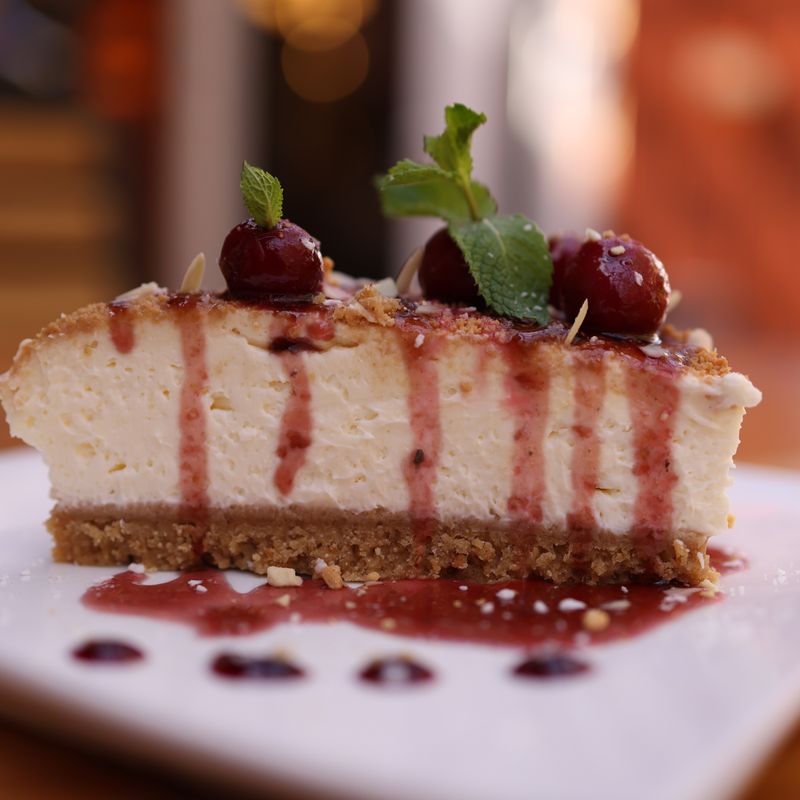
Labneh Cheesecake with Pistachio Crust
A creamy, tangy Middle Eastern–inspired cheesecake made with labneh (strained yogurt) and topped with a buttery pistachio crust. The filling is silky and less dense than traditional cheesecake, with subtle honey sweetness and a bright yogurt tang. Topped with a glossy honey drizzle and crushed pistachios for a textural finish.
- Prep
- 30 min
- Cook
- 50 min
- Wait
- 6 hr
- Total
- 7 hr 20 min
- Makes
- One 9-inch (23 cm) cheesecake (12 slices)
Steps
Before you start
- Labneh must be thick and creamy—if using store-bought, ensure it's strained or use Greek yogurt as a substitute
- Bring cream cheese and eggs to room temperature for 1 hour before baking for a smooth batter
- Preheat oven to 325°F (163°C) and position rack in the center
- Have a springform pan, water bath pan, and aluminum foil ready
Prepare springform pan
- Wrap the exterior of a 9-inch (23 cm) springform pan snugly with heavy-duty aluminum foil, covering the bottom and sides completely to prevent water from seeping in.
- Set aside.
+ Show details− Hide details
Tip: Make sure the foil wrapping is tight and complete to keep water out of the pan during the water bath.
Make pistachio crust
- Pulse 1½ cups (180 g) coarsely chopped pistachios in a food processor until the texture is between fine crumbs and coarse meal—you want some texture, not a powder.
- Transfer to a bowl, add 4 tablespoons (57 g) melted butter, 2 tablespoons (25 g) sugar, and ¼ teaspoon (1.5 g) salt.
- Stir until the mixture is evenly moistened and resembles damp sand.
+ Show details− Hide details
Ready when: Mixture is evenly moistened and holds together when pressed
Tip: Don't over-process the pistachios—some small chunks create a better texture than powder.
Press crust into panOven 325°F / 165°C
- Press the pistachio mixture evenly into the bottom of the prepared springform pan, using the bottom of a measuring cup or your fingers to create a firm, even layer.
- Bake at 325°F (163°C) for 10 minutes until it begins to set and smells toasted.
+ Show details− Hide details
Ready when: Crust is light golden and fragrant
Tip: A pre-baked crust prevents a soggy bottom from the water bath and filling moisture.
Beat cream cheese and labneh
- While the crust bakes, add 8 ounces (227 g) room-temperature cream cheese and 1½ cups (360 g) room-temperature labneh to a bowl.
- Using an electric mixer on medium speed, beat for 2 to 3 minutes until smooth and fluffy, scraping down the sides as needed.
- Do not overmix.
+ Show details− Hide details
Ready when: Mixture is smooth, pale, and creamy
Tip: Overmixing can incorporate too much air, which causes cracks. Mix until just combined and fluffy.
Mix in honey and flavorings
- Add ⅓ cup (110 g) honey, 1 teaspoon (5 ml) vanilla extract, lemon zest from 1 lemon, ⅛ teaspoon (0.5 g) ground cardamom (if using), and ¼ teaspoon (1.5 g) salt to the cream cheese mixture.
- Mix on medium speed for 1 minute until fully combined.
+ Show details− Hide details
Ready when: Honey and flavorings are evenly distributed
Tip: The cardamom is optional but adds an authentic Middle Eastern note; use sparingly as it can overpower.
Blend in cornstarch and eggs
- In a small bowl, whisk together 2 tablespoons (16 g) cornstarch with the room-temperature eggs until smooth.
- Add this mixture to the cream cheese mixture in three additions, mixing on low speed between each addition for 15 to 20 seconds.
- Mix only until combined after each addition—do not overmix.
+ Show details− Hide details
Ready when: Filling is smooth and homogeneous with no streaks
Tip: Adding eggs in stages and mixing gently prevents overaeration, which causes cracks and sinking centers.
Pour filling and set up water bath
- Remove the pre-baked crust from the oven and let cool for 2 minutes.
- Pour the filling into the pan, smoothing the top with an offset spatula.
- Place the springform pan inside a larger 9×13-inch (23×33 cm) roasting pan.
- Pour hot water into the roasting pan until it reaches halfway up the sides of the springform pan (about 1 to 1.5 inches / 2.5 to 4 cm).
+ Show details− Hide details
Ready when: Water bath is filled to proper level
Tip: Hot water conducts heat more gently than cold, preventing a cracked surface. The foil-wrapped bottom keeps water out.
Bake cheesecakeOven 325°F / 165°C
- Return the water bath to the oven and bake at 325°F (163°C) for 40 to 50 minutes.
- The cheesecake is done when the edges are set but the center (about a 2-inch / 5 cm circle in the middle) still has a slight jiggle when you gently shake the pan.
- An instant-read thermometer inserted 1 inch (2.5 cm) from the center should read 150°F (65°C).
+ Show details− Hide details
Ready when: Edges are set, center jiggles slightly; internal temperature reaches 150°F (65°C)
Tip: A gentle jiggle indicates the cheesecake is moist and creamy. Overbaking results in a dense, dry cake.
Cool in oven
- Turn off the oven and crack the door open about 2 inches (5 cm).
- Leave the cheesecake in the water bath and oven for 1 hour.
- This gradual cooling prevents thermal shock and cracking.
- Remove the cheesecake and water bath from the oven.
+ Show details− Hide details
Ready when: Cheesecake has cooled slightly but is still warm
Tip: Slow cooling is essential for a smooth surface—rapid temperature changes cause the characteristic cheesecake cracks.
Chill thoroughly
- Lift the springform pan out of the water bath using tongs or oven mitts.
- Pat the bottom dry with a kitchen towel.
- Place on a wire rack to cool to room temperature, about 30 minutes.
- Then transfer to the refrigerator and chill for at least 5 hours, preferably overnight.
- The cheesecake must be fully cold before unmolding.
+ Show details− Hide details
Ready when: Cheesecake is very cold and firm to the touch
Tip: Cold cheesecake slices cleanly; warm cheesecake will be gummy. A long chill also allows flavors to meld.
Unmold and slice
- Remove the cheesecake from the refrigerator.
- Run a thin, hot knife around the inside edge of the springform pan, then release the springform collar.
- Using a long, thin spatula, gently slide the cake free of the pan base.
- Cut into 12 slices, wiping the knife clean between cuts with a warm, damp cloth for neat edges.
+ Show details− Hide details
Ready when: Cheesecake slices cleanly with no cracks or sticking
Tip: A long, thin knife (like a serrated bread knife) dipped in hot water and wiped clean between cuts prevents drag and produces the cleanest slices.
Top and serve
- Just before serving, warm ¼ cup (85 g) honey in a small saucepan over low heat (do not boil).
- Drizzle about 1 to 1.5 teaspoons of honey over each slice and scatter ½ cup (60 g) coarsely crushed roasted pistachios over the top.
- If using rose water, add a light spray or a single drop to each slice for a delicate Middle Eastern finish.
+ Show details− Hide details
Ready when: Honey is warm and pourable
Tip: Warm honey flows beautifully and clings to the creamy cheesecake. Rose water is optional but adds an authentic flavor echo.
Good to know
Tips
- Labneh is the key to this cheesecake's distinctive tangy creaminess—do not skip it or substitute it with regular yogurt, which is too liquid. If you cannot find labneh, strain full-fat Greek yogurt overnight through cheesecloth.
- Room temperature ingredients (cream cheese, labneh, eggs) blend smoothly and incorporate air evenly, resulting in a silky texture and fewer cracks. Set them out 1 hour before mixing.
- A water bath is non-negotiable for a smooth, crack-free top. The gentle, humid heat prevents the filling from setting too quickly on the surface while the center remains underbaked.
- Resist opening the oven door during baking; the temperature drop can cause the center to collapse. If you must check doneness, do so only in the final 5 minutes.
Make ahead
You can bake the cheesecake up to 2 days ahead; store it in the springform pan, wrapped in plastic wrap, in the refrigerator. Unmold, slice, and top with honey and pistachios just before serving for the best presentation and texture.
Storage & reheating
Room temperature: up to 2 hours (best served chilled). Refrigerator: up to 5 days covered with plastic wrap in the springform pan. Freezer: up to 1 month (wrap the whole cheesecake or individual slices in plastic wrap and then foil). Thaw overnight in the refrigerator before serving. The honey and pistachio toppings are best added fresh just before serving.
Substitutions
- thick labneh (strained yogurt) → Greek yogurt (full-fat, strained through cheesecloth for 30 minutes to remove excess whey). Greek yogurt mimics labneh's thickness and tang. Straining ensures the correct consistency and prevents excess moisture that would make the cheesecake watery.
- raw or roasted unsalted shelled pistachios → Blanched almonds or hazelnuts, finely chopped. These nuts have a similar fat content and texture. Almonds are milder; hazelnuts offer a deeper, earthier flavor. Pistachios are essential to the Middle Eastern character, so this substitution changes the profile.
- honey → Maple syrup or agave syrup (same amount). Both provide sweetness and moisture. Maple syrup adds earthiness; agave is more neutral. Honey's floral notes are unique, so this will alter the flavor subtly.
- ground cardamom → Ground cinnamon or a pinch of ground nutmeg. Both are warmer and less floral than cardamom but maintain the spiced Middle Eastern feel. Use half the amount of nutmeg (⅛ teaspoon / 0.25 g) as it is stronger.
More puddings & custards
See all →
Find more like this
- Meal
- Dessert
- Cuisine
- Middle Eastern
- Main ingredient
- Cheese