Algerian Orange and Anise Salad with Toasted Hazelnuts
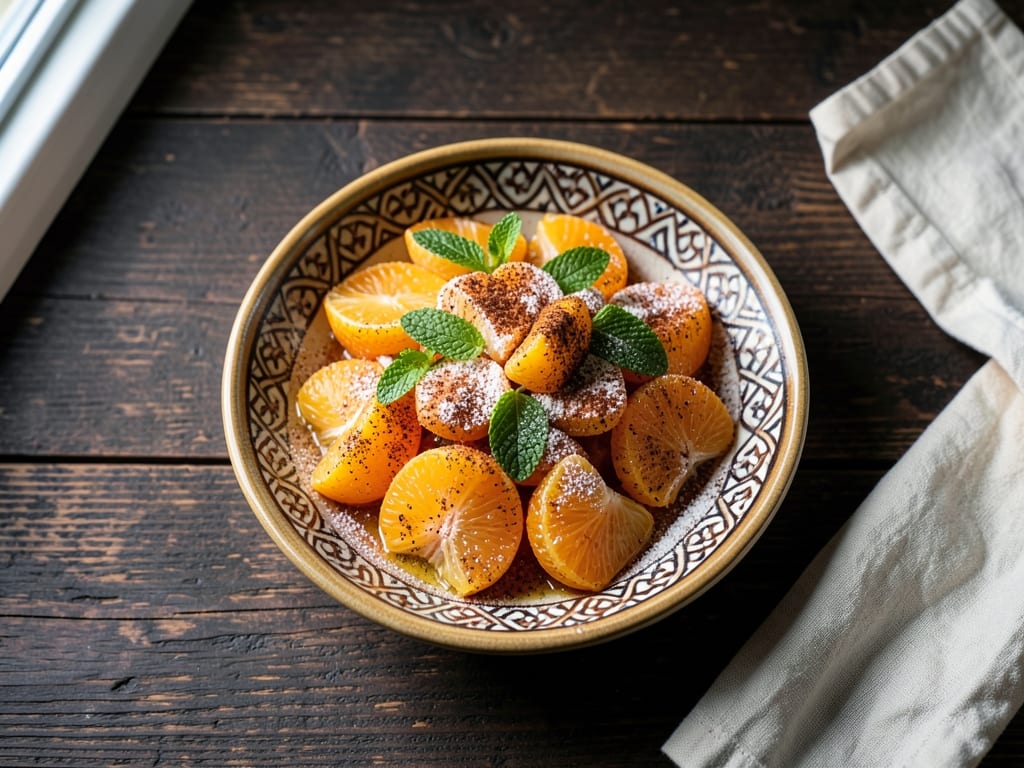
A bright, aromatic North African fruit salad built on fresh oranges with the subtle licorice notes of star anise, warm cinnamon, and toasted hazelnuts. Pomegranate seeds add pops of tartness and color, while a honey-olive oil dressing brings everything together. Served at room temperature, it's an elegant finish to a meal or a refreshing palate cleanser.
- Prep
- 20 min
- Cook
- 5 min
- Wait
- 10 min
- Total
- 35 min
- Makes
- 4 servings (about 1.5 cups each)
Steps
Before you start
- Have all oranges and pomegranates at room temperature for best flavor
- Line a small plate with paper towels to drain toasted hazelnuts
- Use a sharp knife or microplane to remove orange zest carefully, avoiding the bitter white pith
Toast the hazelnuts
- Heat a small dry skillet over medium heat.
- Add hazelnuts and toast, stirring frequently with a wooden spoon, for 4 to 5 minutes until they're fragrant and the skins begin to crack slightly.
- The hazelnuts should not darken much—you're looking for nutty aroma and gentle browning.
- Pour onto a paper towel-lined plate to cool completely, about 5 minutes.
+ Show details− Hide details
Ready when: Hazelnuts smell fragrant and skins begin to crack; they should not burn
Tip: Don't skip the cooling time—warm hazelnuts are fragile and will break when you crack them. Partially toasted nuts develop better flavor than raw ones.
Prepare the oranges
- Zest one of the oranges using a microplane or fine grater, being careful to remove only the colored outer layer and not the bitter white pith underneath.
- You need 1 teaspoon of zest.
- Set the zest aside.
- Then cut away the top and bottom of each orange with a sharp knife.
- Stand the orange upright on a cutting board and carefully slice away the peel and white pith in downward strokes, following the curve of the fruit.
- Working over a small bowl to catch juices, segment the oranges by cutting along both sides of each membrane to release the segments cleanly.
- Squeeze the remaining membranes into the bowl to extract all juice (you should have about 1/4 cup juice).
- Discard seeds if present.
+ Show details− Hide details
Ready when: Oranges are fully segmented with no white pith clinging to segments; juice is collected
Tip: Work slowly over the bowl to catch every drop of juice—it's essential for the dressing and adds natural sweetness.
Crack the cooled hazelnuts
- Once the toasted hazelnuts are cool, gently crack them with the side of a knife or your fingers to break them into rough bite-sized pieces (about 1/2 inch).
- Don't grind them fine—you want texture in the salad.
- Some of the papery skin may fall away naturally, and that's fine.
+ Show details− Hide details
Ready when: Hazelnuts are broken into bite-sized pieces
Tip: Rough pieces give better texture than finely chopped hazelnuts. Handle them gently so they don't powder up.
Make the dressing
- In a small bowl or jar, whisk together the collected orange juice (about 1/4 cup), honey, olive oil, ground cinnamon, orange zest, and salt.
- Stir until the honey dissolves completely and the mixture is smooth.
- Taste and adjust salt if needed—it should be lightly sweet with a whisper of spice.
+ Show details− Hide details
Ready when: Honey is fully dissolved and dressing is smooth and uniform
Tip: Whisk the dressing vigorously to emulsify the oil and juice—this prevents them from separating.
Assemble the salad
- In a serving bowl or on a platter, layer the orange segments and pomegranate seeds gently.
- Pour the dressing over the fruit and toss very gently with a rubber spatula or large spoon, taking care not to crush the segments.
- Scatter the cracked toasted hazelnuts over the top.
- Tuck the whole star anise between the fruit pieces for visual appeal and gentle flavor.
- If using fresh mint, scatter the torn leaves over the top just before serving.
+ Show details− Hide details
Ready when: Fruit is gently combined with dressing; hazelnuts and star anise are visible throughout
Tip: Toss gently to avoid bruising the delicate orange segments. The star anise pieces should be visible for visual appeal and to infuse subtle flavor.
Good to know
Tips
- This salad is best served at room temperature to allow the flavors to bloom. Chilling mutes the delicate citrus and anise notes.
- For a North African presentation, serve on a large platter lined with fresh mint leaves, and drizzle any extra dressing around the edges.
- The star anise pieces are not meant to be eaten—they infuse flavor and look beautiful. Diners can move them aside as they eat.
- If you prefer a more pronounced spice flavor, add 1/8 tsp cayenne or a small pinch of ground clove to the dressing; this bridges the gap between sweet and savory, typical of Algerian cuisine.
Make ahead
The dressing can be made up to 2 days ahead and kept in a covered jar in the refrigerator. The hazelnuts can be toasted up to 1 day ahead and stored in an airtight container at room temperature. Assemble the salad no more than 15 minutes before serving to keep the fruit fresh and the hazelnuts crisp.
Storage & reheating
Best served the day it's made at room temperature. Leftovers will keep in a covered container in the refrigerator for up to 1 day, though the hazelnuts will soften. The salad does not freeze well. To refresh, drain off excess liquid and serve cold or let it come to room temperature for 30 minutes.
Substitutions
- raw hazelnuts, skin on → toasted sliced almonds or pine nuts. Almonds give a cleaner, less earthy flavor; pine nuts are slightly buttery. Toast sliced almonds for 3 to 4 minutes and pine nuts for 2 to 3 minutes.
- pomegranate → dried apricots, chopped, or fresh figs. Use 1/2 cup chopped dried apricots or quartered fresh figs for tartness and chew. Rehydrate dried apricots in warm water for 5 minutes if they're very dry.
- whole star anise → 1/4 tsp fennel seeds or a pinch of ground anise seed. These give the same licorice note but in ground form—stir into the dressing rather than leaving whole pieces.
- raw honey or orange blossom honey → maple syrup or agave nectar. Use the same amount. Maple syrup will add a deeper, woodsy note; agave is more neutral. Orange blossom water (1/4 tsp added to the dressing) can complement either substitute.