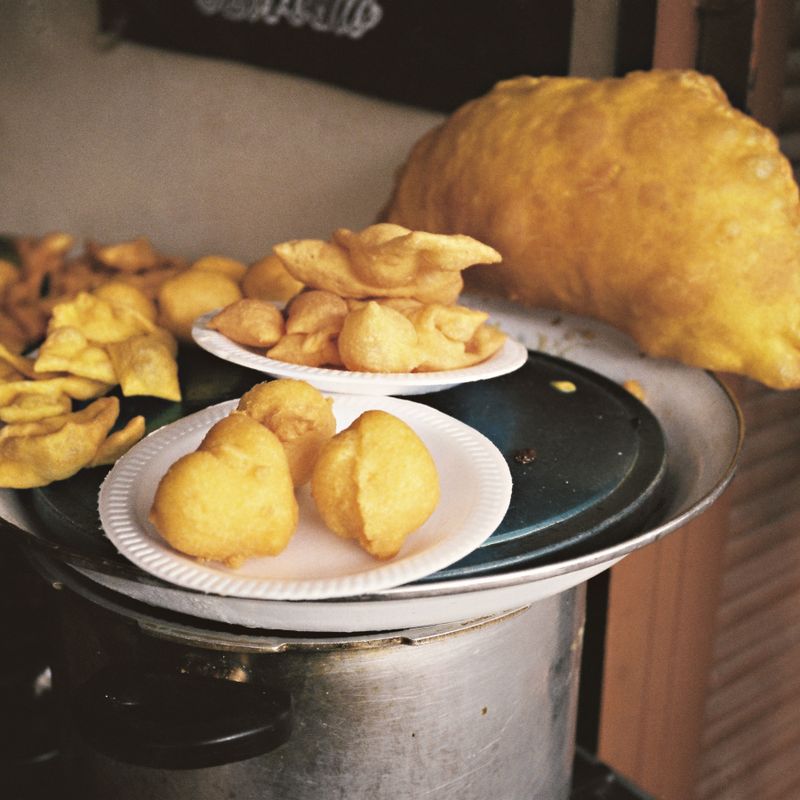
Algerian Makla Fried Pastry Strips
Makla are golden-fried pastry strips from Algeria, flavored with anise and dressed with warm honey and sesame seeds. Crispy on the outside with a tender interior, these treats are traditionally served at celebrations and special occasions. They're best enjoyed warm and pair beautifully with hot tea or coffee.
- Prep
- 30 min
- Cook
- 25 min
- Wait
- 45 min
- Total
- 1 hr 40 min
- Makes
- About 24 strips (serves 8)
Steps
Before you start
- Have all ingredients measured and ready before you start frying
- Heat the honey gently 10 minutes before finishing the pastries
- Set up a baking sheet lined with parchment paper to drain the fried strips
Make the dough
- In a large mixing bowl, whisk together 2½ cups (312 g) all-purpose flour, ½ tsp (3 g) salt, and 1 tsp (3 g) ground anise seed.
- Create a well in the center and add ¾ cup (180 ml) warm water and 3 tbsp (45 ml) vegetable oil.
- Mix with a wooden spoon until a shaggy dough forms, then knead by hand for about 5 minutes until the dough is soft, slightly sticky, and homogeneous.
- The dough should feel smooth and elastic.
+ Show details− Hide details
Ready when: Dough is smooth, elastic, and slightly sticky
Tip: Don't overwork the dough; it should remain tender. If it feels too dry, add water 1 tablespoon at a time.
Rest the dough
- Cover the dough bowl with a damp kitchen towel and let it rest at room temperature for 30 minutes.
- This allows the gluten to relax and makes the dough easier to roll.
+ Show details− Hide details
Tip: A rested dough is much easier to roll thin without tearing.
Roll out the dough
- Lightly dust a clean work surface with flour.
- Turn the rested dough out onto the surface and flatten it with your hands.
- Using a rolling pin, roll the dough into a thin rectangle about 16×12 inches (41×30 cm) and about ⅛ inch (3 mm) thick.
- Work gently and evenly; the thinner the dough, the crispier the strips will be.
+ Show details− Hide details
Ready when: Dough is thin, even, and almost translucent in places
Tip: If the dough springs back, let it rest for 2–3 minutes, then continue rolling. The anise aroma will be strong—this is perfect.
Cut into strips
- Using a sharp knife, cut the rolled dough into strips approximately ½ inch (1.25 cm) wide and 4 inches (10 cm) long.
- You should have about 24 strips.
- Arrange them on parchment paper to prevent sticking.
+ Show details− Hide details
Ready when: All dough is cut into uniform strips
Tip: Keep your knife wet or lightly oiled so the dough doesn't stick to the blade.
Heat the oilOven 350°F / 175°C
- Pour 3 cups (720 ml) vegetable oil into a large heavy-bottomed pot or deep skillet.
- Clip an instant-read thermometer to the side of the pot and heat the oil to 350°F (175°C).
- Let the thermometer stabilize and verify the temperature is steady before beginning to fry.
- The oil should shimmer but not smoke.
+ Show details− Hide details
Ready when: Oil reaches 350°F (175°C) and is shimmering
Tip: Use a thermometer to avoid guessing. If oil is too hot, the strips will burn outside before cooking inside; too cool and they'll be greasy.
Fry the first batch
- Carefully lower 6–8 strips into the hot oil using a slotted spoon, working in batches to avoid crowding.
- Fry for 1–1.5 minutes on the first side until golden and crispy, then use tongs to flip each strip.
- Fry the second side for another 1–1.5 minutes until evenly golden brown.
- The strips should be light and crispy with no pale spots.
+ Show details− Hide details
Ready when: Strips are golden brown and crispy on both sides
Tip: Don't fry too many at once—overcrowding lowers the oil temperature and results in greasy pastry. Space them so each gets direct contact with the hot oil.
Drain and continue fryingOven 350°F / 175°C
- Using a slotted spoon, transfer the fried strips to a baking sheet lined with paper towels.
- Let them cool and drain for 1–2 minutes.
- Return to medium-high heat and repeat with the remaining batches of 6–8 strips, frying each batch for 1–1.5 minutes per side.
- Maintain the oil temperature at 350°F (175°C)—if it drops, wait for it to recover before adding the next batch.
+ Show details− Hide details
Ready when: All strips are golden, crispy, and drained
Tip: Check the oil temperature between batches and adjust the heat as needed. Leftover crumbs in the oil will burn; skim them out with a slotted spoon.
Warm the honey and toast sesame
- While the last batch is frying, warm the honey gently in a small saucepan over low heat until it's liquid and warm to the touch (about 2–3 minutes).
- If using raw sesame seeds, toast them in a dry skillet over medium heat for 2–3 minutes, stirring frequently, until fragrant and lightly golden.
- If using pre-toasted seeds, you can skip this step.
+ Show details− Hide details
Ready when: Honey is warm and pourable; sesame seeds are fragrant and lightly golden
Tip: Don't overheat the honey or it will become too thin. Warm sesame seeds add better flavor than raw ones.
Assemble and finish
- Arrange the warm fried strips on a shallow serving platter.
- Drizzle the warm honey evenly over all the strips, then sprinkle with the toasted sesame seeds.
- Gently toss or mix the strips to coat them with honey and sesame, working quickly while the strips are still warm so the honey adheres.
+ Show details− Hide details
Ready when: All strips are evenly coated with honey and sesame seeds
Tip: Work while the pastries are still warm—the honey will set as they cool, binding everything together. Serve within 30 minutes for the best texture.
Good to know
Tips
- Anise flavor is distinctive—if you or your guests dislike licorice, reduce ground anise to ½ tsp (1.5 g) or omit it entirely.
- For extra-crispy Makla, let the finished pastries cool completely on the paper towels before adding honey. They'll crisp up further as they cool.
- Traditional Algerian Makla are sometimes shaped into loose knots or coils before frying. If you want to try this, tie each strip into a loose knot or roll it gently before frying—it creates a more elegant presentation.
- These pastries are best served warm with mint tea or strong coffee. They pair beautifully with dates or almonds as a breakfast or dessert treat.
Make ahead
You can prepare the dough up to 4 hours ahead. After kneading, cover it and refrigerate. Bring it to room temperature (about 30 minutes) before rolling and frying.
Storage & reheating
Store cooled Makla in an airtight container at room temperature for up to 2 days. They're best eaten the day they're made. To reheat, warm them gently in a 300°F (150°C) oven for 5–8 minutes to restore crispness. Do not freeze—the pastries will become soggy when thawed.
Substitutions
- ground anise seed → ground fennel seed or ½ tsp (1.5 g) star anise powder. Both have a similar licorice flavor. Star anise powder is slightly more intense, so use less.
- sesame seeds, white or toasted → chopped unsalted pistachios or pine nuts. These add crunch and a different flavor profile. Toast them lightly and mix with the honey just before serving.
- honey → warmed orange blossom honey or acacia honey. These floral honeys are traditional in North African pastries and add subtle flavor complexity.
- vegetable oil → peanut oil or refined sunflower oil. Both have high smoke points. Avoid extra-virgin olive oil, which has a lower smoke point and will impart a strong flavor.
More middle eastern sweets
See all →
Find more like this
- Meal
- Dessert
- Cuisine
- Moroccan
- Method
- Stovetop
- Quick & Easy
- 5 Ingredients or Less
- Occasion
- PartiesFamily Gatherings