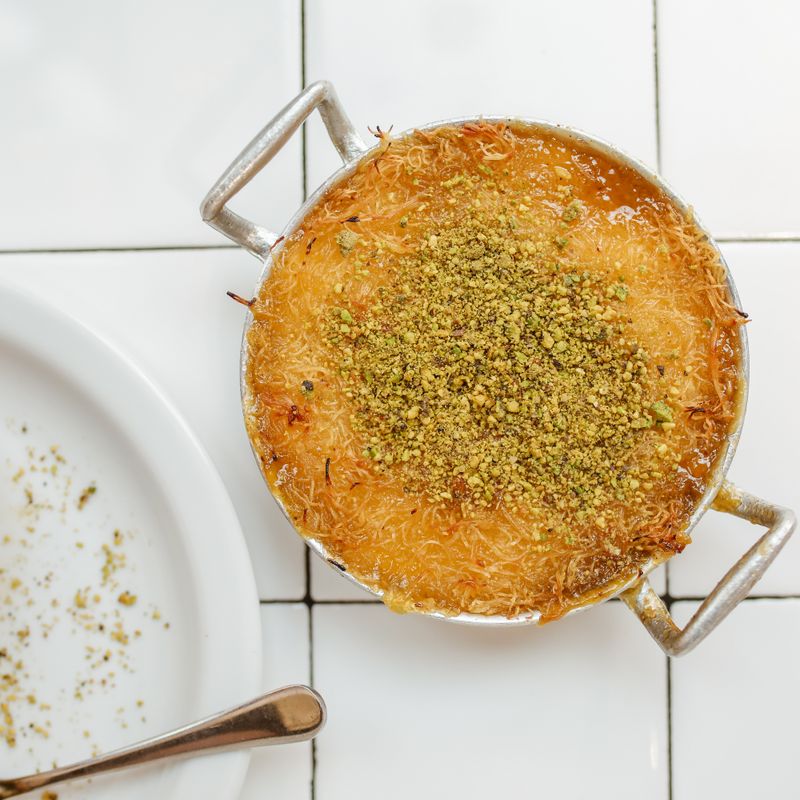
Levantine Knafeh with Cheese and Pistachios
A classic Levantine dessert featuring crispy golden kataifi pastry layered with creamy white cheese and topped with crushed pistachios. The pastry is soaked in a warm, fragrant orange blossom syrup just after baking, creating an irresistible contrast of textures—crunchy exterior, soft cheese center, and sweet aromatic syrup. This impressive pastry is perfect for celebrations and afternoon tea.
- Prep
- 20 min
- Cook
- 35 min
- Wait
- 15 min
- Total
- 1 hr 10 min
- Makes
- 1 round cake (8 slices)
Steps
Before you start
- Remove kataifi from the refrigerator 15 minutes before use so it separates easily
- Have the syrup made and still warm when you remove the knafeh from the oven
- Use a 9-inch (23 cm) round cake pan or pie dish
- Preheat the oven to 350°F (175°C)
Make the syrup
- In a small saucepan, combine the sugar, water, and lemon juice.
- Bring to a boil over medium heat, stirring occasionally to dissolve the sugar.
- Once boiling, reduce the heat to medium-low and simmer for 8–10 minutes without stirring, until the syrup reaches a light, honey-like consistency.
- Remove from heat and stir in the orange blossom water and rose water (if using).
- Set aside and keep warm on the stovetop.
+ Show details− Hide details
Ready when: Syrup is thin and pours easily but clings lightly to a spoon
Tip: Don't skip the lemon juice—it brightens the syrup and prevents it from tasting cloying.
Butter the pan
- Lightly brush the bottom and sides of a 9-inch (23 cm) round cake pan with some of the melted ghee, using about 1 tablespoon.
+ Show details− Hide details
Tip: This prevents the knafeh from sticking when you slice it later.
Layer the bottom crust
- Place half of the separated kataifi noodles (about 7 oz / 200 g) in the buttered pan, spreading them evenly across the bottom and slightly up the sides.
- Drizzle with 3 tablespoons (45 ml) of the melted ghee, letting it soak in, and use a wooden spoon or your fingers to press the pastry gently into an even, compact layer.
+ Show details− Hide details
Ready when: Bottom layer is evenly pressed and saturated with ghee
Tip: Don't pack too hard—the texture should remain light and crunchy after baking.
Add the cheese filling
- Distribute the room-temperature white cheese pieces evenly over the kataifi base, leaving a ½-inch border around the edges.
- Sprinkle with the salt.
+ Show details− Hide details
Ready when: Cheese is evenly scattered with no large gaps
Tip: Room-temperature cheese distributes more evenly and will melt smoothly during baking.
Top crust and butter
- Layer the remaining kataifi noodles (about 7 oz / 200 g) over the cheese, spreading them evenly and tucking the edges down slightly around the pan sides.
- Drizzle the remaining 4 tablespoons (60 ml) of ghee evenly over the top, letting it soak through the pastry.
- Press gently with a wooden spoon to compact the layers slightly.
+ Show details− Hide details
Ready when: Top layer is evenly moistened and compacted
Tip: Pour the ghee slowly so it distributes evenly and doesn't pool in one spot.
Bake until goldenOven 350°F / 175°C
- Place the pan in a preheated 350°F (175°C) oven.
- Bake for 30–35 minutes, until the top is a deep golden brown and the edges are crispy and darker.
- The kataifi should look shredded and slightly caramelized, and you may hear gentle crackling sounds as the pastry crisps.
+ Show details− Hide details
Ready when: Top is deep golden brown and crispy-looking; edges are dark and caramelized
Tip: If the top browns too quickly, loosely tent with aluminum foil for the final 10 minutes, then remove to finish crisping.
Pour warm syrup
- Remove the knafeh from the oven and immediately pour the warm syrup slowly and evenly over the hot pastry, starting from the edges and working toward the center.
- Let the syrup soak in for 30 seconds, then gently pour any remaining syrup over any dry spots.
- The hot pastry will absorb the syrup quickly.
+ Show details− Hide details
Ready when: Syrup has soaked into the pastry and the top is wet and glistening
Tip: Pouring warm (not cold) syrup over hot pastry is crucial for proper absorption; cold syrup will slide off.
Cool and set
- Let the knafeh rest at room temperature for 10–15 minutes.
- As it cools, the pastry will firm up and the cheese will set slightly.
- Run a thin, sharp knife around the edges to loosen it from the pan.
+ Show details− Hide details
Ready when: Top is still warm but no longer hot; pastry is crispy and holding together
Tip: Don't skip this step—slicing too soon will cause the cheese to ooze out and break the pastry.
Cut and garnish
- Using a sharp knife, cut the knafeh into 8 wedges (like a pie).
- Transfer to serving plates with a spatula, keeping each wedge intact.
- Sprinkle the top of each wedge with the chopped pistachios.
+ Show details− Hide details
Ready when: Slices are cut cleanly and transferred without breaking
Tip: A long, thin-bladed knife works best; wipe it clean between cuts for clean edges.
Good to know
Tips
- Kataifi must be thawed gently; leaving it sealed in the refrigerator overnight is better than warming it quickly, which can cause it to dry out or clump.
- The contrast of temperatures—warm syrup on hot pastry, served still warm—is key to the experience. Serve within 30 minutes of making for the best texture.
- If you can't find orange blossom water, order it online or check Middle Eastern or specialty grocery stores. It transforms this dessert from good to transcendent.
- For a more luxurious version, sprinkle a few whole pistachios on top before baking, in addition to the chopped garnish.
Storage & reheating
Store covered at room temperature for up to 2 days. Reheat gently in a 300°F (150°C) oven for 5–7 minutes until warm and crispy. Do not refrigerate, as the pastry will soften. Not suitable for freezing.
Substitutions
- white cheese (akkawi, nabulsi, or mozzarella), cut into ½-inch pieces → Halloumi or fresh mozzarella. Use high-quality mozzarella that holds its shape when heated. Akkawi and nabulsi are traditional but harder to find outside the Levant; these substitutes offer similar melting texture and mild flavor.
- orange blossom water → Additional 1 tablespoon rose water or ½ teaspoon vanilla extract. Rose water and orange blossom water are both traditional; vanilla is less authentic but works if floral syrups are unavailable. Use whichever matches the filling you prefer.
- roasted unsalted pistachios, roughly chopped → Chopped roasted almonds or walnuts. Pistachios are traditional and prized for their color and flavor, but almonds or walnuts offer a similar texture and nutty richness if needed.
- ghee or clarified butter, melted → Clarified butter or unsalted butter. Ghee gives the best color and richness, but clarified butter or regular unsalted butter will work. Avoid salted butter, which will make the pastry too salty.
More middle eastern sweets
See all →



Find more like this
- Meal
- Dessert
- Cuisine
- Lebanese
- Main ingredient
- Cheese
- Diet
- VegetarianHalal
- Method
- Oven
- Occasion
- PartiesFamily Gatherings