
White Chicken Lasagna with Béchamel
Tender seared chicken and garlicky spinach are layered with noodles, a nutmeg-scented Parmesan béchamel, creamy ricotta and plenty of mozzarella. It bakes into golden, bubbling squares that hold their shape when you cut them.
- Prep
- 1 hr 6 min
- Cook
- 55 min
- Wait
- 20 min
- Total
- 2 hr 21 min
- Makes
- 1 lasagna in a 9×13-inch pan (8 generous squares)
Steps
Before you start
- Thaw the frozen spinach in the fridge overnight, or in a colander under cool running water. It must be squeezed very dry or the lasagna will be watery.
- Shred the mozzarella from a block yourself. Pre-shredded cheese melts less smoothly. Use low-moisture, whole-milk mozzarella, not fresh.
- Take the ricotta out of the fridge 20 minutes before you start so it mixes easily.
- Put a large pot of water on to boil first. Preheat the oven while you prep. The timing below assumes both are happening together.
- Measure and prep everything first. The béchamel needs constant attention once it starts.
Prep and preheatOven 375°F / 190°C
- Heat the oven to 375°F (190°C) with a rack in the center.
- Start 4 quarts (4 L) of water heating in the large pot over high heat.
- Grease the bottom and sides of the 9×13-inch dish with the soft butter, and grease one side of a large sheet of foil as well.
- Shred the mozzarella and divide it into 3 equal piles.
- Grate all of the Parmesan, keeping the three portions separate.
- Mince the garlic, chop the shallot and parsley, and squeeze the thawed spinach very dry in a clean towel.
+ Show details− Hide details
Ready when: Spinach feels like a damp clump and no more liquid drips out when you squeeze it.
Tip: Squeeze the spinach hard, in batches if needed. Leftover water is the main cause of soupy lasagna.
Boil the noodles
- When the water is at a full rolling boil, stir in the 1 tablespoon salt and add the noodles one at a time, stirring so they don't stick.
- Boil for 9 to 10 minutes, stirring occasionally.
- Drain gently.
- Slide the noodles into a large bowl or the clean sink filled with cool water so they stop cooking and don't stick together.
- Lift them out one at a time as you assemble.
+ Show details− Hide details
Ready when: Noodles bend easily but still have a firm bite in the center. They will finish softening in the oven.
Tip: Do not cook them to full softness or they will turn mushy and tear during assembly.
Sear the chicken
- Pat the chicken cutlets dry and season both sides with 1 teaspoon salt and the black pepper.
- Heat 1 tablespoon of the olive oil in the 12-inch skillet over medium-high heat until it shimmers.
- Add the cutlets in a single layer, working in two batches if they crowd the pan.
- Cook without moving for 4 to 5 minutes until deeply golden on the bottom, then flip and cook 4 to 5 minutes more.
- Remove from the heat when the thickest part reaches 165°F (74°C).
- Move the chicken to a cutting board and leave the skillet unwashed.
+ Show details− Hide details
Ready when: Both sides are golden and an instant-read thermometer in the thickest part reads 165°F (74°C), with no pink in the center.
Tip: Don't crowd the pan. Crowded chicken steams and turns grey instead of browning.
Rest and chop chicken
- Let the chicken rest on the board for 5 minutes so the juices settle.
- Then cut it into ½-inch (1 cm) pieces, or shred it with two forks.
- Put the chicken in a large bowl and pour in any juices from the board.
+ Show details− Hide details
Ready when: Pieces are uniformly small and white throughout with no pink.
Cook spinach filling
- Return the skillet to medium heat and add the remaining 1 tablespoon olive oil.
- Add the shallot and cook for 2 minutes, stirring, until soft and translucent.
- Add the garlic and cook for 30 seconds until fragrant but not browned.
- Add the squeezed spinach and ¼ teaspoon salt, breaking up clumps, and cook for 2 minutes until heated through and any last moisture has cooked off.
- Scrape the spinach mixture into the bowl with the chicken and stir to combine.
+ Show details− Hide details
Ready when: Shallot is soft and translucent, garlic smells sweet, and the spinach looks dry in the pan.
Tip: Lower the heat if the garlic starts to brown. Burnt garlic turns bitter.
Make the béchamel
- Melt the butter in the 3-quart saucepan over medium heat.
- Whisk in the flour and cook for 2 minutes, whisking constantly, until it smells slightly nutty and looks like wet sand.
- Do not let it brown.
- Pour in the milk about ½ cup (120 ml) at a time, whisking until smooth before each addition.
- Once all the milk is in, raise the heat to medium-high and bring to a gentle simmer, whisking and scraping the corners, for 4 to 5 minutes until the sauce coats the back of a spoon and a finger drawn through it leaves a clear line.
- Take the pan off the heat and whisk in the salt, white pepper, nutmeg and ¾ cup (75 g) Parmesan until melted and smooth.
+ Show details− Hide details
Ready when: Sauce is smooth, thick enough to coat a spoon, and pourable like heavy cream. You should have about 4½ cups (1.1 L).
Tip: If lumps form, whisk hard off the heat, or pour the sauce through a fine-mesh strainer. If it thickens too much while waiting, whisk in a splash of milk.
Mix ricotta layer
- In a medium bowl, stir together the ricotta, beaten egg, ¼ cup (25 g) Parmesan, parsley and ¼ teaspoon salt until evenly combined.
+ Show details− Hide details
Ready when: Mixture is creamy and uniform, with no streaks of egg.
Assemble the layers
- Spread ¾ cup (180 ml) béchamel over the bottom of the dish.
- Lay 3 noodles lengthwise over the sauce, slightly overlapping edges.
- Dollop and spread half of the ricotta mixture over the noodles, then scatter half of the chicken and spinach filling on top.
- Spoon about 1¼ cups (300 ml) béchamel over the filling and sprinkle with one portion of mozzarella.
- Add 3 more noodles and repeat with the remaining ricotta, filling, 1¼ cups béchamel and a second portion of mozzarella.
- Finish with the last 3 noodles.
- Spread the remaining béchamel (about 1 cup/240 ml) over the top so every noodle is covered.
- Sprinkle with the last portion of mozzarella and the ¼ cup (25 g) Parmesan for the top.
+ Show details− Hide details
Ready when: Three noodle layers, with no dry noodle edges poking out of the sauce on the top layer.
Tip: Covering the top noodles fully with sauce keeps them from drying out and turning hard in the oven.
Bake coveredOven 375°F / 190°C
- Set the dish on the rimmed baking sheet.
- Cover tightly with the greased foil, greased side down, so the cheese won't stick.
- Bake at 375°F (190°C) for 25 minutes.
+ Show details− Hide details
Ready when: Sauce is bubbling at the edges of the dish when you peek under a corner of the foil.
Tip: The baking sheet catches any bubbling sauce, which saves you from cleaning the oven.
Bake uncoveredOven 375°F / 190°C
- Carefully remove the foil, watching out for hot steam.
- Bake uncovered at 375°F (190°C) for 20 minutes more.
- If you'd like deeper browning, switch to the broiler for the last 1 to 2 minutes and watch it constantly.
+ Show details− Hide details
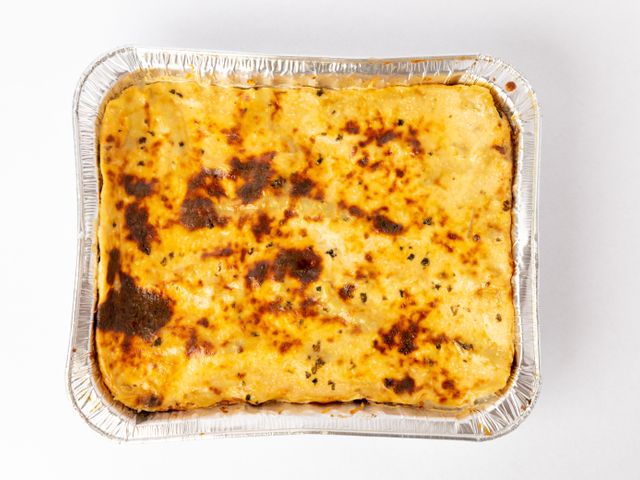
Ready when: Top is golden with browned spots, sauce is bubbling around the edges, and the center reads 165°F (74°C) on an instant-read thermometer.
Tip: Broilers vary widely, so never walk away while it's on.
Rest before slicing
- Let the lasagna stand on a wire rack for 15 minutes.
- Cut into 8 squares with a sharp knife and lift out with a wide spatula.
+ Show details− Hide details
Ready when: Bubbling has stopped and the sauce no longer runs when you press the top with a spatula.
Tip: Skipping the rest produces runny, sloppy slices.
Good to know
Tips
- Use a block of mozzarella you shred yourself and low-moisture, whole-milk cheese. Fresh mozzarella releases too much water.
- Whisk constantly when adding milk to the roux, and add it gradually, for a silky, lump-free béchamel.
- Use a thermometer rather than guessing. 165°F (74°C) in the center of the lasagna means it is hot and safe.
- A sharp knife and a wide spatula give the cleanest squares. Wipe the knife between cuts.
Make ahead
"Assemble the lasagna through the final cheese topping, cover tightly with plastic wrap, and refrigerate for up to 24 hours. Take it out 30 minutes before baking, swap the plastic for greased foil, and bake covered for 35 minutes instead of 25, then uncovered for 20 minutes. Check that the center reaches 165°F (74°C). The béchamel can also be made 2 days ahead: press plastic wrap onto the surface and chill, then rewarm gently with a splash of milk."
Storage & reheating
"Room temperature: no more than 2 hours after baking. Fridge: cover tightly and keep up to 4 days. Freezer: wrap individual squares well and freeze up to 2 months (an unbaked, assembled lasagna freezes up to 1 month; thaw overnight in the fridge before baking). Reheat: put portions in a baking dish, cover with foil, and warm at 350°F (175°C) for 20 to 25 minutes until 165°F (74°C) in the center, or microwave a single square for 2 to 3 minutes at 70% power."
Substitutions
- boneless, skinless chicken breasts → About 3 cups (400 g) shredded rotisserie chicken. Skip steps 3 and 4 and chop the chicken. Season it lightly, as rotisserie chicken is already salted.
- frozen chopped spinach → 1 lb (450 g) fresh baby spinach. Wilt in the skillet in batches, cool, then squeeze very dry in a towel before mixing with the chicken.
- whole-milk ricotta → Cottage cheese, blended or well drained. Use full-fat cottage cheese, drained in a sieve for 15 minutes, and pulse briefly in a food processor for a smoother texture.
- white pepper → Black pepper. Use the same amount. The flavor is slightly sharper and you will see small specks in the sauce.
More lasagna
See all →

Find more like this
- Meal
- Dinner
- Cuisine
- Italian
- Main ingredient
- Chicken BreastMozzarellaSpinach
- Diet
- HalalSugar-Free