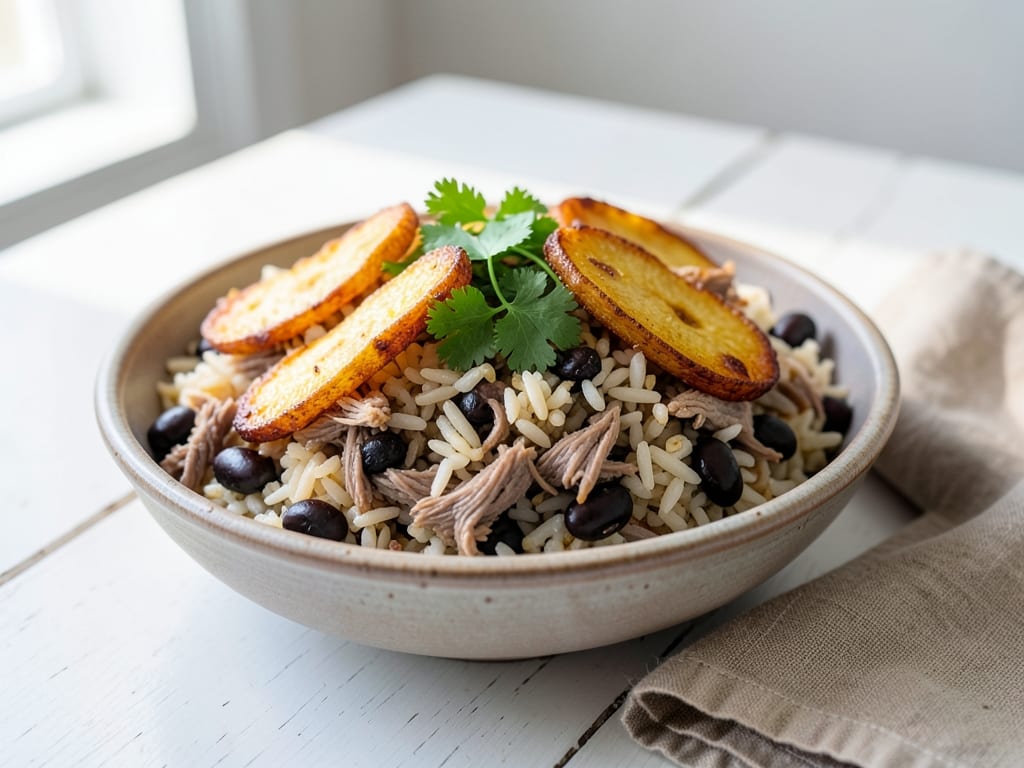
Venezuelan Pabellón Rice Bowl Pilaf
A savory Venezuelan-inspired rice pilaf with tender shredded beef, black beans, and aromatic spices, served in a bowl and topped with crispy fried ripe plantains and fresh cilantro. The beef is browned deeply, then simmered with the rice until the grains absorb rich, meaty broth. Plantains fried until golden add sweetness and texture that balances the savory pilaf.
- Prep
- 20 min
- Cook
- 46 min
- Wait
- 28 min
- Total
- 1 hr 34 min
- Makes
- 4 generous bowls
Steps
Before you start
- Chop all vegetables and measure spices before you begin
- Select ripe plantains with yellow skins and black spots
- Have a large lidded skillet and a separate medium skillet ready
- Read through all steps to understand the timing; rice simmers while plantains fry in parallel
Brown the beef
- Heat 2 tablespoons vegetable oil in a large (12-inch) skillet over medium-high heat until the oil shimmers and is almost smoking, about 1 minute.
- Pat the beef chunks dry with paper towels; this helps browning.
- Season all the beef pieces generously on all sides with kosher salt and freshly ground black pepper.
- Working in two batches to avoid overcrowding the pan, place the beef in the skillet in a single layer.
- Leave the pieces undisturbed for 3–4 minutes so they develop a dark, caramelized crust on the bottom, then stir and continue cooking until all sides are deeply browned, 4–5 minutes more per batch.
- Transfer all browned beef to a plate.
+ Show details− Hide details
Ready when: Beef is dark caramel brown on all sides, not gray
Tip: Resist the urge to stir the beef constantly; let it sit to build a proper crust that creates savory depth.
Sauté aromatics and spices
- Pour off all but 1 tablespoon of the oil from the pan.
- Reduce heat to medium.
- Add the diced onion to the skillet and cook, stirring occasionally, until it becomes soft, translucent, and begins to turn light golden at the edges, 4–5 minutes.
- Add the minced garlic and stir constantly for about 1 minute until the garlic is fragrant and raw smell is gone.
- Stir in the tomato paste and ground cumin, and cook, stirring frequently, for 1–2 minutes.
- You should smell the spices becoming warm and toasted.
+ Show details− Hide details
Ready when: Mixture is fragrant; spices appear darker and the raw garlic smell is gone
Tip: Don't let the spices scorch on the bottom of the pan; stir constantly.
Toast the rice
- Return the browned beef to the skillet, stirring to combine with the aromatics.
- Pour in the 1.5 cups long-grain white rice and stir constantly for 2–3 minutes.
- You're toasting the rice in the fat and spices, which coats the grains and develops their nutty flavor.
- Some grains will turn translucent at the edges.
+ Show details− Hide details
Ready when: Some rice grains appear translucent; mixture smells toasted and fragrant
Tip: Stir constantly to prevent sticking and ensure every grain gets coated with fat.
Add broth and begin simmering
- Pour the 2.75 cups beef broth into the skillet.
- Use a wooden spoon to scrape up all the browned bits stuck to the bottom of the pan—these add huge flavor.
- Stir well to combine everything.
- Taste and season with additional salt if needed.
- Bring the mixture to a boil over medium-high heat, stirring once or twice.
- Once boiling, cover the skillet tightly with its lid, reduce the heat to medium-low, and simmer gently.
+ Show details− Hide details
Ready when: Rice is nearly tender and most liquid is absorbed; you may see a few bubbles around the edges
Tip: Keep the lid fully sealed so steam doesn't escape, which would slow cooking and dry out the rice.
Add black beans and finish cooking
- After the rice has simmered for 18 minutes, lift the lid and check the rice—some grains should be just barely tender.
- Stir in the drained and rinsed black beans, distributing them evenly throughout the pilaf.
- Cover again and continue cooking over medium-low heat for 3–5 minutes more, until the rice is completely fluffy (not mushy) and the beans are heated through.
+ Show details− Hide details
Ready when: Rice grains are tender and separate easily; beans are warm throughout; most liquid is absorbed
Tip: If the pilaf looks too wet at this point, uncover it and cook for another 1–2 minutes over medium heat to evaporate excess broth.
Rest and fluff the pilaf
- Remove the skillet from the heat.
- Keep the lid on and let the pilaf rest undisturbed for 5 minutes.
- This allows any remaining moisture to steam-cook the rice and makes it fluffier.
- After 5 minutes, use a fork to fluff the rice gently, breaking up any clumps.
- The beef will be very tender; check that it shreds easily with the side of the fork.
+ Show details− Hide details
Ready when: Rice is fluffy when fluffed with a fork; beef shreds easily
Tip: Don't skip this resting step; it's what transforms the rice from slightly wet to perfectly fluffy.
Fry the plantainsOven 350°F / 175°C
- While the rice cooks (you can start this at Step 3), heat the 0.5 cup vegetable oil in a separate medium (10-inch) skillet over medium-high heat.
- The oil should reach 350°F (175°C).
- Test the temperature with an instant-read or candy thermometer; alternatively, drop a small piece of plantain into the oil—it should sizzle immediately and brown in about 2 minutes.
- Peel one ripe plantain by making 3–4 lengthwise cuts in the skin from tip to base, then peel away the strips.
- Slice the plantain on a bias into pieces about 1/4 inch thick.
- Carefully lower slices into the hot oil in a single layer (work in batches of 8–10 slices at a time, depending on pan size).
- Fry for 2–3 minutes per side until golden and crispy.
- Use a slotted spoon to transfer the plantains to a paper towel-lined plate.
- Season immediately with a pinch of salt while still hot.
- Repeat with the second plantain.
+ Show details− Hide details
Ready when: Plantain slices are golden to deep golden brown and crispy on both sides; edges may curl slightly
Tip: Keep the oil at 350°F for best results. If it's too cool (below 325°F), the plantains will absorb grease and be soggy. If it's too hot (above 375°F), they'll burn before the inside softens.
Fry queso de freír (optional)Oven 375°F / 190°C
- If you're using fried cheese, increase the oil temperature to 375°F (190°C).
- Slice the queso de freír or halloumi into 1/4-inch thick pieces.
- Fry for 30–45 seconds per side until the cheese is lightly golden and starts to blister.
- Transfer to paper towels with a slotted spoon and drain.
+ Show details− Hide details
Ready when: Cheese is lightly golden with slight blisters; it firms up as it cools
Tip: Fried cheese can be made 15–20 minutes ahead and gently reheated in a warm skillet if needed.
Assemble and serve
- Divide the warm beef and rice pilaf evenly among four serving bowls, mounding it in the center of each bowl.
- Arrange the warm crispy plantain slices on top or around the pilaf.
- If using fried cheese, place a slice or two on top.
- Sprinkle generously with the chopped fresh cilantro.
- Place a lime wedge on the side of each bowl for squeezing over the top just before eating.
+ Show details− Hide details
Tip: Serve immediately while the pilaf is hot and the plantains are still crispy. The lime juice is essential—it brightens all the rich, savory flavors.
Good to know
Tips
- Don't skip the browning step—those caramelized bits on the bottom of the pan are pure flavor. Scrape them up into the broth for a rich, savory depth that makes the whole dish taste better.
- Keep the rice covered while simmering. A tight lid traps steam and ensures even cooking. Lifting the lid releases precious steam and extends cooking time.
- Maintain oil temperature at 350°F for the plantains. Invest in a thermometer if you don't have one—it's the difference between crispy and soggy.
- Finish each bowl with fresh lime juice; the acidity cuts through the richness and brightens all the flavors, making this dish sing.
Make ahead
The beef and rice pilaf (through Step 6) can be made up to 2 days ahead and stored in an airtight container in the refrigerator. Reheat gently on the stovetop over medium-low heat with a splash of broth until warmed through, about 5 minutes. Fry the plantains fresh just before serving so they stay crispy.
Storage & reheating
Store the pilaf in an airtight container in the refrigerator for up to 3 days. Reheat gently on the stovetop over medium-low heat, stirring occasionally and adding a splash of broth if it has dried out. Store fried plantains separately in a paper towel-lined container in the refrigerator for up to 1 day; they will soften over time. To re-crisp them, place on a baking sheet and warm in a 400°F (200°C) oven for 3–5 minutes. Do not freeze; frozen plantains become mushy.
Substitutions
- beef chuck roast → Beef stew meat, beef short ribs, or chuck roast. Use the same weight. The longer, slower simmering (25–30 minutes) will tenderize the meat and allow it to shred. Short ribs may need an additional 5–10 minutes to become fully tender.
- long-grain white rice → Brown rice. Use 3 cups broth instead of 2.75 cups, and simmer for 25–30 minutes instead of 18 minutes. Brown rice absorbs more liquid and takes longer to become tender.
- canned black beans → Pinto beans, red kidney beans, or even cooked chickpeas. Use the same amount and cooking method. The flavor will be slightly different but equally delicious.
- ripe plantains (maduros) → Ripe bananas or green plantains fried differently. Ripe bananas fry much faster (1 minute per side) and are softer; green plantains require double the frying time and won't have the same sweetness. Neither is quite the same, but both work in a pinch.
More pilaf
See all →
Find more like this
- Meal
- Dinner
- Main ingredient
- Black BeansBeef RoastRice
- Method
- Stovetop