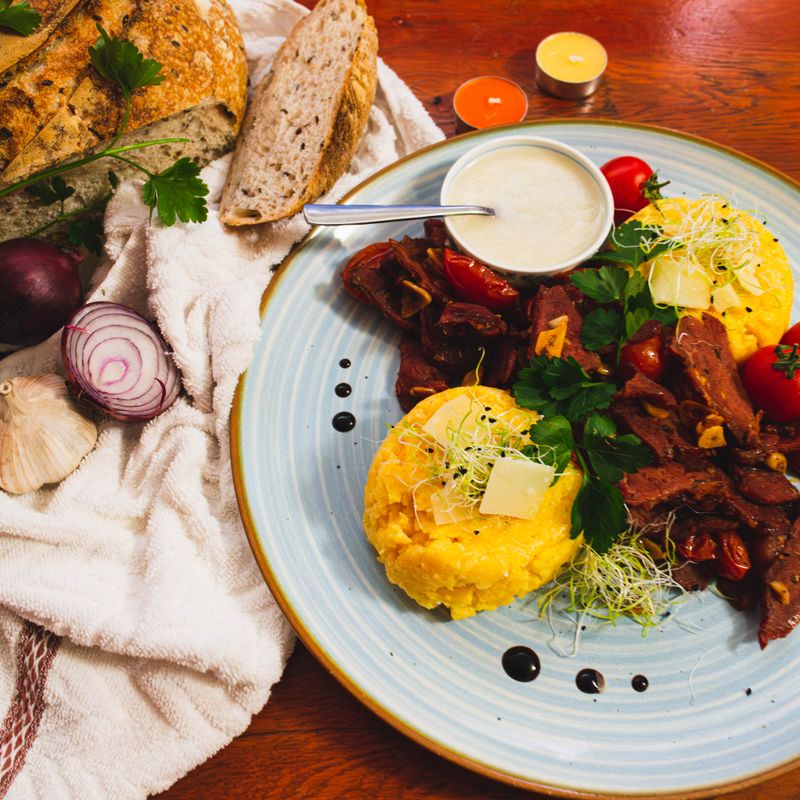
Venetian Red Beans with Polenta
A rustic Italian stew of tender red beans simmered with tomatoes, garlic, and herbs, served over creamy polenta. This warming stovetop dish brings together the hearty comfort of soft cornmeal with a richly flavored, well-reduced bean sauce inspired by Venetian home cooking.
Steps
Before you start
- If using dried beans, soak them overnight in water, then drain before use
- Have all vegetables prepped and ready before you begin cooking
- Read through both the bean and polenta cooking times so you can stagger them
- Ensure your pot is at least 6-quart capacity so the stew simmers gently without boiling over
Prepare vegetables
- On a cutting board, dice the onion and celery into uniform ½-inch pieces.
- Mince the garlic cloves.
- Set all three aside in separate small bowls.
+ Show details− Hide details
Tip: Uniform vegetable sizes help them cook evenly; don't skip dicing them beforehand or you'll be chopping over a hot pan.
Build the soffritto
- Heat the 3 tablespoons olive oil in a 6-quart heavy pot over medium heat for about 1 minute until it shimmers.
- Add the diced onion and celery to the hot oil and stir with a wooden spoon.
- Cook, stirring occasionally, for 5–7 minutes until the onion becomes translucent and the vegetables are softened but not browned.
- You should smell the sweet aroma of the softening vegetables.
+ Show details− Hide details
Ready when: Onion is translucent and vegetables are soft; they do not brown or color
Tip: Keep the heat at medium; too high and the vegetables will brown instead of soften gently.
Add garlic
- Add the minced garlic to the softened vegetables and stir constantly for about 1 minute.
- The garlic will become fragrant and turn golden.
- Be careful not to let it burn.
+ Show details− Hide details
Ready when: Garlic is fragrant and light golden in color
Tip: Keep stirring so the garlic doesn't stick or burn; burned garlic tastes bitter and will ruin the stew.
Combine beans and broth
- Add the drained and rinsed red beans to the pot.
- Pour in the crushed tomatoes with all their juice and the 3 cups vegetable broth.
- Toss in the 2 bay leaves and the sprig of fresh rosemary.
- Stir everything together with the wooden spoon until well combined, breaking up any clumps of tomato.
+ Show details− Hide details
Tip: Rinsing the canned beans removes excess sodium and starch, resulting in a cleaner-tasting stew.
Bring to a boil
- Increase the heat to high and bring the mixture to a boil, stirring occasionally.
- Once large bubbles break the surface at a steady pace, you've reached a boil.
- This should take 3–5 minutes.
+ Show details− Hide details
Ready when: Large bubbles break the surface steadily; the mixture is at a rolling boil
Tip: Don't leave the stove; as it approaches boiling, stir to prevent sticking on the bottom.
Simmer the beans
- Once boiling, immediately reduce the heat to medium-low.
- Simmer gently, uncovered, for 15–20 minutes.
- Stir once or twice during simmering to check that nothing is sticking to the bottom.
- The liquid will reduce by about one-quarter, the beans will be heated through, and the flavors will marry together.
- The stew should bubble gently at the edges, not violently.
+ Show details− Hide details
Ready when: Liquid has reduced slightly, beans are tender and heated through, aromas are deep and concentrated
Tip: A gentle simmer is key; vigorous boiling will break down the beans into mush and cloud the broth.
Start the polenta water
- While the beans simmer (start this after 5 minutes of simmering), pour 4 cups water into a medium saucepan and bring it to a boil over high heat.
- This should take 4–5 minutes.
- Once boiling, add a large pinch of kosher salt.
+ Show details− Hide details
Ready when: Water is at a rolling boil with continuous large bubbles
Tip: Start this step a few minutes after the bean stew begins simmering so the polenta finishes cooking around the same time.
Cook the polenta
- Reduce the heat under the polenta water to medium.
- Slowly pour in the 1 cup polenta cornmeal in a thin, steady stream while whisking continuously with a whisk to break up lumps.
- This whisking step should take 2–3 minutes.
- Once all the polenta is incorporated and the mixture is smooth, switch to a wooden spoon and stir frequently—every minute or so—for 20–22 minutes more.
- The polenta will thicken as it cooks and will begin to pop and bubble like lava; lower your hand when stirring to avoid splatters.
- The polenta is done when it is thick and creamy, pulls away from the sides of the pan as you stir, and a spoon stood upright in it stays put.
+ Show details− Hide details
Ready when: Polenta is very thick and creamy; a spoon inserted upright stays in place; polenta pulls from pan sides when stirred
Tip: Constant stirring prevents lumps and burning on the bottom. If the polenta becomes too thick, stir in a splash of warm water.
Finish the bean stew
- When the beans have finished simmering, use a slotted spoon or tongs to fish out and discard the bay leaves and rosemary sprig.
- Taste the stew and season generously with kosher salt and freshly ground black pepper.
- Stir after each addition and taste again until the flavors sing.
+ Show details− Hide details
Tip: Taste as you season—it's easier to add more salt than to remove it. Season boldly; the stew should be savory and well-seasoned.
Plate and serve
- Divide the hot polenta among four bowls, spooning it to form a bed at the bottom or creating a nest in the center.
- Ladle the warm bean stew generously over the polenta, making sure each serving gets plenty of beans and broth.
- Top each bowl with freshly grated Parmigiano-Reggiano cheese if using.
- Serve immediately while everything is steaming hot.
+ Show details− Hide details
Tip: If the polenta cools before serving, it will firm up; serve it as soon as it's ready. If you've made it ahead, rewarm it on the stove with a splash of water, stirring constantly.
Good to know
Tips
- If your polenta splatters while cooking, drape a damp kitchen towel loosely over the saucepan as a splatter guard—it will still allow steam to escape.
- The bean stew can also be served over pasta, crusty bread, or grains like farro or barley instead of polenta for variety.
- For a richer dish, stir 2 tablespoons of unsalted butter into the finished polenta just before serving, or drizzle a little more extra-virgin olive oil over the top and stir gently.
- If you prefer a brothier stew, increase the vegetable broth to 3½ or 4 cups; if you like it very thick and hearty, reduce it to 2½ cups and simmer a few minutes longer to concentrate the flavors.
Make ahead
The bean stew can be made up to 2 days ahead: prepare it through the simmering step, cool it completely, then refrigerate in a covered container. Reheat gently on the stovetop over medium heat for 5–10 minutes, stirring occasionally, until warmed through; add a splash of water if it has thickened. Polenta is best served fresh, as it firms up quickly when cool and becomes grainy when reheated, but leftover polenta can be sliced, pan-fried in olive oil, and topped with the reheated bean stew.
Storage & reheating
Room temperature: The finished dishes do not keep well at room temperature; eat within 30 minutes. Refrigerator: Store the bean stew in a covered container for up to 3 days. Reheat gently on the stovetop over medium heat, adding a splash of water if it has thickened too much. Polenta left over: Will firm up into a solid mass. Slice it and pan-fry in olive oil until crispy on the outside, or reheat by breaking into chunks and stirring into simmering broth. Freezer: The bean stew freezes well for up to 3 months in an airtight container; thaw overnight in the refrigerator and reheat gently. Do not freeze polenta; it becomes grainy.
Substitutions
- canned red beans → 1 pound dried red beans, soaked overnight and drained, or quick-soaked (boil 2 minutes, rest 1 hour, drain). Dried beans require 45–60 minutes of simmering instead of 15–20, so add them to the stew at the boil step and extend the simmer time. Check them at 45 minutes; they should be tender but not falling apart.
- canned crushed tomatoes → 1 pound fresh tomatoes, cored, roughly chopped, or 2 cups tomato sauce. Fresh tomatoes will give a brighter flavor; use them in late summer. Tomato sauce is milder; you may want to increase it to 2½ cups.
- vegetable broth → chicken broth or beef broth, or equal parts water and broth. Chicken broth adds a savory depth. Beef broth is rich; reduce to 2½ cups to avoid overpowering the beans. Water works but the stew will be less flavorful.
- fresh rosemary → 1 teaspoon dried oregano or 1 teaspoon dried basil. Use half the amount of dried herbs as fresh, since dried herbs are more concentrated. Add them with the broth.