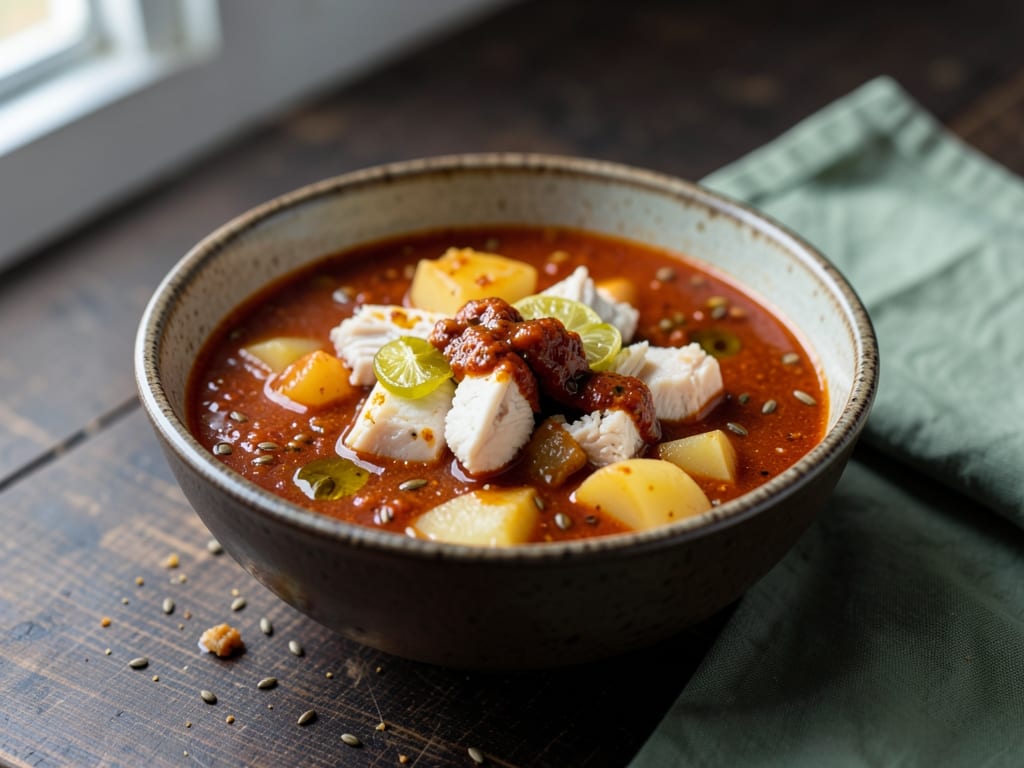
Tunisian Fish Chowder with Harissa and Preserved Lemon
A brick-red, gently spicy chowder built on toasted caraway, tomato paste and harissa, with tender potatoes and chunks of flaky white fish. Minced preserved lemon and a squeeze of fresh juice add a bright, salty finish.
- Prep
- 20 min
- Cook
- 40 min
- Wait
- 5 min
- Total
- 1 hr 5 min
- Makes
- About 2½ quarts (2.4 L), serving 6
Steps
Before you start
- Pat the fish dry and let it sit at room temperature while you prep. It will cook more evenly.
- Rinse the preserved lemon under cold water and scrape away the pulp. Only the rind is used, and it is very salty, so don't add extra salt until the end.
- Harissa brands vary a lot in heat and salt. Start with the amount given and add more at the table.
- Use a heavy 5- to 6-quart (4.7–5.7 L) pot so the potatoes simmer evenly and the fish has room.
Prep the ingredients
- Dice the onion, mince the garlic, peel and cube the potatoes into ¾-inch (2 cm) pieces, and cut the fish into 1½-inch (4 cm) chunks.
- Rinse the preserved lemon, discard the pulp and mince the rind finely.
- Chop the cilantro.
- Keep the fish in the refrigerator until step 8.
+ Show details− Hide details
Ready when: Potato cubes are roughly the same size so they cook at the same rate.
Tip: Keep the potato cubes in cold water if prepping ahead, then drain well before using.
Toast the caraway
- Set the dry pot over medium-low heat.
- Add the caraway seeds and toast, shaking the pot, for about 1 minute.
- Tip them into a spice grinder or mortar and grind to a coarse powder.
- Return the empty pot to the stove.
+ Show details− Hide details
Ready when: The seeds smell nutty and fragrant and darken slightly.
Tip: Caraway burns quickly and turns bitter. Remove it from the heat as soon as it smells toasty.
Soften the onion
- Add the 3 tablespoons olive oil to the pot over medium heat.
- Add the onion and a pinch of salt.
- Cook, stirring often, for 7–8 minutes.
+ Show details− Hide details
Ready when: The onion is soft, translucent and just starting to turn golden at the edges.
Bloom paste and spices
- Stir in the garlic, ground caraway, cumin and paprika and cook for 30 seconds.
- Add the tomato paste and harissa.
- Cook, stirring constantly, for 2 minutes, scraping the bottom so nothing scorches.
+ Show details− Hide details
Ready when: The paste darkens from bright red to brick red and the oil turns red around the edges.
Tip: If the pot looks dry or starts to stick, add a splash of stock.
Add liquids and potatoes
- Pour in the crushed tomatoes and stock, stirring to loosen any browned bits from the bottom.
- Add the potatoes.
- Raise the heat to high and bring to a boil, about 4–5 minutes, then reduce to a gentle simmer.
+ Show details− Hide details
Ready when: The broth reaches a steady boil before you turn it down.
Simmer until tender
- Cover the pot partially and simmer over medium-low heat for 14–16 minutes, stirring once or twice.
+ Show details− Hide details
Ready when: A potato cube is easily pierced with a knife tip but still holds its shape.
Tip: Keep the simmer gentle. A hard boil breaks the potatoes apart and clouds the broth.
Add preserved lemon
- Stir in the minced preserved lemon and a few grinds of black pepper.
- Taste the broth and add salt only if needed, since the harissa, stock and preserved lemon all add salt.
- Make sure the pot is at a bare simmer.
+ Show details− Hide details
Ready when: The broth tastes well seasoned and lightly salty, with a citrusy aroma.
Tip: The fish will absorb some salt as it cooks, so keep the seasoning slightly light.
Poach the fish
- Season the fish chunks lightly with salt.
- Nestle them into the broth in a single layer as much as possible, pressing them under the surface.
- Cover and cook on low for 5–6 minutes without stirring.
- Turn off the heat.
+ Show details− Hide details
Ready when: The fish is opaque and flakes easily, and reads 145°F (63°C) in the thickest piece.
Tip: Don't stir vigorously. Fold gently with a spoon only if needed so the fish stays in chunks.
Rest and finish
- Leave the pot covered off the heat for 5 minutes so the flavors settle.
- Gently stir in the lemon juice and half of the cilantro.
- Taste and adjust with salt, pepper or a little more lemon juice.
+ Show details− Hide details
Ready when: The broth tastes bright and balanced, with the fish still in tender chunks.
Serve
- Ladle into warm bowls, making sure each gets fish and potatoes.
- Top with the remaining cilantro, a drizzle of olive oil if using, and a small spoonful of extra harissa.
- Serve with crusty bread.
+ Show details− Hide details
Tip: Let guests stir in extra harissa themselves, because it gets hot quickly.
Good to know
Tips
- Don't skip blooming the tomato paste and harissa in the oil. It removes the raw tomato taste and deepens the color.
- Add the fish last and keep the heat low. Residual heat finishes it, which keeps it tender instead of rubbery.
- Taste before salting. Preserved lemon, harissa and stock all contribute salt.
- For a thicker broth, crush a few potato cubes against the side of the pot before adding the fish.
Make ahead
"Make the broth through step 7 up to 2 days ahead and refrigerate. Reheat to a gentle simmer, then add the fish and finish as written. Don't cook the fish ahead."
Storage & reheating
"Room temperature: no more than 2 hours. Refrigerator: cool completely and store in an airtight container for up to 2 days. Freezer: not recommended once the fish and potatoes are added, as the texture suffers (the broth base without fish or potatoes freezes well for 3 months). Reheat gently over low heat, stirring rarely, until steaming hot (165°F/74°C). Don't boil."
Substitutions
- preserved lemon → Zest of 1 lemon plus an extra ¼ teaspoon kosher salt. Less complex and fermented in flavor, but gives a similar citrus lift. Add with the lemon juice at the end.
- skinless firm white fish fillets (cod, haddock or pollock) → Halibut, monkfish, or sea bass. Choose firm, mild fish. Delicate fish like sole will fall apart.
- harissa paste → 1 tbsp tomato paste plus 1 tsp cayenne or Aleppo pepper and ½ tsp extra cumin. Gives similar heat, but with less depth. Adjust the heat to taste.
- fish stock or low-sodium vegetable stock → Water plus ½ teaspoon extra salt, or clam juice diluted with water. Dilute bottled clam juice about 1:1 with water, as it is quite salty.