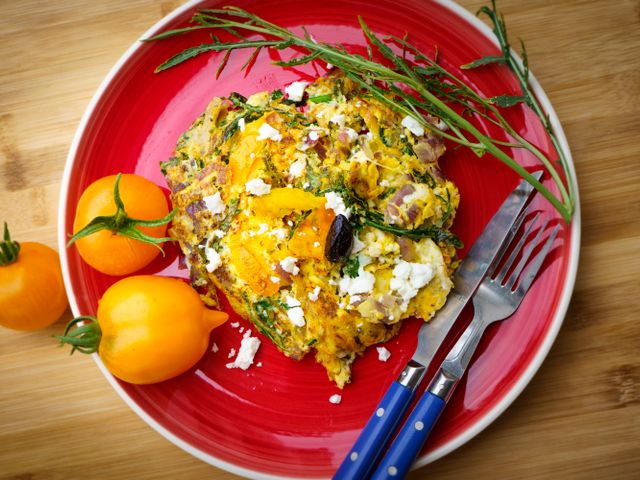
Tomato and Basil Frittata
A rustic Italian-style baked egg dish loaded with roasted tomatoes, fresh basil, and creamy mozzarella. The frittata is cooked on the stovetop until the edges set, then finished in the oven for a golden, tender center. Serve warm or at room temperature.
- Prep
- 15 min
- Cook
- 20 min
- Wait
- 5 min
- Total
- 40 min
- Makes
- 1 frittata (4 servings)
Steps
Before you start
- Preheat your oven to 375°F (190°C)
- Bring eggs to room temperature for even cooking
- Have basil and mozzarella ready to add just before finishing
Roast the tomatoesOven 375°F / 190°C
- Toss the halved cherry tomatoes with 1 tablespoon (15 ml) of the olive oil, a pinch of salt, and pepper.
- Spread on a small baking sheet in a single layer.
- Roast at 375°F (190°C) for 10–12 minutes, until the skins soften and the tomatoes release their juices.
- Set aside to cool slightly.
+ Show details− Hide details
Ready when: Tomato skins are wrinkled and beginning to blister; juices pool on the sheet
Tip: Roasting concentrates the tomato flavor and prevents a watery frittata.
Whisk the eggs
- In a large bowl, whisk together the 8 eggs, heavy cream, and a generous pinch each of salt and pepper until the mixture is pale and slightly frothy, about 2 minutes.
- The mixture should be uniform and fully combined.
+ Show details− Hide details
Ready when: Eggs are pale and slightly frothy
Tip: Don't overbeat; you want air incorporated but not a stiff foam.
Heat the skillet
- Heat the remaining 1 tablespoon (15 ml) olive oil in a 10-inch (25 cm) oven-safe nonstick skillet over medium-high heat.
- Once the oil is shimmering and just beginning to smoke lightly, it is ready.
+ Show details− Hide details
Ready when: Oil shimmers and just begins to smoke lightly
Tip: A hot skillet helps the eggs set quickly and develop a slight crust on the bottom.
Pour and begin cooking
- Carefully pour the whisked egg mixture into the hot skillet.
- Using a spatula, gently push the cooked egg from the edges toward the center for about 1–2 minutes, allowing uncooked egg to flow to the edges.
- Once the edges begin to set (about 1–2 minutes), stop stirring and let it cook undisturbed.
+ Show details− Hide details
Ready when: Edges are opaque and set, center is still loose and jiggly
Tip: If you stir too much, the eggs take longer to cook and the frittata won't have a nice bottom crust.
Add tomatoes and basil
- Scatter the roasted tomatoes evenly over the partially cooked eggs.
- Sprinkle the torn basil and mozzarella pieces across the surface.
- Season lightly with salt and pepper.
- The frittata should be set around the edges and slightly firm about halfway up the sides, but still liquid in the very center.
+ Show details− Hide details
Ready when: Edges are set, center is still loose
Tip: Add the toppings while there's still liquid egg, so they nestle in and stay evenly distributed.
Finish in the ovenOven 375°F / 190°C
- Transfer the skillet to a preheated 375°F (190°C) oven.
- Bake for 8–10 minutes, until the top is lightly golden and the center jiggles only slightly when you gently shake the skillet.
- The eggs should be just set, not rubbery.
+ Show details− Hide details
Ready when: Top is light golden, center has just a slight jiggle when the skillet is gently shaken
Tip: Don't overbake; the residual heat will continue to cook the center even after you remove it from the oven.
Rest and serve
- Remove the skillet from the oven and let the frittata rest for 3–5 minutes.
- This allows the eggs to set completely and makes it easier to cut and serve.
- Slide onto a cutting board, cut into 4 wedges, and serve warm or at room temperature.
+ Show details− Hide details
Ready when: Frittata is set and holds together when cut
Tip: Resting prevents the frittata from breaking apart when you cut it.
Good to know
Tips
- This frittata tastes just as good at room temperature as it does warm, making it perfect for brunch, lunch boxes, or a light dinner.
- For extra richness, add 2 tablespoons of freshly grated Parmigiano-Reggiano to the egg mixture before cooking.
- If you don't have an oven-safe skillet, transfer the partially cooked frittata to a buttered 9-inch (23 cm) pie dish or baking dish before adding the toppings and finishing in the oven.
- For a more substantial meal, add 4 oz (115 g) of diced prosciutto or pancetta scattered over the eggs in step 5, or sauté a small diced onion in the skillet before adding the eggs.
Make ahead
Prepare the tomatoes and basil 2–3 hours ahead and store separately in the refrigerator. The assembled frittata can be cooked up to 8 hours in advance. Do not freeze.
Storage & reheating
Room temperature: up to 4 hours. Refrigerator: up to 3 days in an airtight container. To reheat, cover loosely with foil and warm in a 300°F (150°C) oven for 10–12 minutes. Do not freeze.
Substitutions
- fresh mozzarella → Parmesan cheese (shredded). Use 3 oz (85 g) Parmigiano-Reggiano for a sharper, nuttier flavor. Shred or grate finely so it melts evenly.
- cherry tomatoes → Plum tomatoes (seeded and diced). Use 10 oz (280 g) fresh plum tomatoes, seeded and diced, roasted the same way. Seed them to remove excess moisture.
- fresh basil → Fresh oregano. Use 2 tablespoons (6 g) fresh oregano, roughly chopped. Add it in the same step for a Mediterranean twist.
- heavy cream → Whole milk. Use ¼ cup (60 ml) whole milk. The frittata will be slightly less creamy but still tender and moist.