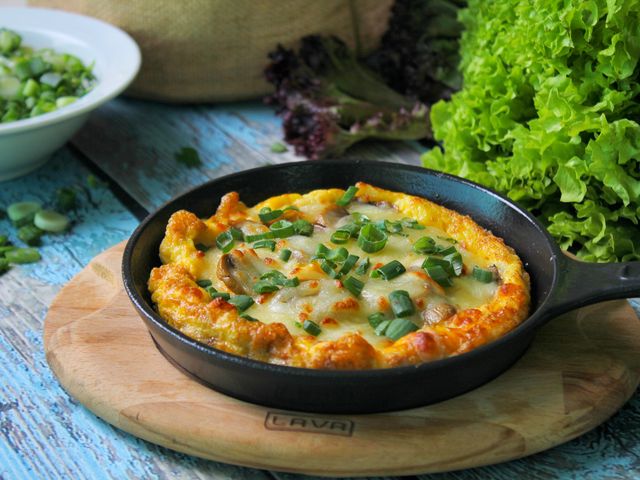
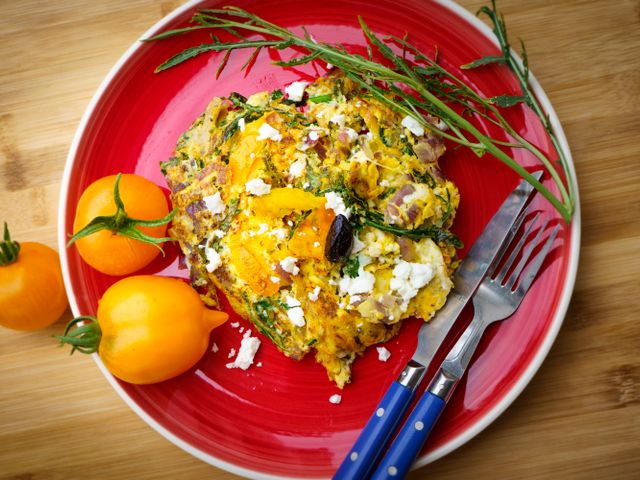
Asparagus and Lemon Frittata
A bright, Italian-style baked frittata loaded with tender asparagus spears and finished with fresh lemon zest and creamy Parmesan. This versatile dish works for breakfast, lunch, or a light dinner—serve it warm, at room temperature, or chilled. It's quick to prepare and feeds 4 people generously.
- Prep
- 15 min
- Cook
- 18 min
- Wait
- 5 min
- Total
- 38 min
- Makes
- 1 frittata (4 servings)
Steps
Before you start
- Preheat your oven to 400°F (200°C)
- Trim asparagus ends and wash well
- Have a 10-inch (25 cm) nonstick or cast-iron skillet ready
Sauté asparagus
- Heat 1 tablespoon of butter in the 10-inch skillet over medium-high heat.
- When the butter foams, add the asparagus pieces with a pinch of salt.
- Sauté, stirring occasionally with tongs, for 4–5 minutes until the spears are bright green and just beginning to soften at the tips but still have a slight bite.
- Transfer to a plate and set aside.
+ Show details− Hide details
Ready when: Asparagus is bright green and tender-crisp
Tip: Don't over-cook the asparagus here; it will finish cooking in the oven and you want it to retain some texture.
Whisk eggs and milk
- In a large mixing bowl, crack the 8 eggs and whisk them together with the milk, lemon zest, and about half the grated Parmesan cheese (roughly 3/8 cup or 38 g).
- Season with a pinch of salt and a few grinds of black pepper.
- Whisk until smooth and well combined, about 1 minute.
- The mixture should be pale and frothy.
+ Show details− Hide details
Ready when: Egg mixture is smooth and uniform in color
Tip: Room-temperature eggs whisk more smoothly and incorporate more air, giving the frittata a lighter texture.
Prepare skillet
- Wipe out the skillet and add the remaining 1 tablespoon of butter over medium heat.
- Let it melt and coat the bottom and sides of the pan evenly, tilting to reach the edges.
- Once foaming, it's ready.
+ Show details− Hide details
Ready when: Butter is foaming and coating the pan
Tip: A well-buttered pan prevents sticking and adds rich flavor to the bottom of the frittata.
Pour egg mixture and add asparagus
- Pour the egg mixture into the prepared skillet.
- Scatter the sautéed asparagus pieces evenly over the top.
- Gently stir 2–3 times with a spatula to distribute the asparagus throughout, but don't over-mix.
- The eggs should start to set around the edges almost immediately.
+ Show details− Hide details
Ready when: Edges begin to set and pull slightly from the sides of the pan
Tip: Keep the stovetop heat at medium to allow the bottom to set gently without browning too quickly.
Cook on stovetop
- Cook on the stovetop for 2 minutes without stirring.
- You want the bottom and edges to set slightly while the center remains mostly liquid.
- The frittata should look shiny and loose in the middle.
+ Show details− Hide details
Ready when: Bottom is lightly set, center jiggles when pan is tilted
Tip: Don't walk away—keep an eye on the edges to ensure they set evenly and the bottom doesn't brown.
Transfer to ovenOven 400°F / 205°C
- Carefully place the skillet in the preheated 400°F (200°C) oven.
- Bake for 12–15 minutes, until the center is just set but still slightly moist (it should jiggle only at the very center when you gently shake the pan), and the top is lightly golden.
- The residual heat will continue to cook the center slightly after you remove it.
+ Show details− Hide details
Ready when: Center is just set with minimal jiggle, top is light golden, no browning around edges
Tip: Overbaking dries out the frittata. It should look barely set in the center—carryover cooking will finish it perfectly.
Finish with cheese and herbs
- Remove the frittata from the oven.
- Immediately sprinkle the remaining grated Parmesan cheese (about 3/8 cup or 37 g) over the top, and scatter the fresh thyme leaves (if using) over it as well.
- Drizzle lightly with the reserved lemon juice, or add a squeeze or two to taste.
+ Show details− Hide details
Ready when: Cheese is scattered and herbs are visible on top
Tip: Add the cheese and herbs while the frittata is still hot so they warm slightly and meld with the surface.
Rest and serve
- Let the frittata rest in the skillet for 5 minutes.
- This allows the center to firm up slightly and makes it easier to slice.
- Loosen the edges with a spatula if needed, then slide the whole frittata onto a cutting board or serving plate.
- Cut into wedges and serve warm, at room temperature, or chilled, as preferred.
+ Show details− Hide details
Ready when: Frittata is cool enough to handle and slice cleanly
Tip: If your skillet has a metal handle, use an oven mitt; cast iron and stainless stay very hot.
Good to know
Tips
- Use a nonstick or well-seasoned cast-iron skillet for the best results and easiest cleanup.
- For a creamier frittata, replace half the milk with crème fraîche or sour cream.
- If you prefer a charred top or more browning, place the finished frittata under the broiler for 1–2 minutes after baking (watch closely).
- Leftovers are excellent cold in a lunch box the next day or reheated gently for breakfast.
Make ahead
You can prepare the asparagus and lemon zest up to 8 hours ahead and refrigerate. Whisk the egg mixture just before cooking. The finished frittata keeps, covered, in the refrigerator for up to 3 days and reheats gently in a 300°F oven for 8–10 minutes, or cold from the fridge.
Storage & reheating
Room temperature: up to 2 hours. Refrigerator: covered, up to 3 days. Freezer: wrapped tightly, up to 1 month (thaw overnight in fridge, then warm gently in a 300°F oven). Reheat by covering with foil and warming in a 325°F oven for 8–12 minutes until heated through.
Substitutions
- fresh asparagus spears → Broccoli florets or green beans (both trimmed and cut into 2-inch pieces). Use the same weight; sauté for 4–5 minutes until just tender-crisp.
- Parmigiano-Reggiano cheese → Pecorino Romano or aged Cheddar. Both are slightly sharper; use the same weight (about 75 g total).
- whole milk → Heavy cream or plain yogurt. Cream makes the frittata richer; yogurt adds tang. Use the same volume (¼ cup or 60 ml).
- fresh thyme sprigs → Fresh tarragon, dill, or basil (or 1 teaspoon dried thyme). Add dried herbs to the egg mixture; add fresh herbs as garnish after baking.