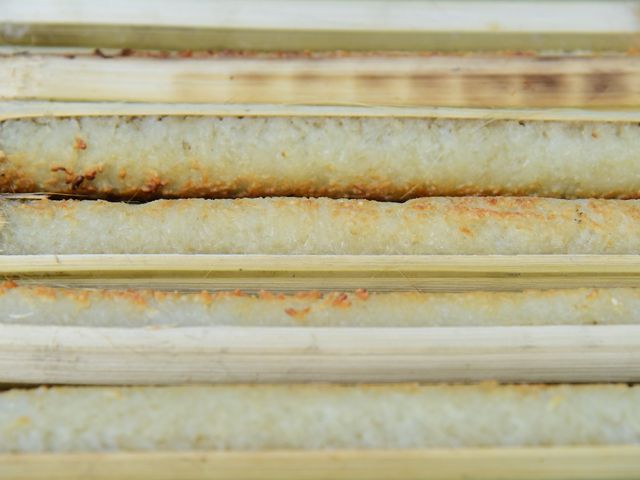
Thai Jasmine Rice with Pandan
Fragrant jasmine rice cooked with pandan leaves and a touch of coconut milk, creating an aromatic Thai-inspired side dish. The pandan imparts a subtle floral, vanilla-like flavor while the coconut milk adds a gentle richness. Serve alongside curries, stir-fries, or grilled proteins.
- Prep
- 5 min
- Cook
- 18 min
- Wait
- 10 min
- Total
- 33 min
- Makes
- About 3 cups (6 servings as a side)
Steps
Before you start
- Rinse jasmine rice under cold water until the water runs nearly clear to remove excess starch
- Tie pandan leaves in a loose knot so they're easy to remove after cooking
- Measure all liquids accurately—the ratio of liquid to rice is critical for proper texture
Combine liquid and seasonings
- In a medium saucepan (2-quart / 2-liter), combine the water, coconut milk, and salt.
- Stir until the salt dissolves and the mixture is evenly combined.
- Bring to a boil over medium-high heat.
+ Show details− Hide details
Ready when: Liquid is at a rolling boil with steam rising vigorously
Tip: Don't skip the salt—it seasons the rice as it cooks and brings out the pandan flavor.
Add rice and pandan
- Stir in the rinsed and drained jasmine rice, breaking up any clumps with a fork.
- Place the knotted pandan leaves on top of the rice.
- Stir once to distribute the pandan evenly throughout.
+ Show details− Hide details
Tip: Tying the pandan leaves in a knot makes them much easier to remove after cooking without leaving fragments in the rice.
Reduce heat and cover
- Once the liquid returns to a gentle simmer, reduce the heat to low.
- Place the lid on the saucepan and cook undisturbed for 15 minutes.
- Do not lift the lid during cooking—steam escaping will affect the texture.
+ Show details− Hide details
Ready when: Steam rises from under the lid and you hear a faint gentle sound
Tip: Resist the urge to lift the lid—the steam trapped inside is essential for even cooking. If your burner runs hot, place the saucepan on a diffuser to maintain steady, low heat.
Rest and remove pandan
- Remove from heat and let the rice rest, covered, for 10 minutes.
- This allows any remaining moisture to be fully absorbed.
- Carefully remove the lid, locate the pandan leaf knot, and gently pull it out.
- Set aside.
+ Show details− Hide details
Ready when: No visible liquid remains in the pan and the rice is translucent and tender
Tip: The pandan leaves will have released their subtle fragrance into the rice—don't skip this step even though it's tempting to serve right away.
Fluff and serve
- Using a fork or rice paddle, gently fluff the rice by separating the grains with light, upward strokes.
- Transfer to a serving bowl and serve immediately while warm.
+ Show details− Hide details
Ready when: Grains are separated, fluffy, and gleaming with a subtle fragrance
Tip: Fluffing with a fork—rather than stirring with a spoon—keeps the grains intact and prevents mushiness.
Good to know
Tips
- The pandan leaf adds a delicate, almost vanilla-like floral note—if you find the flavor too subtle or too strong, adjust the amount in future batches (try 1.5 leaves for less intensity or 3 leaves for more)
- For a more coconut-forward version, replace half the water with additional coconut milk (keeping the total liquid at 2.25 cups / 540 ml)
- Jasmine rice is naturally fragrant; paired with pandan and coconut milk, it creates a dish that's aromatic but not heavy—perfect alongside spiced curries
- If pandan leaves are unavailable and you don't have extract, this recipe still works beautifully with just jasmine rice, water, and coconut milk—you'll simply have a rich, fragrant coconut jasmine rice instead
Storage & reheating
Store in an airtight container in the refrigerator for up to 3 days. Reheat gently in a microwave (1–2 minutes, stirring halfway) or in a saucepan over low heat with a splash of water, stirring occasionally, until warmed through (3–4 minutes). Do not freeze, as the texture of the rice will suffer.
Substitutions
- fresh pandan leaves → 1 teaspoon pandan extract or liquid pandan flavoring. Fresh pandan is preferred for the best flavor and aroma, but extract provides convenience. Stir it in with the water and coconut milk rather than adding a physical leaf. The result will be slightly less aromatic but still pleasant.
- unsweetened coconut milk → 0.5 cup (120 ml) of whole milk or heavy cream. This will make the rice richer but less authentically Thai. You can also use a light coconut milk to reduce richness.
- jasmine rice → Thai white rice or long-grain white rice. Jasmine rice is ideal for its fragrance and tender texture, but long-grain white rice will produce a similar result—just slightly less aromatic.
- kosher salt → Sea salt or table salt, using the same amount. Use whichever salt you have on hand; the amount remains consistent.