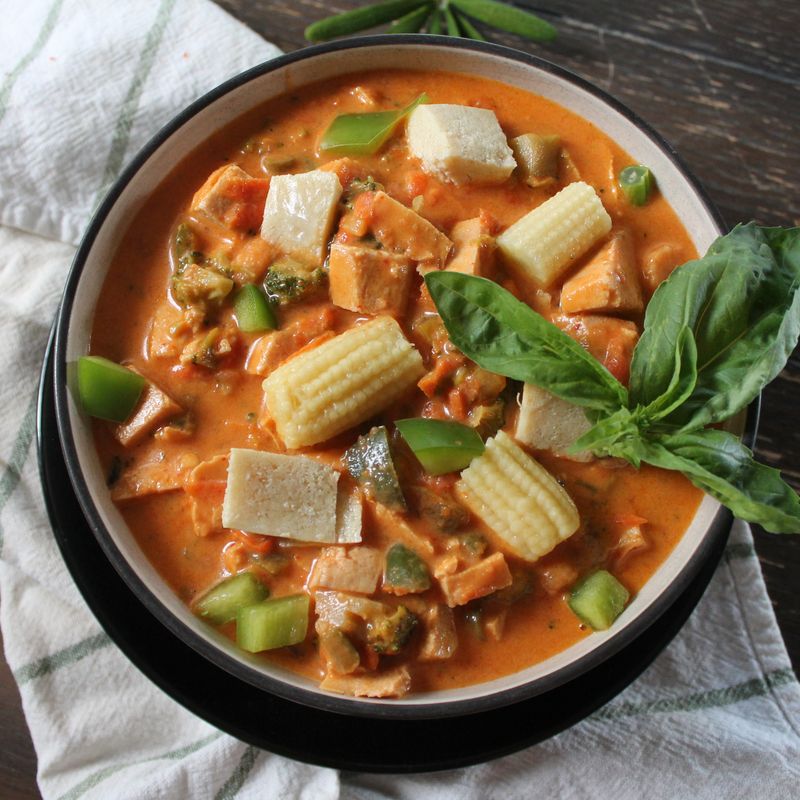
Thai Coconut Curry Vegetable Chowder
A warming, aromatic Thai-inspired chowder that combines creamy coconut milk with vibrant red curry paste and hearty vegetables. The bright lime juice and fresh herbs balance the richness of the coconut, creating a deeply flavorful vegetarian soup that's ready in under an hour.
- Prep
- 15 min
- Cook
- 25 min
- Total
- 40 min
- Makes
- 4 servings (about 6 cups soup)
Steps
Before you start
- Have all vegetables washed, peeled, and chopped before you start cooking—mise en place makes this quick and smooth
- Open the cans of coconut milk and vegetable broth and set aside
- Squeeze fresh lime juice into a small bowl ahead of time
- Read the full ingredient list and instructions so you understand the cooking order
Build the curry base
- Heat coconut oil in a large pot over medium heat for about 1 minute until shimmering.
- Add the diced onion and cook, stirring occasionally, for 3–4 minutes until translucent and softened.
- Add the minced garlic and ginger, stirring constantly for 30 seconds until fragrant.
- Pour in the red curry paste and stir thoroughly to combine with the aromatics.
- Cook, stirring often, for 1–2 minutes.
- The mixture will darken slightly and become very aromatic—you should smell the spices releasing their essential oils.
+ Show details− Hide details
Ready when: Curry paste darkens slightly and smells deeply aromatic; onion is translucent
Tip: Stirring the curry paste helps bloom its spices and prevents burning. Do not leave it unattended.
Add broth and bring to simmer
- Pour the vegetable broth into the pot slowly, stirring constantly and scraping the bottom with your spoon to release any caramelized curry paste stuck to the pan.
- Increase heat to medium-high and bring the mixture to a steady simmer, stirring occasionally.
- Once small bubbles are breaking the surface consistently, reduce the heat to medium to maintain a gentle simmer.
+ Show details− Hide details
Ready when: Mixture bubbles gently and consistently across the surface
Tip: Scraping the pan ensures all the flavorful curry paste dissolves into the broth instead of sticking to the bottom.
Add potatoes and carrots
- Stir the cubed potatoes and carrot rounds into the simmering broth.
- They should be submerged in the liquid.
- Stir gently and return the mixture to a steady, gentle simmer over medium heat.
+ Show details− Hide details
Ready when: Ingredients are stirred in and heat has returned to a gentle simmer
Tip: These longer-cooking vegetables go in first. The potatoes need the most time to become tender.
Simmer potatoes until starting to soften
- Let the pot simmer gently, undisturbed, for about 8 minutes.
- Do not cover the pot.
- Check by piercing a potato cube with a fork—it should still have a little resistance but be beginning to soften.
- The carrots should also be starting to become tender.
+ Show details− Hide details
Ready when: Potato cubes pierce easily but have slight resistance in the center; carrots are beginning to soften
Tip: Don't stir during this time—stirring can break up the vegetables. A gentle simmer (not a rolling boil) cooks them evenly.
Add remaining vegetables and coconut milk
- Stir in the bell pepper, zucchini, snap peas, and the entire can of coconut milk.
- Stir well for 1–2 minutes to distribute the coconut milk evenly throughout the broth.
- Return the soup to a gentle simmer over medium heat.
+ Show details− Hide details
Ready when: All vegetables and coconut milk are stirred in and mixture returns to a gentle simmer
Tip: If your coconut milk is separated (which is normal), stir it well before adding so the cream and liquid combine smoothly into the broth.
Simmer until all vegetables are tender
- Maintain a gentle simmer without a lid for 7–8 minutes more.
- The potatoes should become completely soft (breaking apart easily when pressed with a spoon), the bell pepper and zucchini should be tender but not mushy, and the snap peas should have lost their crunch.
- The broth will smell rich and deeply fragrant with curry and coconut.
+ Show details− Hide details
Ready when: Potatoes are completely soft and break apart when pressed; bell pepper and zucchini are tender; total cooking time from boiling is about 25 minutes
Tip: If potatoes are still firm after 7 minutes, add 2–3 minutes more. Different potato varieties vary in cooking speed.
Season with lime and fish sauce
- Remove the pot from the heat.
- Stir in the fresh lime juice and fish sauce (if using).
- The lime juice adds bright acidity that balances the richness of the coconut.
- The fish sauce deepens the savory notes and adds umami depth.
- Stir well and then taste the soup.
- Add salt and black pepper to your preference—start with ½ teaspoon salt and adjust from there.
- The soup should taste balanced: creamy but bright, spicy but rounded.
+ Show details− Hide details
Ready when: All seasonings are stirred in and soup tastes balanced
Tip: Fish sauce smells pungent on its own but dissolves into the soup to add savory depth. Start with the full tablespoon—you won't taste 'fish' but rather a richer, more complex curry flavor. Taste before adding extra salt, as the fish sauce contributes saltiness.
Serve with fresh herbs
- Ladle the chowder into bowls.
- Top each serving with a generous handful of fresh Thai basil (roughly 1 tablespoon per bowl), chopped just before serving so the leaves stay fragrant.
- Serve with lime wedges on the side so diners can squeeze in extra juice to their preference.
+ Show details− Hide details
Ready when: Soup is ladled into bowls and garnished
Tip: Chop the basil just before serving—it bruises easily and loses flavor if cut too far in advance. If you can't find Thai basil, cilantro is a good substitute, though with a slightly different (lighter, more herbaceous) flavor.
Good to know
Tips
- Don't skip the fish sauce. Even though it's optional, 1 tablespoon adds deep umami and rounds out the curry flavors without making the soup taste fishy. Start with the full amount; most home cooks are surprised by how it enhances the dish.
- Use full-fat canned coconut milk for maximum richness and authentic flavor. Light coconut milk works but will taste thinner. For the creamiest result, use the thick cream that rises to the top of the can, plus the liquid underneath.
- Fresh Thai basil is a game-changer for this dish. If you can find it at a Thai grocery store, Vietnamese market, or specialty produce section, it's worth the effort. Its anise-like flavor is brighter and more sophisticated than cilantro. If unavailable, cilantro is your best backup.
- This recipe doubles easily. Use a larger pot (at least 8-quart / 7.5-liter), double all ingredients, and extend cooking times by only 2–3 minutes (the pot is larger, so it still comes to temperature at about the same rate). Ideal for feeding 8 people or making extra to freeze.
Make ahead
This chowder tastes even better the next day as flavors develop and mellow. Make it up to 2 days ahead, cool completely, and store in the refrigerator. Reheat gently on the stovetop over medium heat, stirring occasionally, for 5–7 minutes until steaming. Add fresh basil and lime wedges right before serving. Do not reheat in a microwave, as the coconut milk can separate unevenly.
Storage & reheating
Room temperature: Up to 2 hours (not recommended due to coconut milk and food safety). Refrigerator: Up to 3 days in an airtight container. Freezer: Up to 2 months in a freezer-safe container; thaw overnight in the refrigerator before reheating. Reheat: Stovetop over medium heat, stirring occasionally, 5–7 minutes until steaming. The coconut milk may separate slightly after freezing—stir well when reheating to recombine.
Substitutions
- Red curry paste → Green curry paste. Use the same amount (2 tbsp). Green curry paste is lighter, brighter, and more herbaceous than red; the finished soup will have less depth but more floral notes. If you use Panang curry paste, reduce to 1.5 tbsp as it's more concentrated.
- Unsweetened canned coconut milk → Half coconut milk + half heavy cream, or half coconut milk + half chicken broth. This reduces the richness and coconut flavor. Use 200 ml coconut milk + 200 ml heavy cream (or broth). The soup will be lighter and less Thai in character, but still delicious.
- Russet or Yukon gold potatoes → Cauliflower florets. Cauliflower is lighter and cooks faster (reduce simmering time in Step 4 from 8 minutes to 5 minutes). The soup will be lower-carb and more delicate. You can also use a mix of potatoes and cauliflower.
- Fish sauce → Soy sauce or tamari. Use the same amount (1 tbsp). Soy sauce is less traditional but adds umami depth. The flavor will be slightly different (more savory, less funky), but the soup will still be delicious. For a vegan version, use tamari.
- Fresh Thai basil → Cilantro or fresh mint. Use the same amount (¼ cup). Cilantro is more widely available and adds bright, citrusy notes; mint is sweeter and more refreshing. Neither is quite as anise-like as Thai basil, but both work beautifully as garnishes.