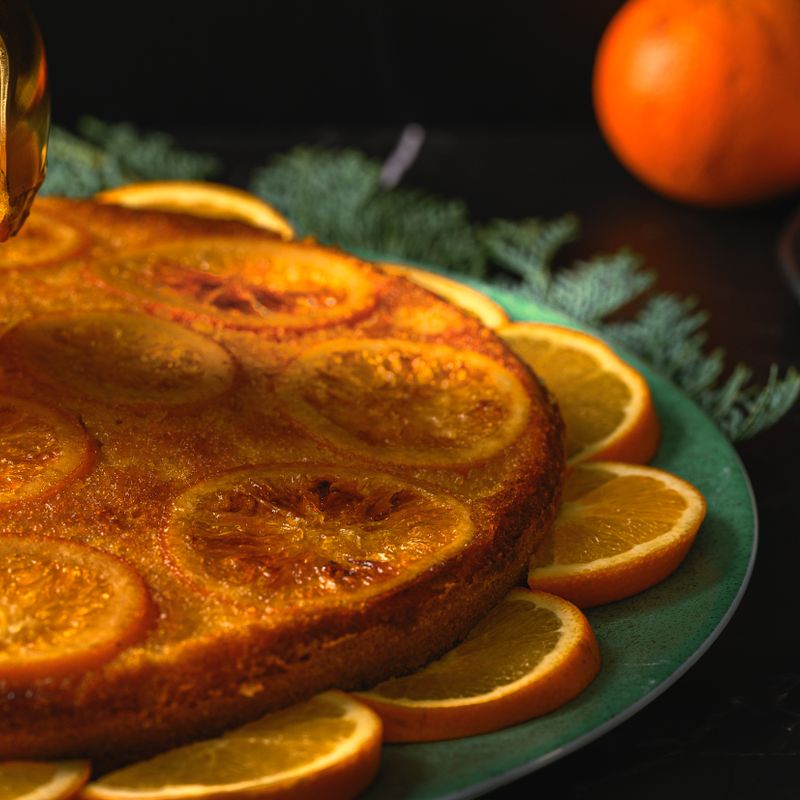
Tequila Sunrise Orange Breakfast Cake with Pomegranate Glaze
A vibrant, tender breakfast cake infused with fresh orange juice and zest, grounded with polenta for subtle corn flavor and a slight crumbly texture. A hint of tequila deepens the citrus notes without overwhelming them. The cake is crowned with a glossy pomegranate glaze that adds brightness and tartness, making this elegant enough for brunch yet simple enough for a weekday breakfast treat.
- Prep
- 20 min
- Cook
- 35 min
- Wait
- 30 min
- Total
- 1 hr 25 min
- Makes
- 1 cake (10 slices)
Steps
Before you start
- Preheat oven to 350°F (175°C)
- Bring all eggs and butter to room temperature
- Zest oranges before juicing them
- Line the bottom of your cake pan with parchment for easy removal
Mix dry ingredients
- In a medium bowl, whisk together flour, cornmeal, baking powder, baking soda, and salt.
- Set aside.
- This ensures the leavening agents are evenly distributed throughout the batter.
+ Show details− Hide details
Ready when: mixture is uniform with no streaks
Tip: Sift the confectioners' sugar for the glaze now too if you haven't already, to save time later.
Cream butter and sugar
- In a large bowl, beat the softened butter and granulated sugar together with an electric mixer on medium speed for 3–4 minutes, scraping down the bowl halfway through.
- The mixture should be pale, fluffy, and noticeably lighter in volume.
- This incorporates air that helps the cake rise.
+ Show details− Hide details
Ready when: mixture is pale, fluffy, and increased in volume by about 50%
Tip: If butter is too cold, it won't cream properly; room temperature is essential for a tender crumb.
Add eggs and extract
- Add eggs one at a time, beating on medium speed for about 30 seconds after each addition until fully incorporated.
- Scrape down the bowl between eggs.
- Add vanilla extract and beat to combine.
- The batter should look smooth and emulsified.
+ Show details− Hide details
Ready when: batter is smooth and emulsified with no visible egg streaks
Tip: Adding eggs slowly ensures an emulsified batter; rushing this step can lead to a separated mixture.
Add orange juice and zest
- In a small bowl, stir together the fresh orange juice, orange zest, and tequila.
- Pour half of this mixture into the creamed butter mixture and fold in gently with a rubber spatula or wooden spoon until almost combined—about 6–8 strokes.
- It's okay if small streaks of flour remain.
+ Show details− Hide details
Ready when: mixture is partially combined with visible flour streaks
Tip: Don't overmix once you add dry ingredients; overmixing develops gluten and can make the cake tough.
Alternate wet and dry
- Add the dry ingredient mixture (flour blend) and fold gently until almost combined.
- Then add the remaining orange-tequila mixture and fold until just combined.
- A few small flour lumps are fine; stop folding once you don't see large streaks of dry flour.
+ Show details− Hide details
Ready when: batter is uniform with no large flour streaks visible
Tip: This alternating method prevents overmixing while ensuring all ingredients are incorporated evenly.
Prepare pan and pour batter
- Butter and flour a 9-inch (23 cm) round cake pan or 8×8-inch (20×20 cm) square pan (or use parchment lining).
- Pour the batter into the prepared pan and smooth the top with a spatula.
+ Show details− Hide details
Ready when: batter is evenly distributed in pan
Tip: Parchment lining makes removal easier and helps prevent sticking.
Bake the cakeOven 350°F / 175°C
- Place the cake in a preheated 350°F (175°C) oven.
- Bake for 32–38 minutes, until a wooden toothpick inserted into the center comes out with just a few moist crumbs, or an instant-read thermometer reads 205°F (96°C) at the center.
- The cake should be golden brown on top and slightly pulling away from the edges of the pan.
+ Show details− Hide details
Ready when: toothpick comes out with a few moist crumbs; center registers 205°F (96°C) on instant-read thermometer; top is golden brown
Tip: Every oven is different; start checking at 32 minutes, as overbaking will dry out the cornmeal-based cake.
Cool in pan
- Remove the cake from the oven and let it cool in the pan on a wire rack for 15 minutes.
- Then turn the cake out onto the rack to cool completely, about 15–20 minutes more, before glazing.
- This allows the structure to set while keeping the cake tender.
+ Show details− Hide details
Ready when: cake is cool to the touch and no longer steaming
Tip: Cooling completely prevents the glaze from running off and getting absorbed into a warm cake.
Make pomegranate glaze
- While the cake cools, whisk together the sifted confectioners' sugar, pomegranate juice, and lemon juice in a medium bowl.
- Start with 1 cup (120 g) of confectioners' sugar and 1/3 cup (80 ml) of pomegranate juice, then add the remaining sugar gradually, whisking until you reach a glaze consistency—thick enough to coat the back of a spoon but thin enough to drip slightly.
- The glaze should be deep pink or crimson.
+ Show details− Hide details
Ready when: glaze is smooth, glossy, and coats a spoon but drips slowly
Tip: If the glaze is too thick, add pomegranate juice by the teaspoon; if too thin, add confectioners' sugar by the tablespoon.
Glaze the cake
- Once the cake is completely cool, pour the pomegranate glaze over the top and spread gently with an offset spatula or the back of a spoon, letting it pool slightly and drip down the sides for a beautiful effect.
- If desired, sprinkle fresh pomegranate arils on top while the glaze is still wet.
+ Show details− Hide details
Ready when: glaze is smooth and covers the top; arils are in place if using
Tip: Work quickly while the glaze is wet if you're adding pomegranate arils, as they'll stick better.
Set glaze and serve
- Let the glazed cake sit at room temperature for 15–20 minutes to allow the glaze to set slightly before slicing.
- Serve at room temperature or lightly chilled.
+ Show details− Hide details
Ready when: glaze is no longer glossy-wet but has set to a matte finish
Tip: Using a hot, damp knife between slices produces the cleanest cuts through the glaze.
Good to know
Tips
- The tequila should not be detectable as alcohol in the final cake—it simply enhances the citrus and adds subtle warmth. If you're concerned, the tequila largely cooks off, but taste a small baked crumb before serving if anyone is alcohol-sensitive.
- Pomegranate juice can be messy to extract; if using fresh pomegranate, cut it in half, hold it over a small bowl with the cut side down, and tap the back with a wooden spoon to release the arils, then press them through a fine sieve.
- Overmixing the batter is the number-one reason for a tough cake with this recipe; fold gently and stop as soon as you don't see streaks of flour.
- This cake is at its best served the same day or the next day—the cornmeal keeps the crumb moist, but the texture is most tender when fresh.
Make ahead
Bake the cake up to 2 days ahead and store covered at room temperature without the glaze. Make the glaze while the cake is cooling, or up to 4 hours ahead and cover; if it thickens, whisk in a little pomegranate juice to loosen it. Glaze the cake no more than 2 hours before serving for the prettiest presentation.
Storage & reheating
Room temperature, covered loosely, for up to 2 days. Refrigerate (covered) for up to 4 days. The cake does not freeze well due to the moist crumb, but the unglazed baked cake can be frozen, wrapped tightly, for up to 1 month. Thaw at room temperature, then glaze fresh. Reheat slices gently in a 300°F (150°C) oven for 5–8 minutes if desired.
Substitutions
- silver tequila → orange liqueur (such as Cointreau or Grand Marnier), or omit for a non-alcoholic version and increase orange juice by 2 tablespoons (30 ml). Silver tequila adds a subtle agave warmth; orange liqueur would amplify citrus notes. If omitting entirely, the flavor will be more straightforwardly citrus-forward.
- cornmeal (polenta) → all-purpose flour (increase to 2.25 cups / 281 g total). The cake will be slightly denser and less rustic-textured but still moist. This substitution is useful if you don't have cornmeal on hand.
- pomegranate juice → cranberry juice cocktail or tart cherry juice (unsweetened) in the glaze. This shifts the glaze color to deep red or burgundy and adds tartness; adjust the ratio of sugar to juice to taste.
- fresh orange juice → store-bought fresh-squeezed orange juice (ensure no added sugars). Store-bought juice works fine, though fresh-squeezed gives the most vibrant flavor.
More breakfast bakes
See all →


Find more like this
- Meal
- Breakfast
- Diet
- Vegetarian
- Method
- Oven
- Quick & Easy
- Easy
- Occasion
- Parties