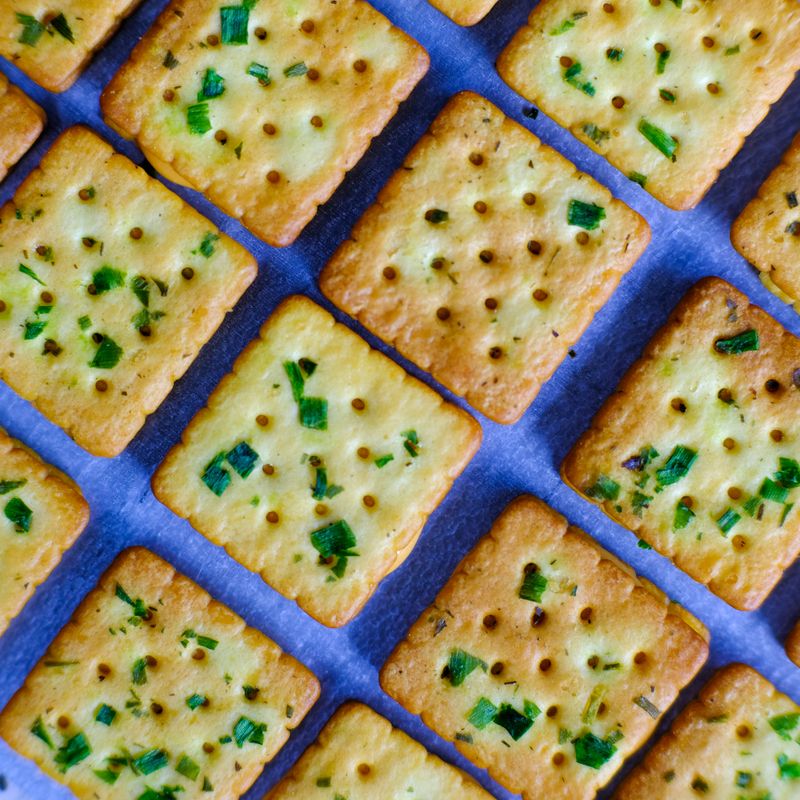
Sourdough Vietnamese Annatto and Roasted Shallot Crackers
Crispy, golden-red sourdough crackers infused with annatto's warm, earthy flavor and studded with deeply caramelized roasted shallots and cracked black pepper. These Vietnamese-inspired crackers have a subtle bitterness and natural tang from sourdough, making them perfect as a savory snack or accompaniment to cheese and charcuterie.
- Prep
- 25 min
- Cook
- 35 min
- Wait
- 15 min
- Total
- 1 hr 15 min
- Makes
- 24 crackers (about 6 oz / 170 g total)
Steps
Before you start
- Preheat oven to 400°F (200°C) for roasting shallots at least 15 minutes ahead
- Have active sourdough starter at room temperature (fed 4–8 hours prior)
- Line two baking sheets with parchment paper for the crackers
- Measure and prepare all ingredients before starting; the dough comes together quickly
Roast the shallotsOven 400°F / 205°C
- Preheat oven to 400°F (200°C).
- Toss the sliced shallots with 1.5 tablespoons (22 ml) neutral oil and a pinch of salt on a small baking sheet.
- Spread in an even layer.
- Roast for 12–15 minutes, stirring halfway through, until deeply golden and caramelized at the edges.
- The shallots should be tender and concentrate their sweetness.
- Remove and set aside to cool.
- (Reduce oven to 375°F / 190°C for baking the crackers.)
+ Show details− Hide details
Ready when: Shallots are deeply golden and tender, edges are caramelized
Tip: Don't skip roasting—it transforms the shallots' flavor from sharp to mellow and sweet, essential for balance against the annatto.
Toast annatto seeds
- In a small dry skillet over medium heat, toast the annatto seeds for about 30 seconds, stirring frequently, until fragrant and slightly deeper in color.
- Transfer to a small bowl and crush lightly with the back of a spoon to release color and flavor.
- Set aside.
+ Show details− Hide details
Ready when: Seeds are fragrant and slightly deepened in color
Tip: Toast just until fragrant—over-toasting makes annatto bitter. Crushing releases its color into the dough.
Mix dough base
- In a large bowl, whisk together the bread flour (1.25 cups / 160 g), whole wheat flour (0.5 cup / 60 g), and fine sea salt (0.75 teaspoon / 4.5 g).
- Make a well in the center and add the sourdough starter (0.75 cup / 180 ml), olive oil (2 tablespoons / 30 ml), and warm water (0.25 cup / 60 ml).
- Stir with a rubber spatula until a shaggy dough forms, breaking up any lumps.
- The dough should be stiff but cohesive.
+ Show details− Hide details
Ready when: All flour is incorporated and dough is shaggy and cohesive
Tip: Don't overmix; just combine until there are no dry flour streaks. The dough will become smoother as you work it.
Incorporate annatto and shallots
- Add the toasted crushed annatto seeds and cooled roasted shallots (reserving a small handful for garnish if desired) to the dough.
- Fold and knead gently in the bowl for 2–3 minutes, using a spatula or your hands, until the annatto and shallots are evenly distributed.
- The dough will take on a golden-red hue.
- The texture should be firm, slightly tacky, but not sticky.
+ Show details− Hide details
Ready when: Annatto and shallots are evenly distributed, dough is golden-red and uniform
Tip: If dough feels too sticky, dust lightly with a tablespoon of flour. If too dry, wet your hands slightly and continue folding.
Add cracked pepper and fold
- Sprinkle the freshly cracked black pepper (1 teaspoon / 2 g) over the dough.
- Fold and knead for 1 minute more to incorporate evenly.
- The dough is now ready to shape.
+ Show details− Hide details
Ready when: Black pepper is evenly speckled throughout the dough
Tip: Fold gently to avoid crushing the shallots further; you want visible pieces for texture.
Roll out dough thinly
- Divide the dough in half.
- Working with one half at a time, place it on a piece of parchment paper and cover with another sheet of parchment.
- Using a rolling pin, roll the dough to about 1/8 inch (3 mm) thick, as evenly as possible.
- The sheet should be roughly 9×13 inches (23×33 cm) or fit your baking sheet.
- Repeat with the second half of dough.
+ Show details− Hide details
Ready when: Dough is evenly thin, about 1/8 inch, and covers the parchment sheet
Tip: Keep the dough between parchment to prevent sticking. If it springs back, let it rest for 1 minute and roll again.
Score and prepare for baking
- Using a sharp knife or pastry wheel, score the rolled dough into roughly 1.5×2-inch (4×5 cm) rectangles or other desired cracker shapes.
- Don't cut all the way through; score lightly so the crackers break apart cleanly after baking.
- Carefully peel away the top parchment layer and slide the bottom parchment with the dough onto a prepared baking sheet.
- Repeat for the second piece of dough on another baking sheet.
+ Show details− Hide details
Ready when: Dough is scored into even pieces, ready to bake
Tip: Score lightly with a sharp blade to avoid tearing the dough. Prick once or twice with a fork if you prefer flat crackers without puffing.
Optional seasoning and bakeOven 375°F / 190°C
- If using fleur de sel, sprinkle a few flakes over each cracker.
- Reduce oven to 375°F (190°C) if not already done.
- Bake both sheets for 20–25 minutes, rotating them halfway through, until the crackers are golden-brown and crisp to the touch.
- The edges and corners will brown more deeply—this is desired.
- Listen for a crisp texture; if a cracker bends, bake another 1–2 minutes.
- Remove from oven.
+ Show details− Hide details
Ready when: Crackers are golden-brown, crisp, and snap cleanly when bent; edges are caramelized
Tip: Rotate sheets halfway through to ensure even browning. Don't underbake; slightly darker crackers will be crispier and store better.
Cool and break apartOven 350°F / 175°C
- Transfer the parchment sheets to cooling racks and let the crackers cool for 5–10 minutes until fully set and crisp.
- Once cooled, break the crackers along the score lines into individual pieces.
- If any pieces remain soft, return to the oven at 350°F (175°C) for 2–3 minutes.
- Store cooled crackers in an airtight container.
+ Show details− Hide details
Ready when: Crackers are completely cooled, completely crisp, and break cleanly along score lines
Tip: Cooling is essential—they'll continue to firm up as they cool. Warm crackers will feel soft but will harden as they sit.
Good to know
Tips
- Toast the annatto seeds lightly for 30 seconds to release their warm, earthy flavor. Over-toasting makes them bitter. Crushing them slightly helps distribute color evenly throughout the dough.
- Roast the shallots until deeply caramelized—this concentrates their sweetness and balances the annatto's slight bitterness. Undercooked shallots will taste sharp and thin.
- Roll the dough as thinly and evenly as possible (1/8 inch / 3 mm) for uniform, crispy crackers. Thicker spots will be chewy.
- Don't skip rotating the baking sheets halfway through. The oven's hot spots can brown the edges too quickly before the center crisps.
Storage & reheating
Room temperature: Store in an airtight container or zip-top bag for up to 1 week. If they soften, crisp them in a 300°F (150°C) oven for 3–5 minutes. Freezer: Layer between parchment in a freezer bag for up to 3 months; thaw at room temperature and recrisp if needed.
Substitutions
- annatto seeds (achiote) → Smoked paprika (1 tablespoon / 8 g) or turmeric (0.5 teaspoon / 1.5 g) for color and warm flavor without the bitterness. Paprika adds smokiness, turmeric adds earthiness; neither replicates annatto's unique bittersweet profile exactly, but both work well with shallots.
- active sourdough starter, at room temperature → 0.5 cup (120 ml) plain yogurt plus 0.25 cup (60 ml) water, mixed together; reduce sourdough starter to 0.25 cup (60 ml) if using yogurt. Yogurt adds tang and helps with structure, but crackers will lack sourdough's complexity. Works best with at least some starter.
- black peppercorns, freshly cracked → White pepper (1 teaspoon / 2 g) for a more subtle, slightly less sharp peppery heat. White pepper is milder and less visible, creating a more delicate bite.
- bread flour → All-purpose flour (1.25 cups / 155 g). Crackers will be slightly less crispy and chewier; reduce baking time by 1–2 minutes to prevent over-browning.
More party snacks
See all →
Find more like this
- Meal
- Snack
- Cuisine
- Vietnamese
- Method
- Oven