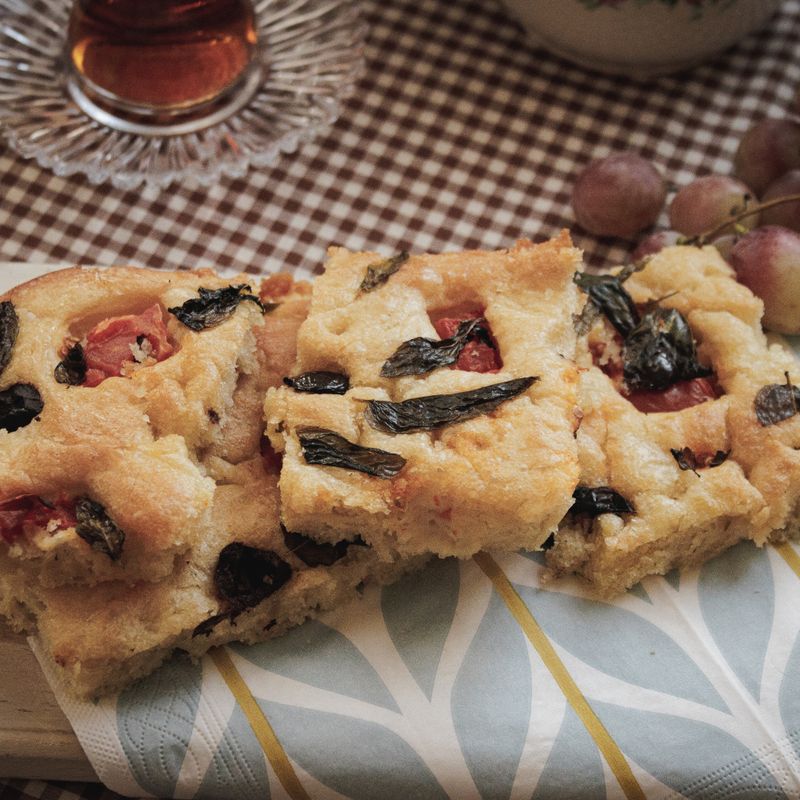
Sourdough Tomato Basil Focaccia Wedges
A rustic Italian focaccia made with naturally leavened sourdough, baked with a generous layer of olive oil, fresh tomatoes, and basil. The long fermentation develops deep flavor, while the dimpled surface and olive oil create a tender, crispy crust. Serve warm as an appetizer or alongside soup and salad.
- Prep
- 25 min
- Cook
- 25 min
- Wait
- 6 hr 30 min
- Total
- 7 hr 20 min
- Makes
- 1 focaccia (8 wedges)
Steps
Before you start
- Feed your sourdough starter 4–6 hours ahead until bubbly and at peak (doubled or tripled); it should smell tangy and active
- Use a 10×14-inch (25×35 cm) sheet pan or 9×13-inch (23×33 cm) baking pan
- Have all ingredients at room temperature (70–75°F / 21–24°C)
- Preheat oven to 425°F (220°C) about 15 minutes before the final proof ends
Mix dough and rest
- In a medium bowl, combine the fed sourdough starter (120 g), bread flour (320 g), and room-temperature water (220 ml).
- Stir with a wet hand or wooden spoon until no dry flour remains and all flour is hydrated.
- The dough will be shaggy.
- Cover the bowl with plastic wrap or a towel and let rest for 20–30 minutes at room temperature.
- This autolyse rests the flour and begins gluten development.
+ Show details− Hide details
Ready when: Dough is shaggy and all flour is wet
Tip: A wet hand makes mixing easier than a spoon; dip your hand in water as you work.
Add salt and mix
- After the rest, add sea salt (7 g) and olive oil (15 ml) to the dough.
- Using a wet hand, pinch and fold the dough in on itself, turning the bowl slightly after each fold, for 2–3 minutes until the salt and oil are fully incorporated and the dough becomes smoother and slightly firm.
- The dough is ready when it holds together when lifted and no streaks of oil remain visible.
+ Show details− Hide details
Ready when: Dough is smooth, elastic, and salt and oil are fully incorporated
Tip: Wet hands prevent sticking; fold gently to avoid knocking out gas and developing gluten gradually.
Bulk fermentation
- Transfer the dough to a large bowl lightly oiled with a small amount of olive oil.
- Cover tightly with plastic wrap.
- Let the dough ferment at room temperature (70–75°F / 21–24°C) for 4–4.5 hours.
- The dough should increase in volume by about 50–75%, with visible bubbles on the surface and sides when you peek under the plastic.
- If your kitchen is cooler (65–68°F / 18–20°C), add 30 minutes to the fermentation.
+ Show details− Hide details
Ready when: Dough has increased in volume by 50–75%, is soft and bubbly, and jiggles gently when bowl is shaken
Tip: If you're in a very warm kitchen (78°F+), reduce fermentation time by 30–45 minutes to avoid over-proofing.
Shape into focaccia
- Dust your work surface lightly with cornmeal (about 5 g) and flour.
- Turn the dough out onto the surface gently; it will be soft and airy.
- Using a bench scraper or your hands, gently stretch the dough into a rough rectangle about 8×10 inches (20×25 cm), working from the center outward.
- Do not overwork; if the dough springs back, let it rest for 2 minutes, then continue stretching.
- Aim for even thickness of about ½ inch (1.3 cm).
+ Show details− Hide details
Ready when: Dough is stretched to approximately 8×10 inches (20×25 cm) and about ½ inch (1.3 cm) thick
Tip: Work gently to preserve the gas bubbles developed during fermentation; they create the tender crumb.
Transfer to pan and dimple
- Lightly oil a 10×14-inch (25×35 cm) sheet pan or 9×13-inch (23×33 cm) baking pan with about 15 ml of the topping oil.
- Transfer the shaped dough to the pan, gently stretching it to fit.
- If it resists, let it rest for a few minutes.
- Once in the pan, use your fingertips to dimple the entire surface, pressing down at intervals (roughly 1 inch / 2.5 cm apart) to create characteristic focaccia indentations.
- Leave about ¼ inch (6 mm) of space around the edges.
- Drizzle the remaining topping oil (about 30 ml) evenly over the surface, working it into the dimples.
+ Show details− Hide details
Ready when: Dough fills the pan and is dimpled across the surface; oil coats the top
Tip: Dimpling prevents large air bubbles from puffing up unevenly during baking and creates signature focaccia texture.
Final rise and topping prep
- Cover the pan loosely with plastic wrap or a kitchen towel.
- Let the shaped dough rest and rise at room temperature for 1–1.5 hours.
- Meanwhile, halve the cherry tomatoes (280 g) and tear the fresh basil leaves (20 leaves) into bite-sized pieces.
- By the end of the rising time, the dough should be puffy, soft, and jiggly; it should rise to about ¾ inch (2 cm) thick and feel airy when gently poked.
+ Show details− Hide details
Ready when: Dough is visibly puffed, soft, and jiggles when pan is gently shaken
Tip: If the dough feels cold or not quite puffy after 60 minutes, wait another 15–30 minutes; timing varies with kitchen temperature.
Add tomato toppingOven 425°F / 220°C
- Preheat your oven to 425°F (220°C) about 10 minutes before this step.
- Once the dough is fully risen, scatter the halved tomatoes (280 g) across the surface of the focaccia, pressing them gently into the oil and dough.
- Distribute them evenly so there's tomato in most bites.
- Sprinkle the fleur de sel or coarse sea salt (3 g) over the tomatoes.
+ Show details− Hide details
Ready when: Tomatoes are pressed gently into the dough and salt is distributed
Tip: Add tomatoes just before baking to prevent them from releasing excess moisture and making the topping soggy.
Bake until goldenOven 425°F / 220°C
- Place the pan in the preheated 425°F (220°C) oven on the middle rack.
- Bake for 20–25 minutes, until the top is deep golden brown (almost caramel-colored), the edges are crispy and brown, and the focaccia springs back slowly when lightly poked on the side.
- The oil should be sizzling around the edges.
- If the top is not brown enough after 20 minutes, bake an additional 2–3 minutes, but watch carefully to avoid burning.
+ Show details− Hide details
Ready when: Top is deep golden to caramel brown, edges are crispy, and focaccia feels firm and springs back when poked gently on the side
Tip: Rotate the pan halfway through if your oven bakes unevenly, but only if you notice one side browning much faster than the other.
Rest and garnish
- Remove the focaccia from the oven and let it cool in the pan for 5 minutes.
- Scatter the torn fresh basil (20 leaves) over the warm focaccia so the heat slightly wilts it and releases its aroma.
- Let cool for another 5–10 minutes before cutting or serving.
- This resting period allows the crumb to set slightly, so wedges don't crumble.
+ Show details− Hide details
Ready when: Focaccia is warm but firm enough to cut without collapsing
Tip: Add basil after baking so it stays vibrant and aromatic; baked basil loses color and flavor.
Cut and serve
- Using a sharp chef's knife or a bench scraper, cut the focaccia into 8 wedges (cut into quarters lengthwise, then diagonally, or in whatever wedge shape suits you).
- Serve warm or at room temperature.
- Drizzle with a tiny bit more olive oil if desired.
+ Show details− Hide details
Ready when: Focaccia is cut cleanly into wedges
Tip: A hot knife dipped in hot water between cuts helps create clean, even wedges without dragging the soft crumb.
Good to know
Tips
- Your sourdough starter should be active, fed 4–6 hours ahead, and at peak rise (visibly bubbly and doubled or nearly tripled in volume) before you start. An unpredictable or sluggish starter will extend fermentation time significantly.
- This recipe uses 70% hydration, which is moderate for a focaccia. The dough should feel soft and slightly sticky but not mushy. If mixing by hand without a scale, that's harder; use a scale.
- For a crispier crust, brush the baked focaccia lightly with a garlic-infused oil or drizzle of good olive oil as soon as it comes out of the oven, or serve alongside a small bowl of olive oil for dipping.
- If you want a thicker, puffier focaccia, extend the final rise to 1.5–2 hours and use a 9×13-inch (23×33 cm) pan instead. The baking time may increase by 3–5 minutes.
Make ahead
The dough can be mixed and refrigerated during bulk fermentation: after the initial 1 hour of bulk fermentation at room temperature, cover and refrigerate for up to 12 hours. Shape and dimple directly from the cold dough, skip the final rise, and increase baking time by 5–8 minutes. Or, shape, dimple, and refrigerate overnight; remove from the fridge 30 minutes before baking and proceed as usual.
Storage & reheating
Store cooled focaccia covered at room temperature for up to 2 days. Reheat in a 350°F (175°C) oven for 8–10 minutes until warm. Wrapped airtight, it keeps in the refrigerator for 3–4 days. To freeze, wrap cooled focaccia tightly in plastic wrap and foil; thaw and reheat as above. Focaccia is best eaten the day it is baked.
Substitutions
- active sourdough starter, fed and bubbly → use 1 tsp (5 g) instant yeast mixed with the flour and water instead of starter; reduce fermentation time to 2–2.5 hours. This produces a less tangy focaccia with a different flavor profile, but is faster.
- cherry tomatoes or small plum tomatoes → use sun-dried tomatoes (rehydrated in warm water for 10 minutes, then drained and halved) or fresh sliced heirloom tomatoes. Sun-dried tomatoes add concentrated, deeper flavor; fresh tomatoes vary in juice content and will alter texture slightly.
- fresh basil leaves → use 1 tsp (2 g) dried basil mixed into the dough, or ½ tsp dried oregano scattered on top before baking. Dried herbs are stronger; start with less and taste. Oregano adds a different Mediterranean flavor.
- fleur de sel or coarse sea salt → use Maldon sea salt or regular kosher salt; increase amount to 4–5 g for the same saltiness. Larger crystals of fleur de sel dissolve slowly and add pleasant crunch; regular salt should be sprinkled more thinly.
More flatbreads
See all →

Find more like this
- Meal
- Dinner
- Cuisine
- Italian
- Main ingredient
- Tomatoes
- Method
- Oven
- Quick & Easy
- Make Ahead